All species › Gamebirds › New World quail › Gambel's Quail
Position in the tree Birds Aves › Birds with a flexible palate Neognathae › Fowl Galloanserae
Gambel's Quail | Callipepla gambelii
Gambels kuifkwartel | Codorniz chiquiri
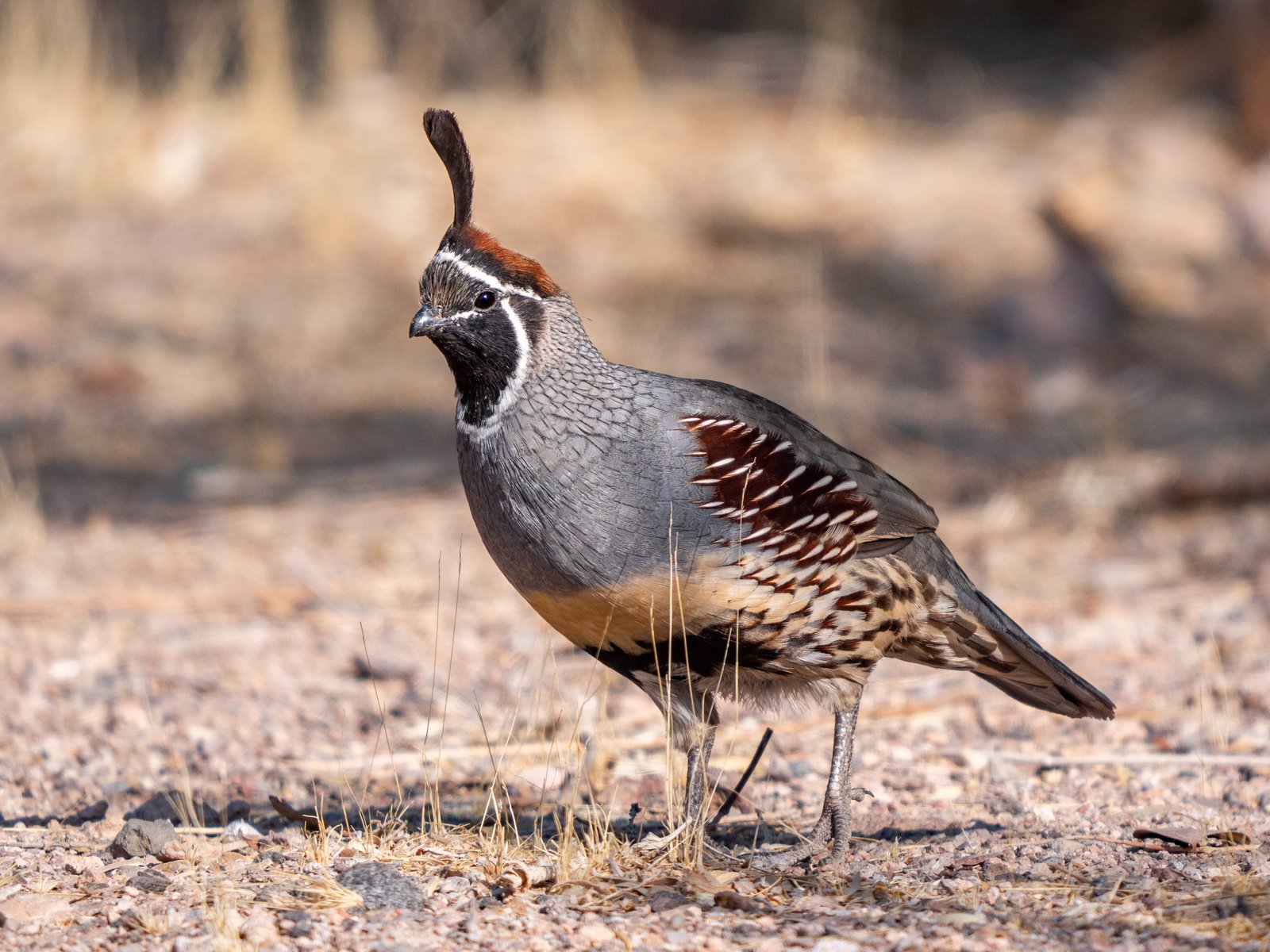
Gambel's Quail is the crested quail of the Sonoran Desert. The male wears a forward-curling black plume above a chestnut crown and has a black patch in the middle of its cream belly. In the guide area it lives in north-western Mexico, in coveys that run between the shrubs. The species is named after the American naturalist William Gambel.
Voice
From a lookout perch the male gives a loud kwa-KWAA-ka with the stress on the middle syllable. The covey's assembly call is a cackling chi-ca-go-go; when alarmed, short excited clicks. A covey is often heard by its constant soft chatter while foraging.
Recording: Richard E. Webster — CC BY-NC-SA 4.0 · shortened to the first 60 s, mono · xeno-canto
Identification
25–28 cm; compact, with a short tail and a teardrop-shaped plume on the head. The male has a grey breast and upperparts, a chestnut crown, a black face and throat outlined in white, chestnut flanks with white streaks and a cream belly with a large black patch. The female is plainer grey-brown, with a shorter plume, no black on the face and no belly patch, but also has rufous, white-streaked flanks.
Confusion species
California Quail Callipepla californica meets its range in north-eastern Baja California; it has a scaled belly without a black patch and a brown rather than chestnut crown. Elegant Quail Callipepla douglasii, in southern Sonora, has an upright buff crest and white-spotted underparts. Scaled Quail Callipepla squamata is blue-grey and scaled, with a short white crest.
Habitat
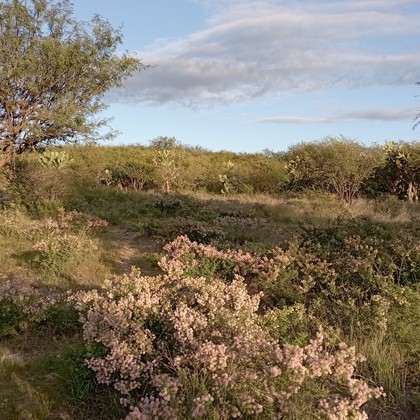
Desert scrub with mesquite, palo verde and cacti, especially along dry washes, stream valleys and riparian growth, and in fields, orchards and farmyards on their edge. It usually stays within reach of water. It eats seeds, shoots, leaves and cactus fruit, and in the breeding season also insects. Outside the breeding season coveys sometimes number dozens of birds.
Where the bird is most at home, classified by the vegetation units of Mexico and Central America.



Range and movements
In the guide area in north-eastern Baja California along the lower Colorado, in much of Sonora and in north-western Chihuahua. Outside the guide area in the south-western United States, from south-eastern California and southern Nevada and Utah to Arizona, New Mexico and western Texas.
- Resident
- dark = core range, pale = thinly spread
How and when to look
In the scrub around Hermosillo and along rivers and irrigation canals in Sonora, early in the morning when the males call from a bush or post. Coveys regularly come to water and to farmyards.
Conservation status
Not threatened. Common in Sonora. Numbers fluctuate strongly with winter rainfall, which determines how many young are raised the following year.
Scientific name
Callipepla gambelii | (Gambel, 1843)
Gambel described the species in 1843 as Lophortyx Gambelii; because it was later moved to another genus, the author and year stand in brackets. The genus Callipepla was introduced in 1832 by Wagler. Callipepla is Greek, from kallipeplos 'beautifully robed', from kallos 'beauty' and peplos 'robe'. gambelii honours the American explorer and naturalist William Gambel Jr. (1821–1849). The specimen the first description was based on came from southern Nevada, United States.