All species › Birds of prey › Kites, Old World vultures, eagles and hawks › Ferruginous Hawk
Position in the tree Birds Aves › Birds with a flexible palate Neognathae › All other modern birds Neoaves › Landbirds Telluraves › Raptors, owls, kingfishers and woodpeckers Afroaves › Hawks and owls Hieraves
Ferruginous Hawk | Buteo regalis
Rosse ruigpootbuizerd | Aguililla real
The Ferruginous Hawk is the largest buteo of North America, a raptor of open grassland with legs feathered down to the toes. It hunts prairie dogs, ground squirrels and other large rodents, often from the ground or a low perch near a colony. In the guide area it is a winter visitor to the grasslands and deserts of northern Mexico.

Voice
Usually silent in winter. When disturbed a hoarse, descending kree-ah, somewhat lower than that of the Red-tailed Hawk.
Recording: Sue Riffe — CC BY-NC-SA 4.0 · converted to mono · xeno-canto
Identification
56–69 cm, with long, broad wings that taper towards the tip, a large head and a wide bill with a yellow gape extending to below the eye. The light morph has a pale head, rufous back and shoulders, white underparts and rufous feathered legs, which in flight stand out as a dark V against the white belly. The underwing is white, with rufous coverts and small dark wrist patches; the tail is whitish with a rufous or grey wash. A smaller share of birds is entirely dark rufous to blackish-brown, with white flight feathers and a pale tail. Juveniles have white legs and no rufous on the underparts. Male and female are alike; the female is larger.
Confusion species
The Red-tailed Hawk Buteo jamaicensis is smaller, with a dark bar along the leading edge of the underwing, a belly band of streaks, unfeathered legs and, in adults, a rufous tail. The White-tailed Hawk Geranoaetus albicaudatus has grey upperparts, a black underwing and a white tail with a black subterminal band. Dark birds can resemble a young Golden Eagle Aquila chrysaetos, which is much larger, with a dark underwing and white patches at the base of the primaries and tail.
Habitat
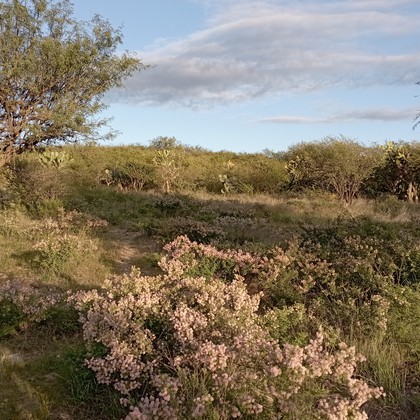
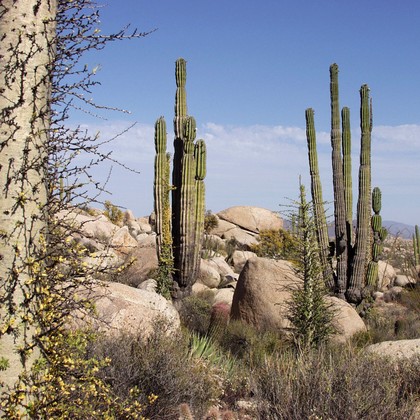
Semi-desert grassland and open plains in the Chihuahuan Desert, especially with colonies of prairie dogs or ground squirrels, farmland and pasture, also in the agricultural valleys of Baja California. Sits on the ground, on a post, a pylon or a lone tree, or hangs motionless in the wind over the land.
Where the bird is most at home, classified by the vegetation units of Mexico and Central America.


Range and movements
Winter visitor from October to March to northern Mexico: northern Baja California, Sonora, Chihuahua, Coahuila, Nuevo León and Durango, fewer in Zacatecas, San Luis Potosí and Tamaulipas. Further south on the Mexican plateau, to Jalisco, Guanajuato, Hidalgo, Puebla and the State of Mexico, scarce and irregular. Not in Central America. Outside the guide area it breeds on the prairies and in the semi-desert of southern Canada and the western United States, and also winters in the south-west of the latter.
- Winter visitor (c. Oct–Mar)
- dark = core range, pale = thinly spread
How and when to look
In December and January a few regularly sit on posts and on the ground in the prairie dog colonies of the grasslands near Janos, in north-western Chihuahua, and in the grasslands south of Saltillo and near Galeana in southern Nuevo León.
Conservation status
Not threatened. The conversion of grassland to cropland and the decline of prairie dog colonies have made it less numerous in parts of its breeding range. In the guide area it depends on the grasslands of the Chihuahuan Desert, which are increasingly being ploughed up.
Scientific name
Buteo regalis | (Gray, 1844)
Gray described the species in 1844 as Archibuteo regalis; because it was later moved to another genus, the author and year stand in brackets. The genus Buteo was introduced in 1799 by De Lacépède. Buteo is the Latin word for a buzzard. regalis is Latin for 'royal, regal', after this largest and most stately buteo of North America. The specimen the first description was based on came from Real del Monte, Hidalgo, Mexico.