All species › Passerines › New World sparrows › Five-striped Sparrow
Position in the tree Birds Aves › Birds with a flexible palate Neognathae › All other modern birds Neoaves › Landbirds Telluraves › Falcons, parrots and passerines Australaves › Falcons and passerines Eufalconimorphae › Parrots and passerines Psittacopasserae
Five-striped Sparrow | Amphispizopsis quinquestriata
Vijfstrepengors | Zacatonero cinco rayas
The Five-striped Sparrow is a dark, grey-brown sparrow of steep, scrub-covered rocky slopes in western Mexico. Its name refers to the pale and dark stripes on head and throat. A small population breeds just across the border in south-eastern Arizona; otherwise the species is almost confined to the guide area.
Voice
The song is a series of short, dry, somewhat husky phrases, each followed by a short pause, such as chip-chip-churr or tsee-tsuwee. Males sing from a tall shrub or boulder, mainly in the rainy season. The call is a low, metallic chink.
Recording: Alex Lin-Moore — CC BY-NC-SA 4.0 · shortened to the first 60 s, mono · xeno-canto
Identification
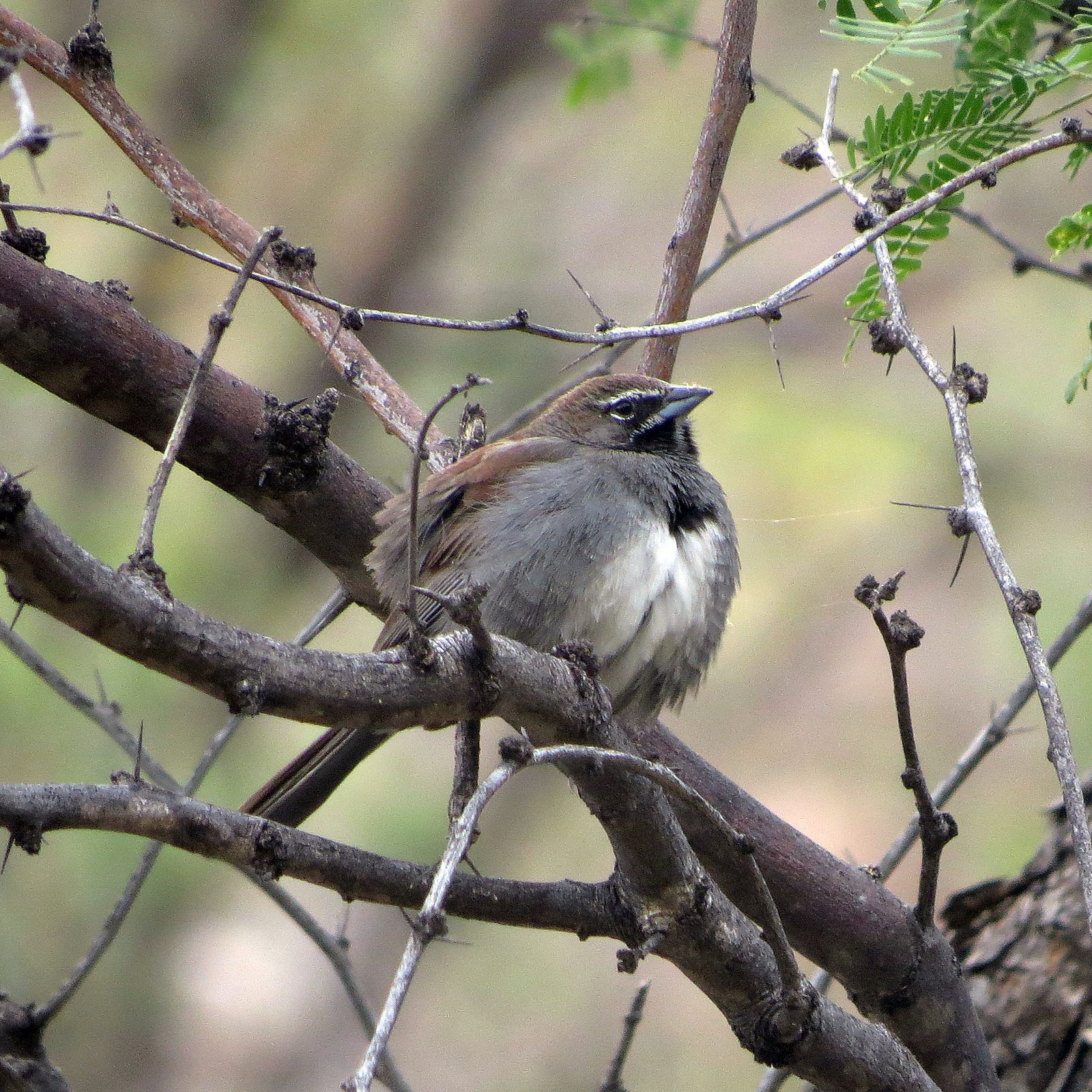
14–16 cm. A medium-sized, dark sparrow with a fairly long, rounded tail. Upperparts plain dark grey-brown, head greyer. White supercilium and on each side a white malar stripe bordering a black throat patch; together with the black throat these make up the five stripes. Breast and flanks grey, with a black spot in the centre of the breast; belly white. Bill dark grey. The sexes are alike; juveniles lack the black throat and breast spot and are finely streaked on the breast.
Confusion species
Black-throated Sparrow Amphispiza bilineata also has a black throat with white supercilium and malar stripe, but is paler sandy grey above, has an unmarked pale grey to white breast without a black spot, and lives in open, flatter desert. Black-chested Sparrow Peucaea humeralis of south-western Mexico has a white throat, a black breast band and rufous shoulders.
Habitat
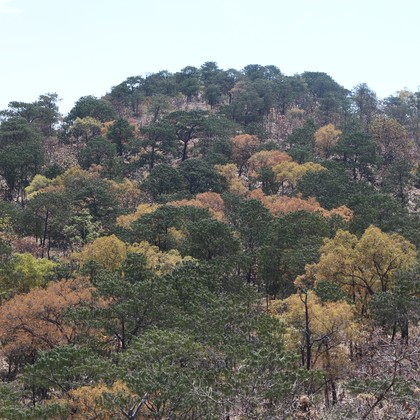
Steep, rocky slopes, ravines and canyons with tall, dense thornscrub, often interspersed with grass tussocks; also in the transition to tropical dry forest and low oak woodland, from about 600 to 2000 m. It forages on the ground beneath shrubs for seeds and insects. It breeds late in the year, after the onset of the summer rains in July and August.
Where the bird is most at home, classified by the vegetation units of Mexico and Central America.



Range and movements
Almost confined to western Mexico. In the guide area along the western slope of the Sierra Madre Occidental, from Sonora and western Chihuahua through Sinaloa and Durango to Nayarit and Jalisco. Elsewhere only a small breeding population in south-eastern Arizona. The northernmost birds move south in winter; further south the species is resident.
- Resident
- Summer visitor (c. Apr–Sep)
- Winter visitor (c. Oct–Mar)
- dark = core range, pale = thinly spread
How and when to look
Best found in July and August, when males sing from the tops of shrubs on steep slopes after the first summer rains; outside that period the species is silent and hard to see.
Conservation status
Not threatened (LC). Locally fairly common on steep slopes in western Mexico. Overgrazing and the burning or clearing of scrub degrade its habitat locally.
Scientific name
Amphispizopsis quinquestriata | (Sclater & Salvin, 1868)
Sclater & Salvin described the species in 1868 as Zonotrichia quinquestriata; because it was later moved to another genus, the author and year stand in brackets. The genus Amphispizopsis was introduced in 1980 by Wolters. Amphispizopsis combines the genus name Amphispiza with Greek -opsis 'resembling', as this sparrow resembles the Black-throated Sparrow. quinquestriata is Latin for 'five-striped', from quinque 'five' and stria 'stripe', after the five white and black stripes on head and throat. The specimen the first description was based on came from Mexico; probably Bolaños, Jalisco.