All species › Passerines › Tyrant flycatchers and allies › Fork-tailed Flycatcher
Position in the tree Birds Aves › Birds with a flexible palate Neognathae › All other modern birds Neoaves › Landbirds Telluraves › Falcons, parrots and passerines Australaves › Falcons and passerines Eufalconimorphae › Parrots and passerines Psittacopasserae
Fork-tailed Flycatcher | Tyrannus savana
Vorkstaartkoningstiran | Tirano tijereta gris
The Fork-tailed Flycatcher is a kingbird of open grassland and savanna, with a black cap, a pale grey back, white underparts and a very long, deeply forked black tail. It perches on low bushes, posts and fences and catches insects from there. In the guide area it lives locally from south-eastern Mexico to Panama.

Voice
Dry, short tik notes and a fast, sputtering chatter, often in flight.
Recording: JAYRSON ARAUJO DE OLIVEIRA — CC BY-NC-SA 4.0 · shortened to the first 60 s, mono · xeno-canto
Identification
18–20 cm without the elongated outer tail feathers; including the tail, males are 37–41 cm and females 28–30 cm. Head black like a cap, with a concealed yellow crown patch. Back pale grey, wings dark greyish brown. Underparts bright white. Tail black and deeply forked, the outer feathers much longer in the male than in the female. Juveniles have a browner cap and a much shorter tail; during moult the long tail may be missing.
Confusion species
Scissor-tailed Flycatcher Tyrannus forficatus has a pale grey head without a black cap, salmon-pink flanks and a tail that is largely white below. Eastern Kingbird Tyrannus tyrannus also has a blackish head and white underparts, but a dark back and a short tail with a white terminal band, and occurs in the guide area only as a passage migrant.
Habitat
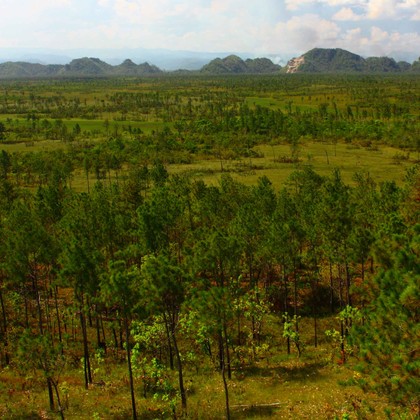
Open savanna, pine savanna, pasture with scattered bushes and trees and the edges of marshes, in the lowlands. It hunts flying insects from a low perch and also eats fruit. The nest is an open cup in a bush or tree.
Where the bird is most at home, classified by the vegetation units of Mexico and Central America.



Range and movements
Locally in open lowlands from south-eastern Mexico through Belize, Guatemala, Honduras, Nicaragua and Costa Rica to Panama. Outside the guide area over much of South America; southern breeders move to northern South America in the southern winter.
- Resident
- Summer visitor (c. Apr–Sep)
- Winter visitor (c. Oct–Mar)
- Passage (Mar–Apr, Oct–Nov)
- dark = core range, pale = thinly spread
How and when to look
Look for it in savannas and pastures with low bushes; the long tail is visible from afar in flight and on a fence post.
Conservation status
Not threatened. Locally common in open country and benefits from the conversion of forest to pasture.
Scientific name
Tyrannus savana | Daudin, 1802
Daudin described the species in 1802 and placed it straight away in the genus where it still stands. The genus Tyrannus was introduced in 1799 by De Lacépède. Tyrannus is Latin (from Greek turannos) for 'tyrant, despot', after the aggressive way these birds drive off even raptors. savana goes back to Buffon's name 'le Savana', because the bird lives in (flooded) savannas. The specimen the first description was based on came from Río de la Plata and Montevideo, Uruguay.