All species › Trogons › Trogons › Gartered Trogon
Position in the tree Birds Aves › Birds with a flexible palate Neognathae › All other modern birds Neoaves › Landbirds Telluraves › Raptors, owls, kingfishers and woodpeckers Afroaves › Mousebirds, rollers and woodpeckers Coraciimorphae › Trogons and cavity nesters Cavitaves
Gartered Trogon | Trogon caligatus
Goulds trogon | Trogón violáceo norteño
The Gartered Trogon is a small, yellow-bellied trogon of forest edges, secondary forest and semi-open wooded country from eastern Mexico to Panama. It is the most widespread trogon of the lowlands of the guide area. It was formerly treated as one species with Trogon violaceus and Trogon ramonianus of South America. Its Dutch name honours the British ornithologist John Gould.

Voice
A fast, even series of high, clear chew notes, often ten to twenty in a row, higher and faster than in the larger trogons. Also a soft cackling.
Recording: Richard E. Webster — CC BY-NC-SA 4.0 · shortened to the first 60 s, mono · xeno-canto
Identification
23–25 cm. The male has a violet-blue head and breast, a black face and throat, a yellow eye-ring, a green back and a yellow belly, with a narrow, often indistinct white band between breast and belly. The bill is blue-grey. The underside of the tail is finely barred black and white with broad white tips. The female is grey on the head, breast and back, with a yellow belly, a broken white eye-ring and a black-and-white barred undertail.
Confusion species
Black-headed Trogon Trogon melanocephalus is larger and has a pale blue eye-ring and a blacker head and breast. White-tailed Trogon Trogon chionurus (Panama) is larger and the male has a blue eye-ring and an almost entirely white undertail. Male Graceful Black-throated Trogon Trogon tenellus has a green head and breast; the female is brown rather than grey.
Habitat
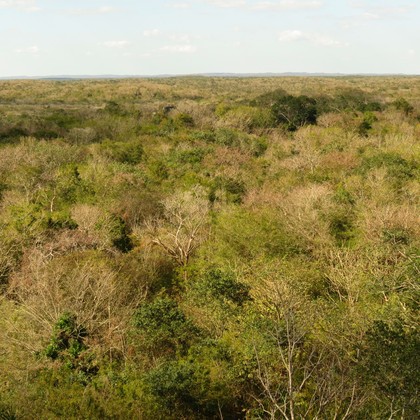
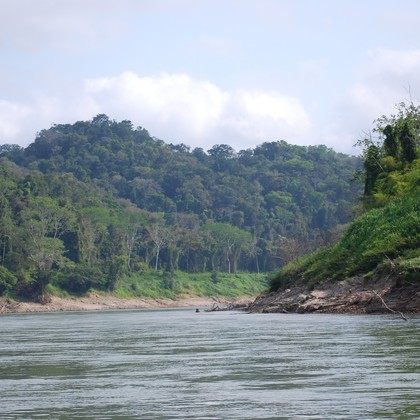
Humid and semi-humid lowland and foothill forest up to about 1500 m, especially forest edges, secondary forest, gallery forest, shade coffee and cacao and semi-open country with trees. It perches upright in the middle and upper tree layers and eats fruit and insects. It often excavates its nest in an arboreal wasp nest, sometimes in a termite nest or rotting wood.
Where the bird is most at home, classified by the vegetation units of Mexico and Central America.




Range and movements
Gulf and Caribbean slope of eastern Mexico from southern Tamaulipas and San Luis Potosí through Veracruz, Puebla, Oaxaca, Tabasco, Chiapas and the Yucatán Peninsula, and on through Belize, Guatemala, Honduras, Nicaragua and Costa Rica to Panama. On the Pacific side locally from Chiapas, Guatemala and El Salvador to Costa Rica and Panama. Outside the guide area in Colombia, western Venezuela, western Ecuador and north-western Peru.
- Resident
- dark = core range, pale = thinly spread
How and when to look
Common at Tikal in Guatemala, in the Cayo District of Belize and along Pipeline Road (Camino del Oleoducto) in Panama. It often perches in the open at forest edges and along roads.
Conservation status
Not threatened. It tolerates disturbance well and also occurs in secondary forest, plantations and semi-open country with trees.
Scientific name
Trogon caligatus | Gould, 1838
Gould described the species in 1838 and placed it straight away in the genus where it still stands. The genus Trogon was introduced in 1760 by Brisson. Trogon is Greek, from trōgōn 'gnawing, fruit-eating'. caligatus is Latin for 'booted' (from caliga 'soldier's boot'); what Gould meant exactly is uncertain, perhaps the feathered legs. The specimen the first description was based on came from Magdalena Valley, Colombia (inferred from the plate).