All species › Birds of prey › Kites, Old World vultures, eagles and hawks › Golden Eagle
Position in the tree Birds Aves › Birds with a flexible palate Neognathae › All other modern birds Neoaves › Landbirds Telluraves › Raptors, owls, kingfishers and woodpeckers Afroaves › Hawks and owls Hieraves
Golden Eagle | Aquila chrysaetos
Steenarend | Águila real
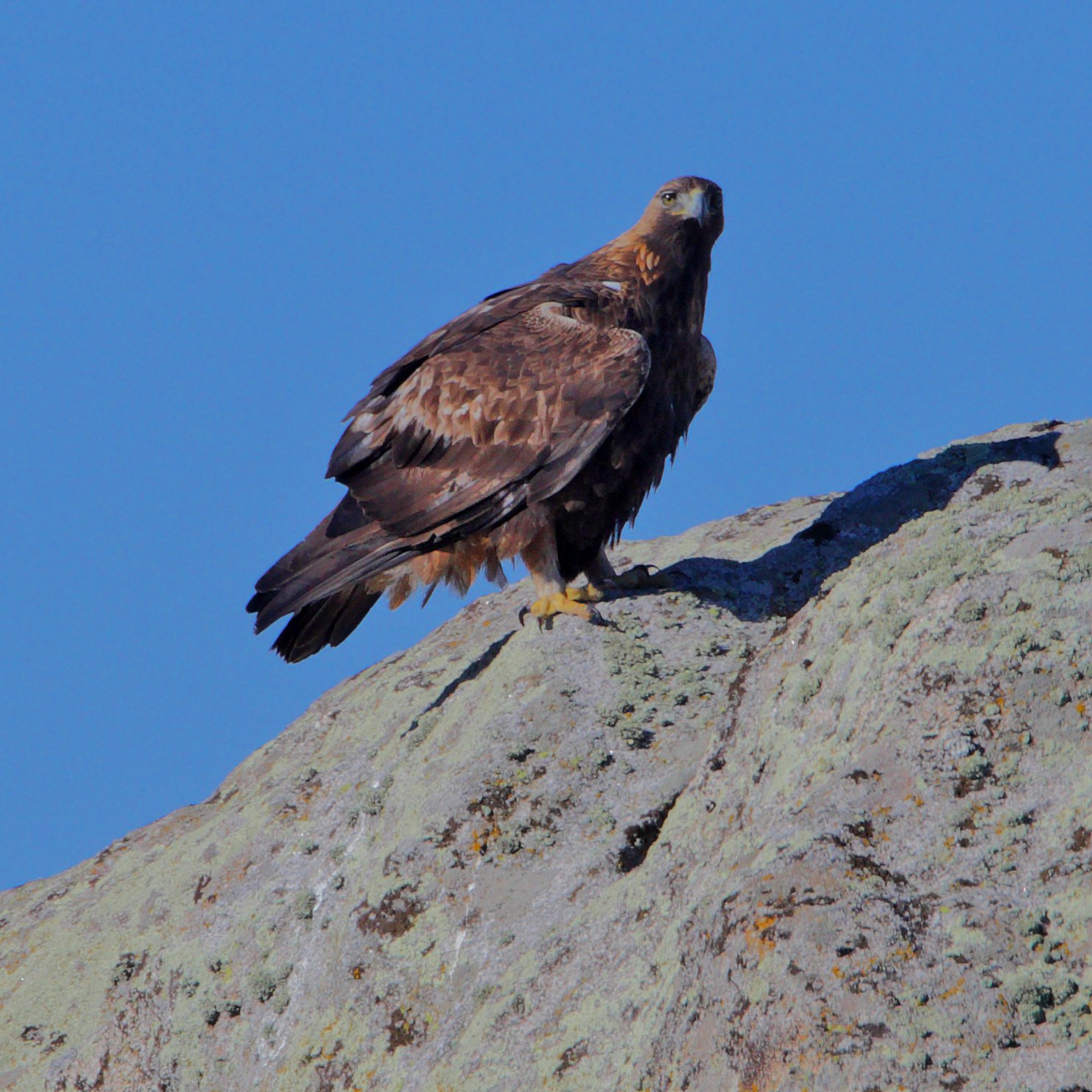
The Golden Eagle is a large, dark brown eagle of open, mountainous country, with a golden nape and long, broad wings. It hunts mainly medium-sized mammals such as hares, rabbits and ground squirrels, and also birds and carrion. In the guide area it lives only in Mexico, as a scarce resident in the north and on the central plateau; in winter birds from western North America join them. The eagle in the coat of arms on the Mexican flag is taken to be a Golden Eagle.
Voice
Mostly silent. Near the nest a weak, high kee-kee-kee or a whistled kyew, thin for a bird of this size.
Recording: Vaslin Matthieu — CC BY-NC-SA 4.0 · converted to mono · xeno-canto
Identification
75–90 cm. Adults are uniformly dark brown with a golden to creamy crown and nape, a dark bill with a yellow cere and legs feathered down to the toes. In flight the wings are long and broad, with spread primaries at the tip, and the tail is fairly long and rounded; when soaring the bird holds its wings in a shallow V. Young birds have a white patch at the base of the primaries and a white tail with a broad black terminal band; the white decreases with each year. Male and female are alike; the female is larger.
Confusion species
The young Bald Eagle Haliaeetus leucocephalus is also dark, but has a larger head and bill, white-mottled underwings and bare legs. The Turkey Vulture Cathartes aura has a small, bare head and two-toned underwings and rocks in a marked V. Dark birds of the Ferruginous Hawk Buteo regalis are smaller, with a pale tail and pale primaries from below. The Great Black Hawk Buteogallus urubitinga is black with a white tail band and lives in lowland forest.
Habitat
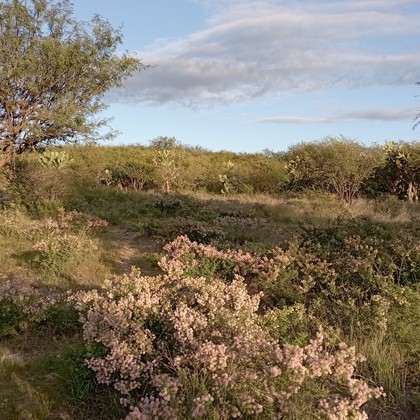
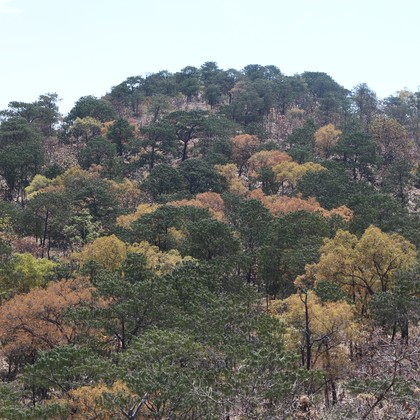
Open, dry and mountainous country: semi-desert grassland, scrub and plateau with cliffs, ravines and scattered trees, chaparral and open pine-oak forest in the mountains, from sea level to above 3000 m. It nests on a ledge in a cliff, sometimes in a large tree. It hunts low over the ground or from a high soar.
Where the bird is most at home, classified by the vegetation units of Mexico and Central America.




Range and movements
Only in Mexico. Resident in Baja California and Baja California Sur, Sonora, Chihuahua, Coahuila, Nuevo León, Durango, Zacatecas, San Luis Potosí, Aguascalientes, Jalisco and Guanajuato, locally south to Querétaro and Hidalgo; rare further south. In winter, mainly from November to March, birds from the western United States and Canada move into northern Mexico. Absent from Central America. Outside the guide area it occurs across much of North America, Europe, Asia and North Africa.
- Resident
- Winter visitor (c. Oct–Mar)
- Passage (Mar–Apr, Oct–Nov)
- dark = core range, pale = thinly spread
How and when to look
The grasslands around Janos in Chihuahua and the plateau of Zacatecas and San Luis Potosí, where pairs hunt over cliffs and open grassland; also over the ridges of the Sierra de San Pedro Mártir in Baja California. Birds often sit for long periods on a rocky point or a post and can then be seen from the road.
Conservation status
Not threatened. In Mexico the number of breeding pairs is small; the species has declined there through loss and fragmentation of grassland, shooting, poisoning and electrocution on power lines, and it is legally protected.
Scientific name
Aquila chrysaetos | (Linnaeus, 1758)
Linnaeus described the species in 1758 as Falco Chrysaëtos; because it was later moved to another genus, the author and year stand in brackets. The genus Aquila was introduced in 1760 by Brisson. Aquila is Latin for 'eagle', possibly from aquilus 'dark in colour'. chrysaetos is Greek for the golden eagle, from khrusos 'gold' and aetos 'eagle'. The specimen the first description was based on came from Sweden.