All species › Woodpeckers and allies › Woodpeckers › Golden-green Woodpecker
Position in the tree Birds Aves › Birds with a flexible palate Neognathae › All other modern birds Neoaves › Landbirds Telluraves › Raptors, owls, kingfishers and woodpeckers Afroaves › Mousebirds, rollers and woodpeckers Coraciimorphae › Trogons and cavity nesters Cavitaves › Hornbills, kingfishers and woodpeckers Picocoraciae › Kingfishers, bee-eaters and woodpeckers Picodynastornithes
Golden-green Woodpecker | Piculus chrysochloros
Bronsspecht | Carpintero verdidorado
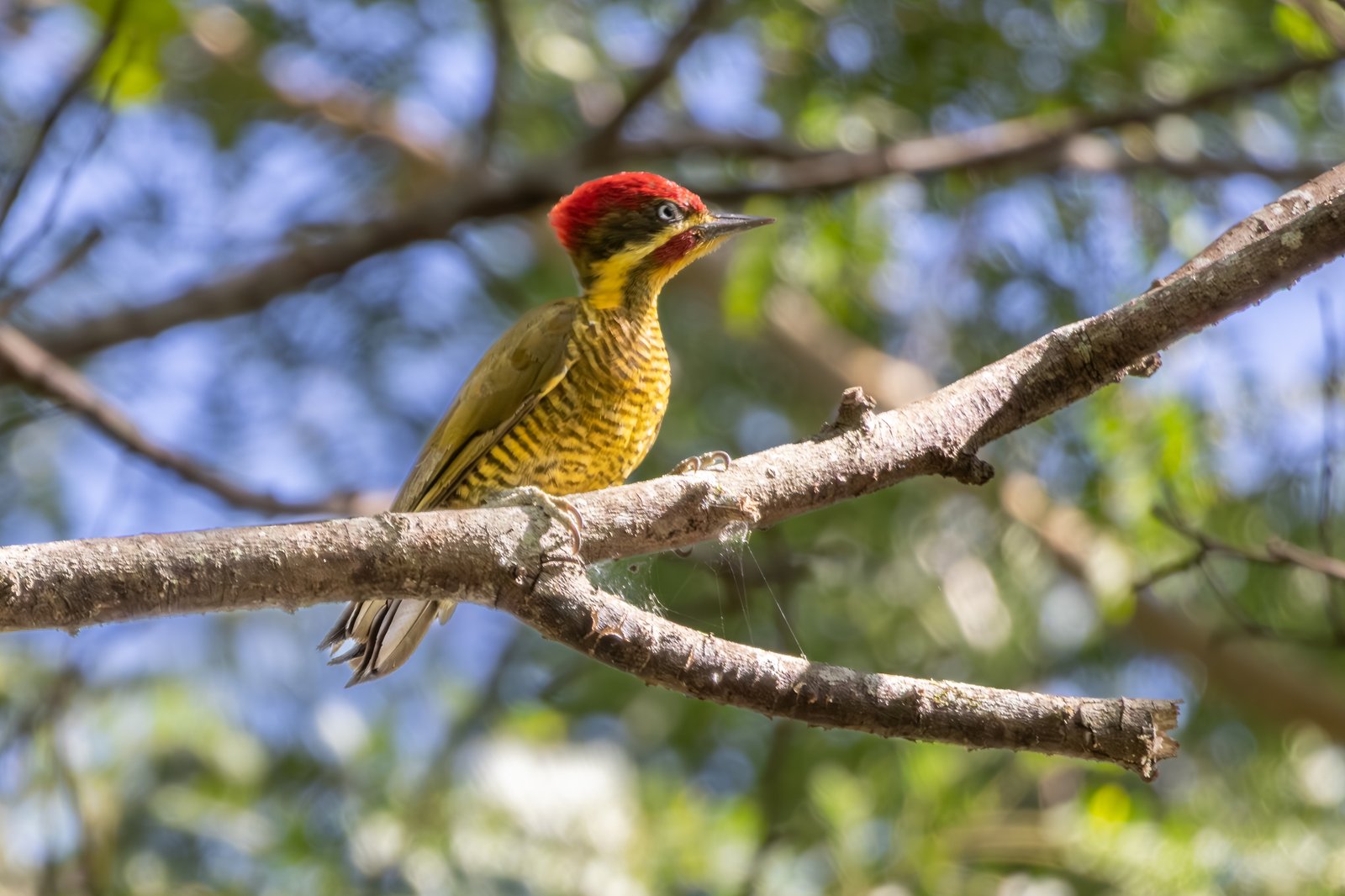
The Golden-green Woodpecker is a medium-sized, olive-green woodpecker with a yellow throat and a yellow stripe along the side of the neck. It has a large range in South America and reaches its northern limit in eastern Panama; in the guide area it is therefore a scarce bird of the lowland forest of Darién. It forages high in the crowns and is easily overlooked.
Voice
Mostly silent. A loud, shrill, slightly falling call and a drawn-out, rasping series; drums in short rolls.
Recording: JAYRSON ARAUJO DE OLIVEIRA — CC BY-NC-SA 4.0 · converted to mono · xeno-canto
Identification
20–23 cm. The upperparts are plain olive-green with a bronze sheen. The throat is yellow, and a broad yellow stripe runs from the bill base below the olive cheek patch to the side of the neck. The underparts are densely barred pale yellow and olive. The male has a red crown and nape and a red moustache; the female lacks red on the head. The eye is pale.
Confusion species
Stripe-cheeked Woodpecker Piculus callopterus is smaller, with fine white streaks on the cheeks, an olive throat and rufous flight feathers; it lives mainly in the foothills. Golden-olive Woodpecker Colaptes rubiginosus has a grey crown, pale cheeks and a dark throat. Spot-breasted Woodpecker Colaptes punctigula has a white cheek, a barred back and a spotted breast.
Habitat
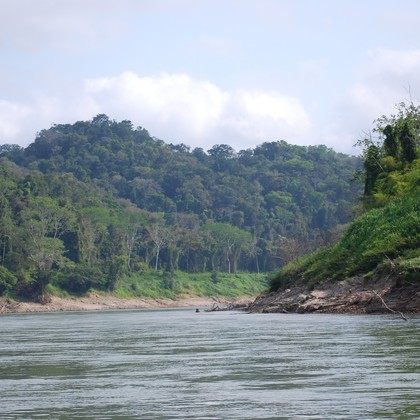
Canopy and middle layer of humid lowland forest, gallery forest and tall secondary forest, in the guide area mainly below about 600 m. It feeds mainly on ants and termites dug from branches and from arboreal nests in the crowns, often with mixed flocks.
Where the bird is most at home, classified by the vegetation units of Mexico and Central America.



Range and movements
In the guide area only in eastern Panama: eastern Panamá Province (Bayano valley) and Darién, including the Emberá comarca. Outside the guide area over much of tropical South America, from Colombia and Venezuela to northern Argentina.
- Resident
- dark = core range, pale = thinly spread
How and when to look
In the lowland forest of Darién, for example around El Real and along the rivers towards Darién National Park. It pays to watch mixed flocks in the crowns for a green woodpecker with a yellow throat.
Conservation status
Not threatened. Widespread in South America; in Panama scarce and dependent on lowland forest, which is disappearing rapidly in the east of the country.
Scientific name
Piculus chrysochloros | (Vieillot, 1818)
Vieillot described the species in 1818 as Picus chrysochloros; because it was later moved to another genus, the author and year stand in brackets. The genus Piculus was introduced in 1824 by Spix. Piculus is a diminutive of Latin picus 'woodpecker': 'little woodpecker'. chrysochloros is Greek, from khrusos 'gold' and khlōros 'green', after the golden-green plumage. The specimen the first description was based on came from Paraguay and Brazil.