All species › Passerines › Tyrant flycatchers and allies › Great Crested Flycatcher
Position in the tree Birds Aves › Birds with a flexible palate Neognathae › All other modern birds Neoaves › Landbirds Telluraves › Falcons, parrots and passerines Australaves › Falcons and passerines Eufalconimorphae › Parrots and passerines Psittacopasserae
Great Crested Flycatcher | Myiarchus crinitus
Grote kuiftiran | Papamoscas viajero
The Great Crested Flycatcher is a large, contrasting Myiarchus flycatcher that breeds in eastern North America and winters in the guide area, from southern Mexico to Panama. With its dark grey breast, bright yellow belly and rufous tail it is the most colourful of the group.

Voice
A loud, rising wheeep and a rolling prrrrt; often heard in winter quarters too.
Recording: Bobby Wilcox — CC BY-NC-SA 4.0 · shortened to the first 60 s, mono · xeno-canto
Identification
17–21 cm. Head and back olive-brown, crown slightly bushy. Wings dark with pale wing-bars, rufous edges to the primaries and a white edge to the innermost tertial. Tail with much rufous. Throat and breast fairly dark grey, sharply demarcated from the bright yellow belly. Bill black with a pale, often pinkish base to the lower mandible. Male and female are alike.
Confusion species
Brown-crested Flycatcher Myiarchus tyrannulus has a paler grey throat and breast, a paler yellow belly and an all-dark, heavier bill. Panama Flycatcher Myiarchus panamensis has little rufous in wings and tail. Dusky-capped Flycatcher Myiarchus tuberculifer is smaller, with a dark cap and little rufous in the tail.
Habitat
In winter mainly in humid lowland forest, forest edges, secondary forest, gallery forest, shade coffee and semi-open country with tall trees. It forages high in the canopy, sallies for insects from a perch and also eats much fruit.
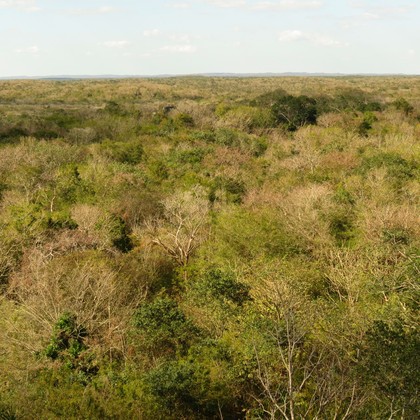
Where the bird is most at home, classified by the vegetation units of Mexico and Central America.




Range and movements
Winters from south-eastern Mexico (mainly southern Veracruz and the Yucatán Peninsula) through Central America to Panama; on passage also along the Gulf coast of Mexico. Outside the guide area a breeding bird in eastern North America and a winter visitor to Colombia and Venezuela.
- Winter visitor (c. Oct–Mar)
- dark = core range, pale = thinly spread
How and when to look
In winter it is often first heard by its loud wheeep. The sharp division between grey breast and yellow belly and the pale base to the lower mandible separate it from Brown-crested Flycatcher.
Conservation status
Not threatened. Common; in winter quarters it benefits from forest edges and shade plantations.
Scientific name
Myiarchus crinitus | (Linnaeus, 1758)
Linnaeus described the species in 1758 as [Turdus] crinitus; because it was later moved to another genus, the author and year stand in brackets. The genus Myiarchus was introduced in 1844 by Cabanis. Myiarchus is Greek, from muia 'fly' and arkhos 'ruler': 'fly-ruler'. crinitus is Latin for 'long-haired', after the bushy crest. The specimen the first description was based on came from South Carolina.