All species › Passerines › Tyrant flycatchers and allies › Grey-capped Flycatcher
Position in the tree Birds Aves › Birds with a flexible palate Neognathae › All other modern birds Neoaves › Landbirds Telluraves › Falcons, parrots and passerines Australaves › Falcons and passerines Eufalconimorphae › Parrots and passerines Psittacopasserae
Grey-capped Flycatcher | Myiozetetes granadensis
Grijskruintiran | Bienteveo cabecigrís
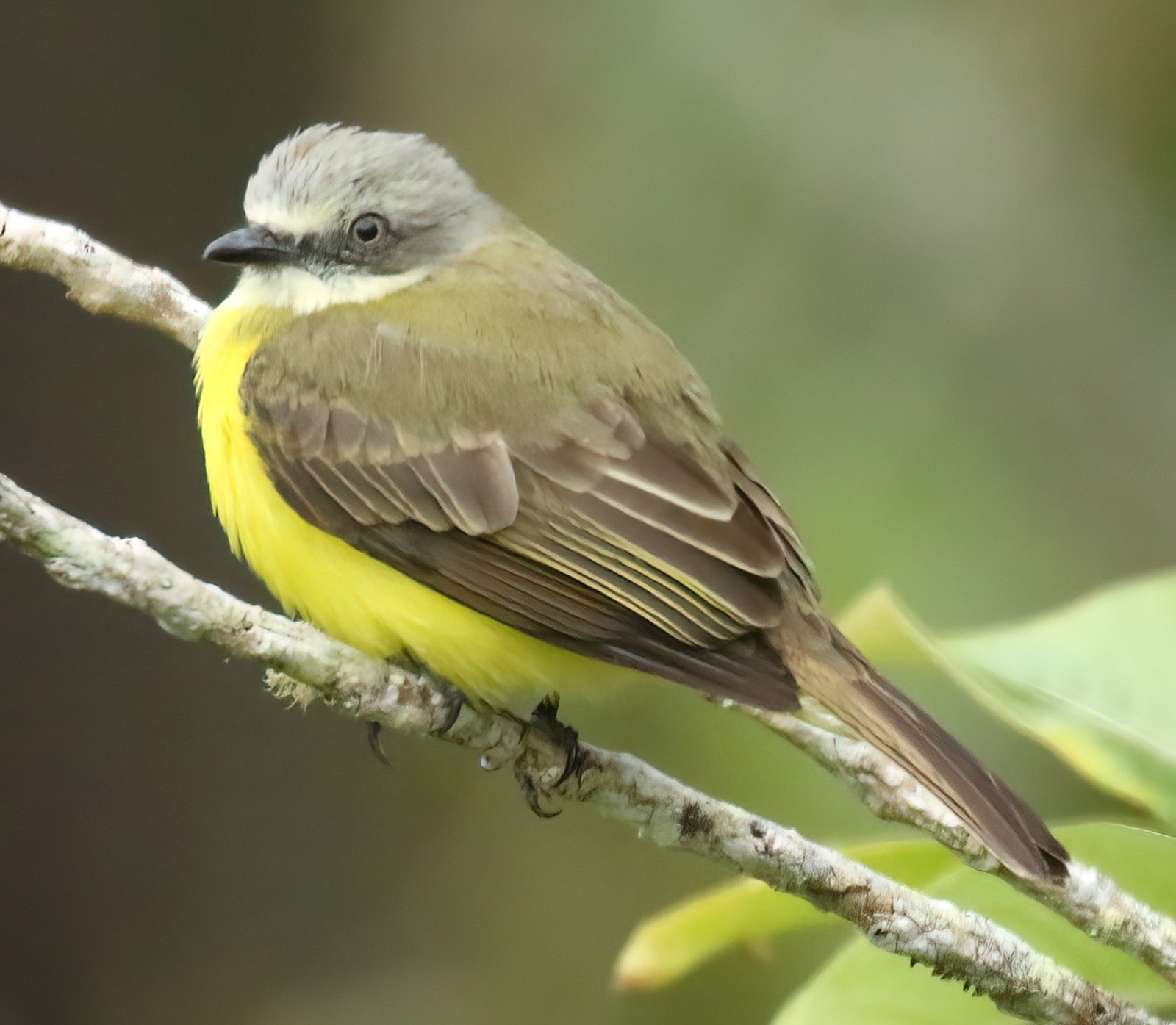
The Grey-capped Flycatcher is a kiskadee-like tyrant flycatcher with a grey head without a long white supercilium, which separates it from the related Social Flycatcher. It lives at forest edges, in clearings and along waterways in humid regions. In the guide area it occurs from eastern Honduras to Panama.
Voice
Sharp, short calls such as kip or kip-kip, often followed by a louder kee-yew, and a rolling pirrr. Pairs call to each other a great deal.
Recording: JAYRSON ARAUJO DE OLIVEIRA — CC BY-NC-SA 4.0 · converted to mono · xeno-canto
Identification
16–17 cm, with a short, stubby black bill. Head grey, with a narrow white line across the forehead and a short white streak behind the eye, but no continuous supercilium; lores and ear-coverts slightly darker grey. The male has a concealed orange-red crown patch, which is smaller or absent in the female. Back olive-green, wings and tail darker with narrow pale edges. Throat white, rest of the underparts bright yellow.
Confusion species
Social Flycatcher Myiozetetes similis and Rusty-margined Flycatcher Myiozetetes cayanensis have a dark crown and mask with a broad white supercilium. White-ringed Flycatcher Conopias albovittatus has a black crown with a white band running all the way round. Great Kiskadee Pitangus sulphuratus is much larger, with a black-and-white striped head.
Habitat
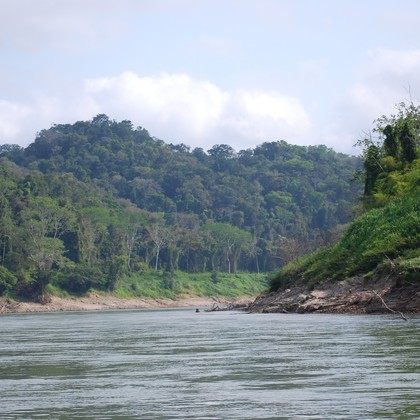
Edges of humid forest, clearings with scattered trees, mature secondary forest, banks of rivers and lakes, pasture with trees and gardens near forest, in the lowlands and foothills to about 1200 m. It usually perches high on an exposed branch, hunts insects and eats many small fruits. The domed nest is often placed in a tree over water.
Where the bird is most at home, classified by the vegetation units of Mexico and Central America.





Range and movements
On the Caribbean slope from eastern Honduras through Nicaragua and Costa Rica to Panama; in southern Costa Rica and in Panama also on the Pacific slope. Outside the guide area in western Colombia and Ecuador and in western Amazonia, to northern Bolivia and western Brazil.
- Resident
- dark = core range, pale = thinly spread
How and when to look
Common at forest edges and along rivers in the Caribbean lowlands of Costa Rica, for example around La Selva. The grey head without a long supercilium is the best feature when it perches next to Social Flycatchers.
Conservation status
Not threatened. Widespread and common in suitable semi-open country near forest.
Scientific name
Myiozetetes granadensis | Lawrence, 1862
Lawrence described the species in 1862 and placed it straight away in the genus where it still stands. The genus Myiozetetes was introduced in 1859 by Sclater. Myiozetetes is Greek, from muia 'fly' and zētētēs 'seeker': 'fly-seeker'. granadensis refers to New Granada, the old name for Colombia and surroundings (including Panama). The specimen the first description was based on came from Isthmus of Panama.