All species › Passerines › New World sparrows › Guadalupe Junco
Position in the tree Birds Aves › Birds with a flexible palate Neognathae › All other modern birds Neoaves › Landbirds Telluraves › Falcons, parrots and passerines Australaves › Falcons and passerines Eufalconimorphae › Parrots and passerines Psittacopasserae
Guadalupe Junco | Junco insularis
Guadalupejunco | Junco de Guadalupe
The Guadalupe Junco occurs only on Guadalupe Island, off the west coast of Baja California. It resembles the Dark-eyed Junco but is more drably marked and has a longer bill. For a long time it was treated as a form of Dark-eyed Junco; it is now usually regarded as a separate species.
No photograph of a living wild bird of this species with a suitable Creative Commons licence exists. Do you have one that meets the rules? Send it in.
Voice
The song is a more varied, less monotonous series of trills and notes than that of Dark-eyed Junco. Call a dry tik.
No recording with a suitable Creative Commons licence is available for this species yet.
Identification
14–15 cm. Head and breast grey with dark lores, back and scapulars greyish brown, flanks pale brown, belly white. Bill fairly long and thick, pale pink. Eyes dark. Outer tail feathers white. Wings short and rounded. The sexes are similar.
Confusion species
No other junco occurs on Guadalupe. Dark-eyed Junco Junco hyemalis of the mainland has a shorter bill, longer wings and a more sharply marked head. Other small songbirds on the island lack the combination of pink bill and white outer tail feathers.
Habitat
Cypress forest, the remnants of pine forest on the highest parts of the island, and scrub in ravines; also around buildings. It forages on the ground for seeds and insects.
Where the bird is most at home, classified by the vegetation units of Mexico and Central America.


Range and movements
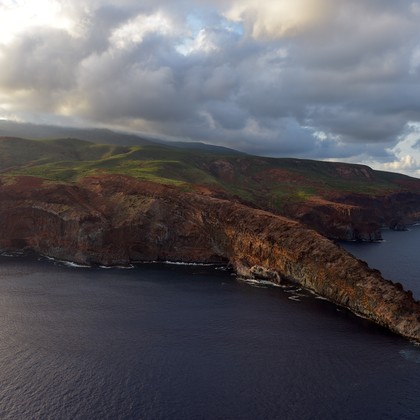
Endemic to Guadalupe Island, about 250 km off the coast of Baja California in the Pacific Ocean. Found nowhere else.
- Resident
- Summer visitor (c. Apr–Sep)
- Passage (Mar–Apr, Oct–Nov)
- dark = core range, pale = thinly spread
How and when to look
The island is a biosphere reserve and can be visited only with a permit. Visitors find the species fairly easily around the cypress forest and the settlements.
Conservation status
Vulnerable (VU). The world population is small and confined to a single island. Grazing by feral goats long destroyed the forest; since the goats were removed the vegetation has been recovering, but feral cats remain a threat.
Scientific name
Junco insularis | Ridgway, 1876
Ridgway described the species in 1876 and placed it straight away in the genus where it still stands. The genus Junco was introduced in 1831 by Wagler. Junco comes from Latin iuncus meaning 'rush'. insularis is Latin for 'of an island', after Guadalupe Island, to which this junco is confined. The specimen the first description was based on came from Guadalupe Island, Baja California, Mexico.