All species › Woodpeckers and allies › Woodpeckers › Guatemalan Flicker
Position in the tree Birds Aves › Birds with a flexible palate Neognathae › All other modern birds Neoaves › Landbirds Telluraves › Raptors, owls, kingfishers and woodpeckers Afroaves › Mousebirds, rollers and woodpeckers Coraciimorphae › Trogons and cavity nesters Cavitaves › Hornbills, kingfishers and woodpeckers Picocoraciae › Kingfishers, bee-eaters and woodpeckers Picodynastornithes
Guatemalan Flicker | Colaptes mexicanoides
Guatemalagrondspecht | Carpintero de pechera mesoamericano
The Guatemalan Flicker is the flicker of the highlands from Chiapas to northern Nicaragua. It was long treated as a form of the Northern Flicker but is now regarded as a separate species. It can be recognised by its rufous-brown crown, densely barred back and white rump.

Voice
A long, fast series wik-wik-wik-wik, a single loud klee-yer and a soft wicka-wicka between partners.
Recording: Diego Manzano Méndez — CC BY-NC 4.0 · converted to mono · iNaturalist
Identification
29–33 cm. Crown and nape cinnamon to rufous brown, the face grey. The male has a red moustachial stripe, the female none. The back is brown with dense, broad black barring; there is a black crescent on the breast, and the rest of the underparts are pale brown with many black spots. The underside of the wings and tail is orange-red to salmon. The white rump is conspicuous in flight.
Confusion species
Northern Flicker Colaptes auratus occurs only north and west of the Isthmus of Tehuantepec and has a brownish-grey crown and a less densely barred back. Golden-olive Woodpecker Colaptes rubiginosus is green, has a grey crown with red edges and lacks the white rump and black breast band.
Habitat
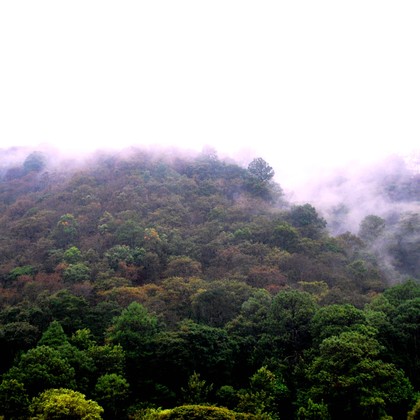
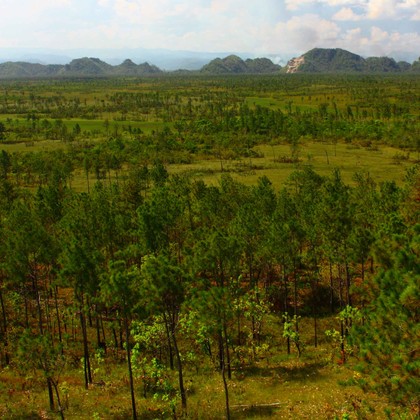
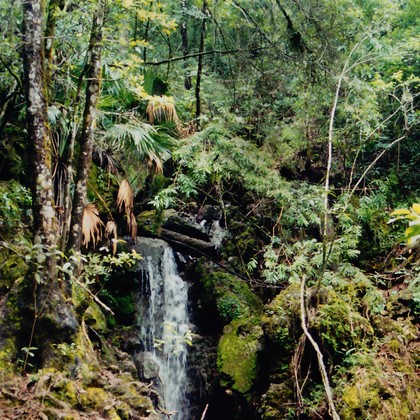
Open pine and pine-oak forest, pine savanna, forest edges and clearings with scattered pines in the highlands, mainly between about 1000 and 3000 m, also field edges and pastures with trees. It forages much on the ground for ants.
Where the bird is most at home, classified by the vegetation units of Mexico and Central America.


Range and movements
Highlands of Chiapas in southern Mexico, Guatemala, El Salvador, Honduras and northern and central Nicaragua. Does not occur outside the guide area.
- Resident
- dark = core range, pale = thinly spread
How and when to look
Regularly seen in the forests around San Cristóbal de las Casas in Chiapas, at Laguna Chicabal near Quetzaltenango in Guatemala and in La Tigra near Tegucigalpa in Honduras.
Conservation status
Not threatened. Locally common in the pine and pine-oak forests of the highlands; open, partly cleared landscapes with old pines suit the species.
Scientific name
Colaptes mexicanoides | de Lafresnaye, 1844
De Lafresnaye described the species in 1844 and placed it straight away in the genus where it still stands. The genus Colaptes was introduced in 1825 by Vigors. Colaptes is Greek kolaptēs 'chiseller', from kolaptō 'to peck, to chisel', after the hacking into wood. mexicanoides means 'resembling mexicanus', with Greek -oidēs 'like', after its likeness to the Red-shafted Flicker (formerly Colaptes mexicanus). The specimen the first description was based on came from Mexico.