All species › Woodpeckers and allies › Woodpeckers › Northern Flicker
Position in the tree Birds Aves › Birds with a flexible palate Neognathae › All other modern birds Neoaves › Landbirds Telluraves › Raptors, owls, kingfishers and woodpeckers Afroaves › Mousebirds, rollers and woodpeckers Coraciimorphae › Trogons and cavity nesters Cavitaves › Hornbills, kingfishers and woodpeckers Picocoraciae › Kingfishers, bee-eaters and woodpeckers Picodynastornithes
Northern Flicker | Colaptes auratus
Gouden grondspecht | Carpintero de pechera
The Northern Flicker is a large, brown woodpecker with a white rump that often feeds on the ground on ants. In the guide area the red-shafted form breeds in the mountains of Mexico, south to Oaxaca; in winter it is joined by birds from North America. South of the Isthmus of Tehuantepec it is replaced by the Guatemalan Flicker.

Voice
A long, fast, far-carrying series wik-wik-wik-wik, a single loud klee-yer and during encounters a soft, repeated wicka-wicka. Drums less loudly and for a shorter time than most other woodpeckers.
Recording: Don Profota — CC BY-NC-SA 4.0 · converted to mono · xeno-canto
Identification
28–31 cm. Brown with black barring on the back, a black crescent on the breast and pale, black-spotted underparts; white rump in flight. In birds breeding in Mexico the underside of the wings and tail is salmon red, the face grey and the crown brown; the male has a red moustachial stripe, the female none. In winter a few birds of the yellow-shafted form reach northern Mexico, with yellow shafts, a grey crown, a brown face, a red nape patch and, in the male, a black moustachial stripe. Intergrades occur.
Confusion species
Gilded Flicker Colaptes chrysoides (Sonora and Baja California) has yellow wing and tail shafts, a cinnamon-brown crown, more black under the tail and lives in cactus desert. Guatemalan Flicker Colaptes mexicanoides (Chiapas and further south) has a rufous-brown crown and a more densely barred back. Gila Woodpecker Melanerpes uropygialis has a black-and-white barred back and no black breast band.
Habitat
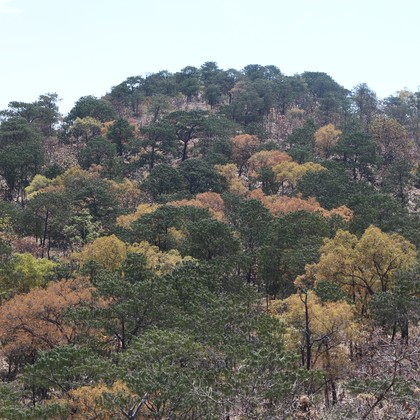
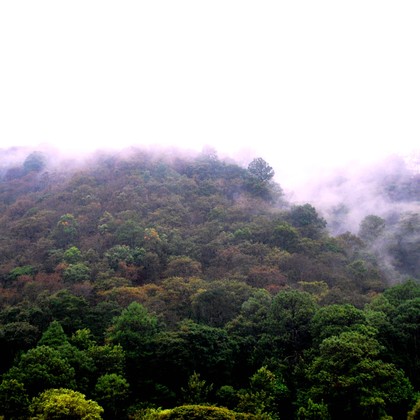
Open pine-oak, pine and fir forest in the mountains, mainly between about 1500 and 3500 m, forest edges, clearings and mountain meadows with scattered trees, and parks and gardens in towns on the plateau. It forages much on the ground. In winter also in lower open country, semi-desert and riparian woodland in northern Mexico.
Where the bird is most at home, classified by the vegetation units of Mexico and Central America.



Range and movements
Breeds in the mountains of Baja California (Sierra de Juárez and Sierra de San Pedro Mártir), in the Sierra Madre Occidental and Sierra Madre Oriental, the mountains of the central plateau and the Trans-Mexican Volcanic Belt, south into the Sierra Madre del Sur of Guerrero and Oaxaca. In winter also scattered in lower parts of northern Mexico. Outside the guide area in North America north to Alaska.
- Resident
- dark = core range, pale = thinly spread
How and when to look
Readily found in the pine forests of the Sierra de San Pedro Mártir in Baja California and in the forests on the edge of Mexico City, such as the Desierto de los Leones. The white rump shows at once when the bird flushes.
Conservation status
Not threatened. Locally common in the mountain forests of Mexico; also uses parks and gardens with old trees.
Scientific name
Colaptes auratus | (Linnaeus, 1758)
Linnaeus described the species in 1758 as Cuculus auratus; because it was later moved to another genus, the author and year stand in brackets. The genus Colaptes was introduced in 1825 by Vigors. Colaptes is Greek kolaptēs 'chiseller', from kolaptō 'to peck, to chisel', after the hacking into wood. auratus is Latin for 'gilded', after the golden-yellow underside of the wings and tail. The specimen the first description was based on came from South Carolina.