All species › Woodpeckers and allies › Woodpeckers › Spot-breasted Woodpecker
Position in the tree Birds Aves › Birds with a flexible palate Neognathae › All other modern birds Neoaves › Landbirds Telluraves › Raptors, owls, kingfishers and woodpeckers Afroaves › Mousebirds, rollers and woodpeckers Coraciimorphae › Trogons and cavity nesters Cavitaves › Hornbills, kingfishers and woodpeckers Picocoraciae › Kingfishers, bee-eaters and woodpeckers Picodynastornithes
Spot-breasted Woodpecker | Colaptes punctigula
Vlekborstgrondspecht | Carpintero pechipunteado
The Spot-breasted Woodpecker is a South American woodpecker that in the guide area occurs only in eastern Panama. It lives in open, often wet landscapes with scattered trees and can be recognised by its white cheeks and black-spotted yellow breast.

Voice
A loud, repeated series wik-wik-wik-wik, a single kee-ah and a soft wicka-wicka during encounters. Rarely drums.
Recording: Jerome Fischer — CC BY-NC-SA 4.0 · shortened to the first 60 s, mono · xeno-canto
Identification
18–21 cm. The forehead is black, the crown and nape red in the male; in the female only the nape is red. The cheeks are white, the throat white with fine black streaks. The male has a red moustachial stripe, the female a black-speckled one. The back is golden olive with black barring, the rump yellowish. The underparts are yellow to olive-yellow with round black spots on the breast and flanks.
Confusion species
Golden-olive Woodpecker Colaptes rubiginosus has a greyish-white cheek, barred rather than spotted underparts and lives mainly in forest. Red-crowned Woodpecker Melanerpes rubricapillus also has a barred back, but plain greyish-brown underparts without spots and no white cheek with a moustachial stripe.
Habitat
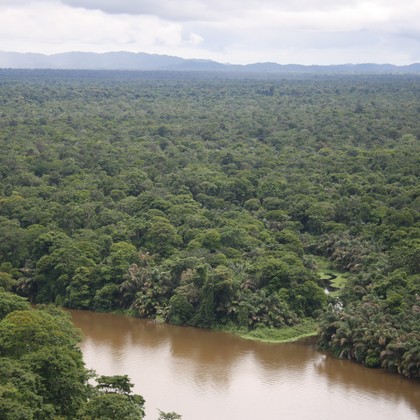
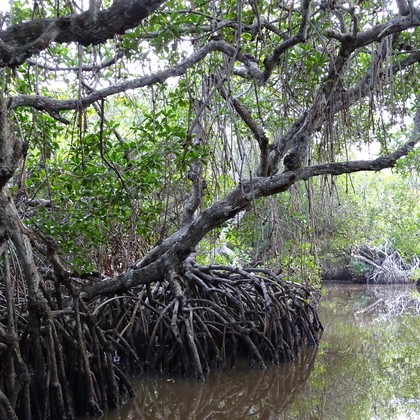
Open and semi-open lowlands below about 500 m: marshes with scattered trees, flooded and gallery forest, mangrove edges, riverbanks and pasture with trees. It often forages low on trunks and palms and sometimes on the ground for ants and termites.
Where the bird is most at home, classified by the vegetation units of Mexico and Central America.




Range and movements
In the guide area only in eastern Panama: eastern Panamá province (from Tocumen Marsh and the Bayano valley) and Darién, mainly in the Tuira and Chucunaque drainages; elsewhere only scattered records. Outside the guide area in northern and western South America south to the Amazon basin.
- Resident
- dark = core range, pale = thinly spread
How and when to look
Regularly seen at Tocumen Marsh near Panama City and along the Pan-American Highway around Tortí in eastern Panama.
Conservation status
Not threatened. Locally fairly common in open country in Panama and can benefit from clearing that leaves swamp forest and pasture with trees.
Scientific name
Colaptes punctigula | (Boddaert, 1783)
Boddaert described the species in 1783 as Picus punctigula; because it was later moved to another genus, the author and year stand in brackets. The genus Colaptes was introduced in 1825 by Vigors. Colaptes is Greek kolaptēs 'chiseller', from kolaptō 'to peck, to chisel', after the hacking into wood. punctigula is Latin, from punctum 'spot' and gula 'throat', after the spotted throat and breast. The specimen the first description was based on came from Cayenne, French Guiana.