All species › Passerines › Tyrant flycatchers and allies › Guatemalan Tyrannulet
Position in the tree Birds Aves › Birds with a flexible palate Neognathae › All other modern birds Neoaves › Landbirds Telluraves › Falcons, parrots and passerines Australaves › Falcons and passerines Eufalconimorphae › Parrots and passerines Psittacopasserae
Guatemalan Tyrannulet | Zimmerius vilissimus
Brilvliegenpikker | Mosquero ceja gris
The Guatemalan Tyrannulet is a small, olive-green tyrant flycatcher of forest edges and semi-open country in the highlands of northern Central America, with a grey crown, a white eyebrow and sharply defined yellow edges to the wing feathers. It often holds its tail cocked and eats many mistletoe berries. It lives only in the guide area, from Chiapas to El Salvador.

Voice
A clear, plaintive whistle, often repeated in short series, and a rapid, rather shrill twitter.
Recording: Alain Verneau — CC BY-NC-SA 4.0 · converted to mono · xeno-canto
Identification
11–12 cm, with a small, short black bill and a fairly long tail that is often slightly raised. Crown grey, with a white eyebrow and a dark eye-stripe. Back olive-green. Wings dark with narrow, sharply defined yellow edges to the coverts and flight feathers, but no true wing-bars. Underparts greyish white with a yellowish wash on the flanks and lower belly. Male and female are alike.
Confusion species
Mistletoe Tyrannulet Zimmerius parvus is very similar and was formerly treated as the same species; it lives mainly in the lowlands and foothills, from eastern Guatemala and Belize to Panama, and in the field is best separated by habitat and range. Sooty-headed Tyrannulet Phyllomyias griseiceps has a greyer head without a clear eyebrow and lacks the yellow wing edges. Yellow-bellied Tyrannulet Ornithion semiflavum is smaller, with a shorter tail and bright yellow underparts.
Habitat
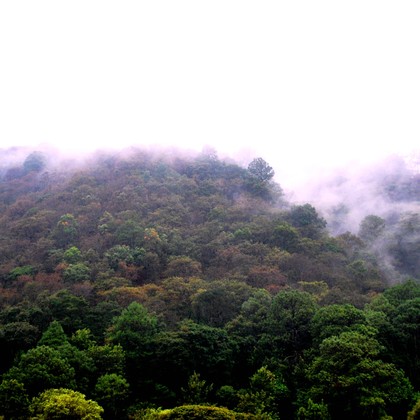
Edges and clearings of montane forest, oak and pine-oak forest, mature secondary forest, shade coffee and wooded gardens in the highlands. It searches the canopy for insects and also eats many berries, especially of mistletoes.
Where the bird is most at home, classified by the vegetation units of Mexico and Central America.




Range and movements
Endemic to the guide area: the highlands of Chiapas in southern Mexico, Guatemala and El Salvador. The exact boundary with Mistletoe Tyrannulet, including in Honduras, is not everywhere clear.
- Resident
- dark = core range, pale = thinly spread
How and when to look
Look for it at forest edges, coffee plantations and gardens in the highlands of Guatemala and Chiapas, often in trees with mistletoe. The cocked tail and yellow wing edges help with identification.
Conservation status
Not threatened. Fairly common in the highlands and tolerant of semi-open, man-made landscapes.
Scientific name
Zimmerius vilissimus | (Sclater & Salvin, 1859)
Sclater & Salvin described the species in 1859 as Elainia vilissima; because it was later moved to another genus, the author and year stand in brackets. The genus Zimmerius was introduced in 1977 by Traylor. Zimmerius honours the American ornithologist John Todd Zimmer (1889–1957), an authority on South American birds. vilissimus is Latin for 'very common, worthless', superlative of vilis 'cheap', after the plain plumage. The specimen the first description was based on came from Cobán, Guatemala.