All species › Passerines › Wrens › Happy Wren
Position in the tree Birds Aves › Birds with a flexible palate Neognathae › All other modern birds Neoaves › Landbirds Telluraves › Falcons, parrots and passerines Australaves › Falcons and passerines Eufalconimorphae › Parrots and passerines Psittacopasserae
Happy Wren | Pheugopedius felix
Sonorawinterkoning | Chivirín feliz
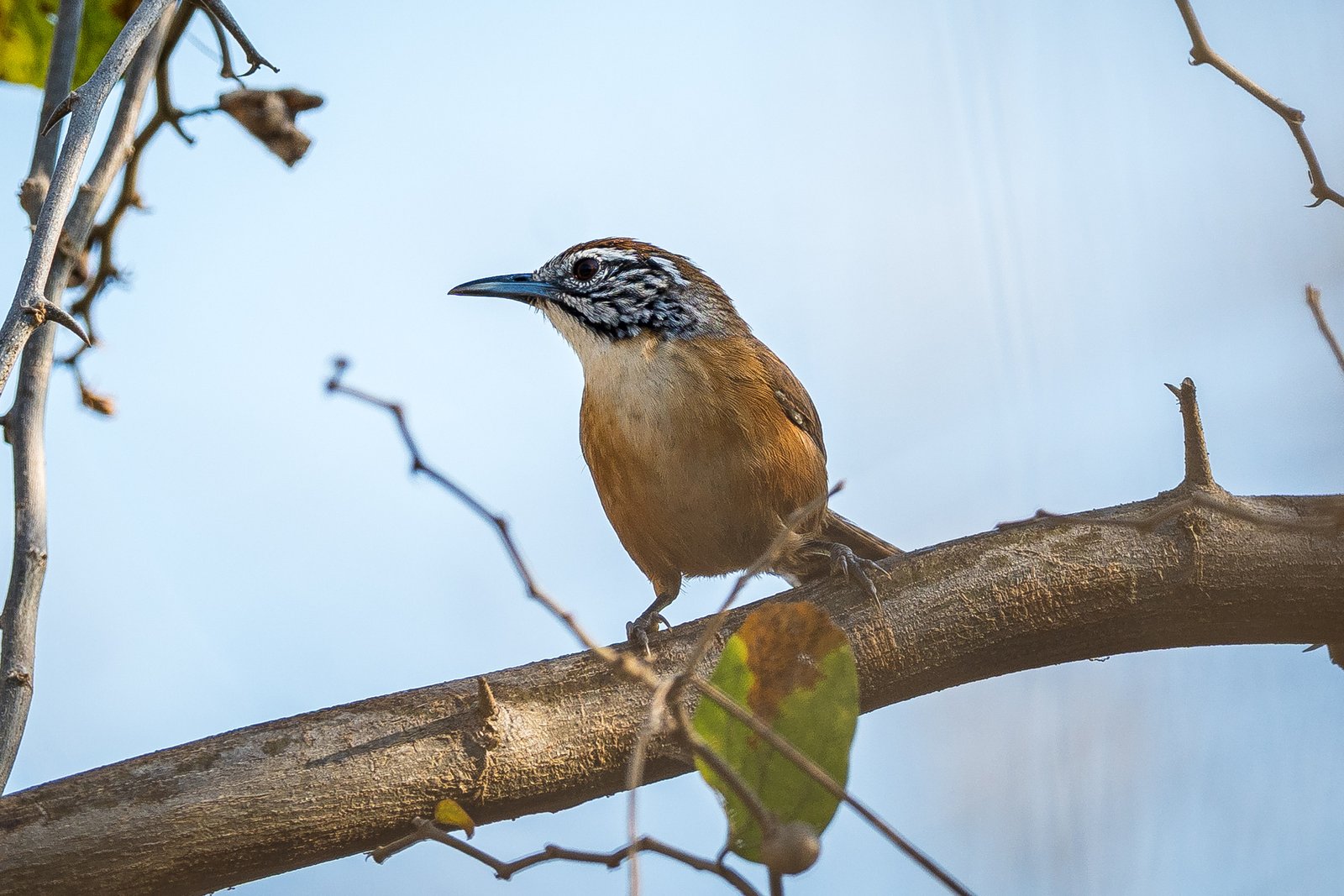
The Happy Wren is a small wren of dry forest and scrub on the Pacific side of Mexico, with a black-and-white striped face and warm buff underparts. It lives in pairs in dense undergrowth and often sings in duet. It occurs only in Mexico.
Voice
A loud, fast song of clear, rolling whistled phrases, often a duet in which male and female alternate. The call consists of dry, grating notes.
Recording: Manuel Grosselet — CC BY-NC-SA 4.0 · converted to mono · xeno-canto
Identification
12–14 cm. Crown and back rufous-brown to greyish brown, tail with black bars. A long white supercilium above a black eye-stripe; cheeks streaked black and white. Throat white, breast and belly warm buff to cinnamon. Bill fairly long and dark. Sexes alike.
Confusion species
Sinaloa Wren Thryophilus sinaloa has a less strongly striped face and dull greyish-white underparts. Banded Wren Thryophilus pleurostictus has white underparts with black bars on the flanks. Bewick's Wren Thryomanes bewickii is greyer above, has pale grey underparts and a long, mobile tail with pale corners.
Habitat
Tropical dry forest, thorn scrub, riverside vegetation and forest edges in the lowlands and foothills, locally higher. It forages low in dense vegetation and vine tangles for insects and spiders.
Where the bird is most at home, classified by the vegetation units of Mexico and Central America.




Range and movements
Endemic to Mexico. Pacific slope from southern Sonora to Oaxaca, inland to the Balsas drainage; also on the Islas Marías.
- Resident
- dark = core range, pale = thinly spread
How and when to look
Common around San Blas in Nayarit and in the dry forest along the Pacific coast. It is usually heard first; a duetting pair often comes close in the bushes.
Conservation status
Not threatened. Common within its range and also found in secondary growth.
Scientific name
Pheugopedius felix | (Sclater, 1860)
Sclater described the species in 1860 as Thryothorus felix; because it was later moved to another genus, the author and year stand in brackets. The genus Pheugopedius was introduced in 1851 by Cabanis. Pheugopedius is Greek, from pheugō 'to shun, flee' and pedion 'plain, open country': a bird that shuns the open ground. felix is Latin for 'happy, fortunate'; probably after the cheerful song. The specimen the first description was based on came from Santa Catarina Juquila, Oaxaca, Mexico.