All species › Birds of prey › Kites, Old World vultures, eagles and hawks › Harris's Hawk
Position in the tree Birds Aves › Birds with a flexible palate Neognathae › All other modern birds Neoaves › Landbirds Telluraves › Raptors, owls, kingfishers and woodpeckers Afroaves › Hawks and owls Hieraves
Harris's Hawk | Parabuteo unicinctus
Woestijnbuizerd | Aguililla rojinegra
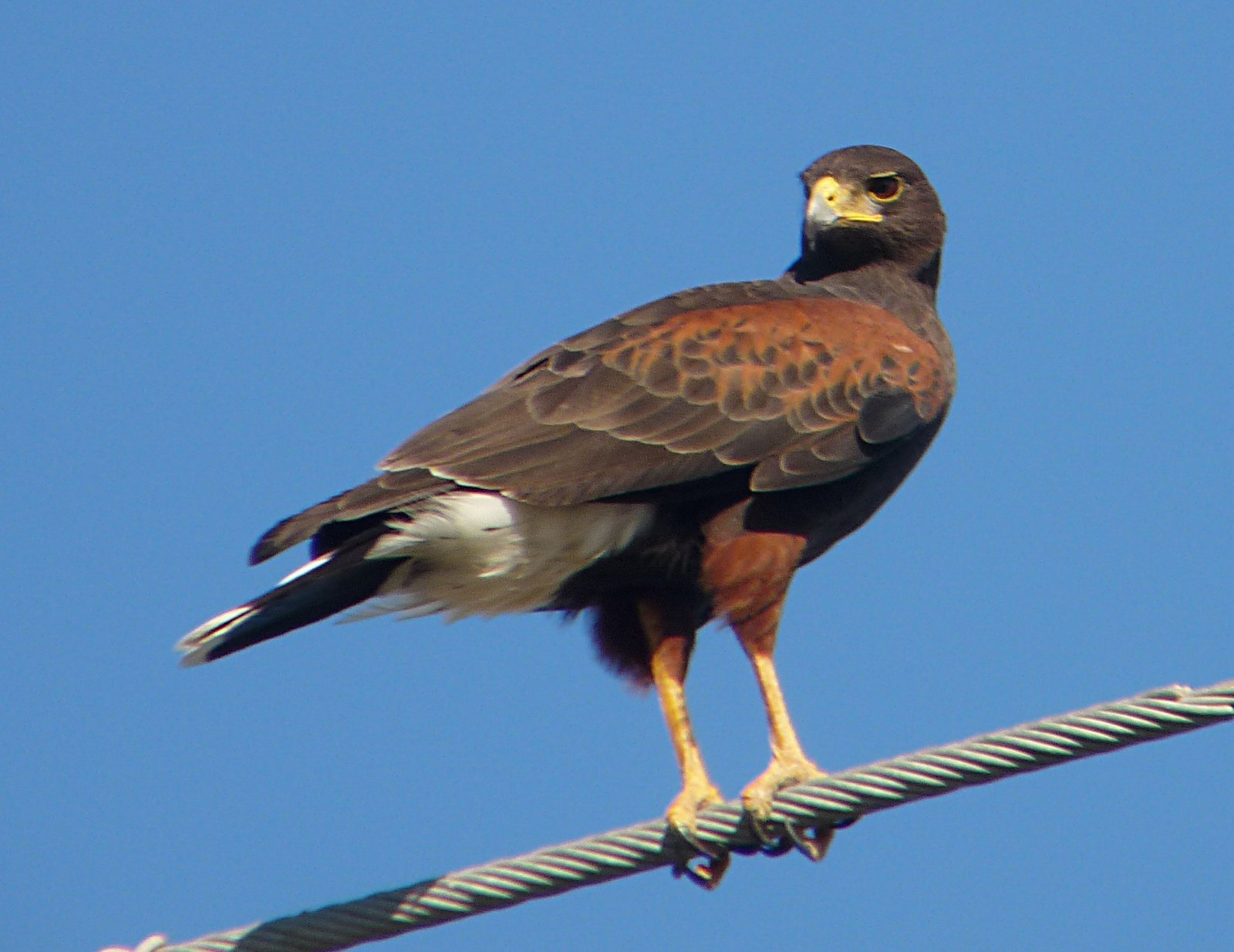
Harris’s Hawk is a dark, chocolate-brown buzzard with chestnut shoulders and thighs, long yellow legs and a black tail with a white base and white tip. It lives in dry, open country and often hunts in family groups that surround prey together; sometimes the birds even perch on each other’s backs on a post or cactus. In the guide area it is a resident, common in northern and western Mexico and scarce and local further south.
Voice
A harsh, rasping, drawn-out eerrrrrr, especially when disturbed near the nest.
Recording: Ricardo José Mitidieri — CC BY-NC-SA 4.0 · converted to mono · xeno-canto
Identification
46–59 cm, with broad wings, a long tail and long legs. Adults are dark chocolate brown with chestnut shoulders, underwing coverts and thighs. Cere, lores and legs are yellow. The tail is black with a broad white base and a narrow white tip; the white base is also visible above the tail. In flight the chestnut underwing coverts contrast with the dark flight feathers. Young birds are paler, with white, dark-streaked underparts, less chestnut and a finely barred tail with a pale base. Male and female are alike; the female is clearly larger.
Confusion species
The Common Black Hawk Buteogallus anthracinus and Great Black Hawk Buteogallus urubitinga are uniformly black without chestnut and have a broad white band halfway along the tail. The Zone-tailed Hawk Buteo albonotatus is slimmer, has grey-barred flight feathers and flies with its wings in a V, like a Turkey Vulture. Young Harris’s Hawks resemble young Red-tailed Hawks Buteo jamaicensis, but have a longer tail with a white base and chestnut shoulders.
Habitat
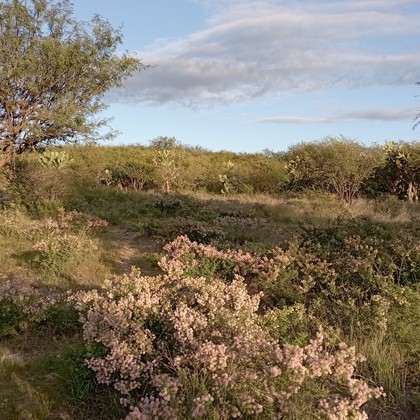
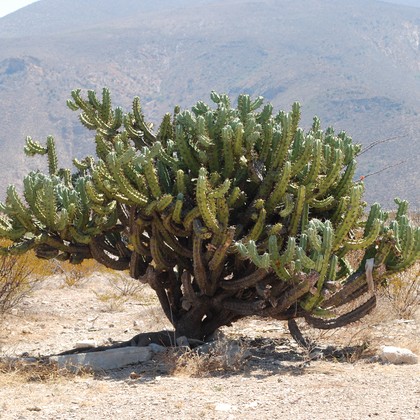
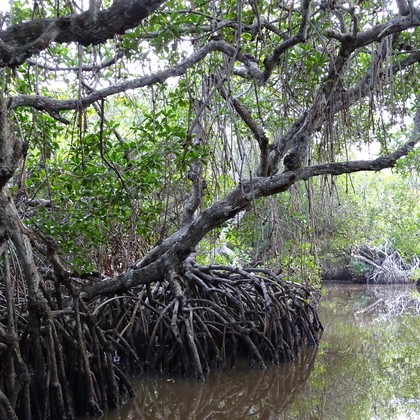
Desert and semi-desert with columnar cacti, mesquite and thorn scrub, dry open grassland with scattered trees, ranchland and field edges, and in the south of the guide area also dry coastal plains and mangroves. It perches on posts, power poles, cacti and dead trees and hunts hares, rodents, birds and lizards from the ground up into the air.
Where the bird is most at home, classified by the vegetation units of Mexico and Central America.




Range and movements
Resident in northern Mexico, from Baja California, Sonora and Chihuahua to Coahuila, Nuevo León and Tamaulipas, south across the central plateau and along the Pacific side to Oaxaca, and on the Gulf side to northern Veracruz. In Central America scarce and local, mainly in dry open country and mangroves along the Pacific side of El Salvador, Honduras, Nicaragua and Costa Rica; rare in Panama. Outside the guide area in the southwestern United States and in South America to Chile and Argentina.
- Resident
- dark = core range, pale = thinly spread
How and when to look
In the Sonoran Desert and on the Baja California Peninsula family groups often perch on columnar cacti and power poles along the road. In the mesquite scrub of Nuevo León and Tamaulipas birds can be seen in the early morning as they set out to hunt together.
Conservation status
Not threatened. Locally common in northern Mexico; scarce in Central America.
Scientific name
Parabuteo unicinctus | (Temminck, 1824)
Temminck described the species in 1824 as Falco unicinctus; because it was later moved to another genus, the author and year stand in brackets. The genus Parabuteo was introduced in 1874 by Ridgway. Parabuteo is Greek para 'beside, near' plus the genus Buteo: 'near-buzzard'. unicinctus is Latin, from unus 'one' and cinctus 'girdled': 'one-banded', after the white band at the base of the tail. The specimen the first description was based on came from near Boa Vista, Roraima, Brazil.