All species › Gamebirds › Guans, curassows and chachalacas › Highland Guan
Position in the tree Birds Aves › Birds with a flexible palate Neognathae › Fowl Galloanserae
Highland Guan | Penelopina nigra
Berggoean | Pajuil
The Highland Guan is the smallest guan in the guide area and a bird of highland cloud forest from Chiapas to northern Nicaragua. Male and female differ strongly: the male is black with a red dewlap, the female rufous-brown with black barring. It is the only species in the genus Penelopina and does not occur outside the guide area.

Voice
In the breeding season the male gives a long, rising whistle, oo-weeeeh, and makes a dry, crackling rattle with its wings during a short dive between the trees. Also soft, clucking calls.
Recording: Manuel Grosselet — CC BY-NC-SA 4.0 · converted to mono · xeno-canto
Identification
59–65 cm; a slender, long-tailed guan with a small head and a short bill. The male is entirely glossy blue-black, with a bright red bill, a bare red dewlap and red legs. The female is warm rufous to chestnut-brown, densely barred black on the upperparts, wings and tail, more finely and faintly barred below; she also has red legs, but a duller bill and no conspicuous dewlap. Immature males at first resemble the female and gradually turn black.
Confusion species
Horned Guan Oreophasis derbianus lives partly in the same mountains, but is much larger, with a white, black-streaked breast, a white tail band and a red horn on the crown. Crested Guan Penelope purpurascens is almost one and a half times as large, olive-brown with white streaks on the neck and breast, and lives mainly lower down. The female may be confused with a chachalaca, but chachalacas are unbarred grey-brown and live in small groups in lower, more open country.
Habitat
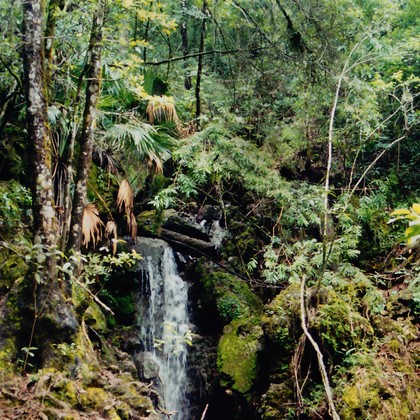
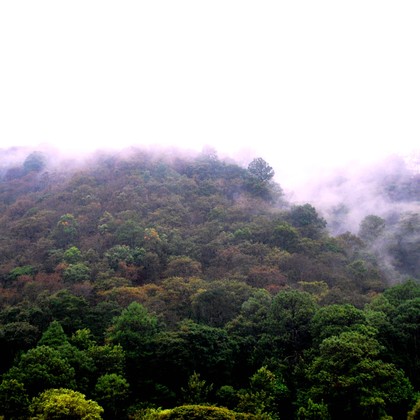
Humid montane forest and cloud forest, also pine-oak forest with dense undergrowth, from about 1000 to 3000 m, mainly above 1500 m. It lives alone or in pairs in the mid-storey and canopy, but also forages on the forest floor for fallen fruit. It eats mainly fruit, leaves and buds. The nest is a loose cup of twigs and leaves low in a tree or shrub.
Where the bird is most at home, classified by the vegetation units of Mexico and Central America.
Range and movements
Highlands of extreme eastern Oaxaca and of Chiapas, Guatemala, north-western El Salvador, Honduras and northern Nicaragua. The species does not occur outside the guide area.
- Resident
- dark = core range, pale = thinly spread
How and when to look
The chances are best in large, protected cloud forests, such as El Triunfo in Chiapas, the Sierra de las Minas and the Biotopo del Quetzal in Guatemala, Montecristo in El Salvador and Cusuco and La Tigra in Honduras. In the breeding season, February to May, the male's rising whistle often gives the bird away before sunrise.
Conservation status
Vulnerable. The species is declining through the felling and fragmentation of montane forest and through hunting. In large protected areas it is still locally fairly common.
Scientific name
Penelopina nigra | (Fraser, 1852)
Fraser described the species in 1852 as Penelope niger; because it was later moved to another genus, the author and year stand in brackets. The genus Penelopina was introduced in 1862 by Reichenbach. Penelopina is a diminutive of the genus Penelope: 'little Penelope', after its smaller build. nigra is Latin for 'black', after the glossy black male. The specimen the first description was based on came from unknown (described from aviary birds).