All species › Passerines › Finches, euphonias and allies › Hooded Grosbeak
Position in the tree Birds Aves › Birds with a flexible palate Neognathae › All other modern birds Neoaves › Landbirds Telluraves › Falcons, parrots and passerines Australaves › Falcons and passerines Eufalconimorphae › Parrots and passerines Psittacopasserae
Hooded Grosbeak | Hesperiphona abeillei
Witschouderdikbek | Picogordo encapuchado
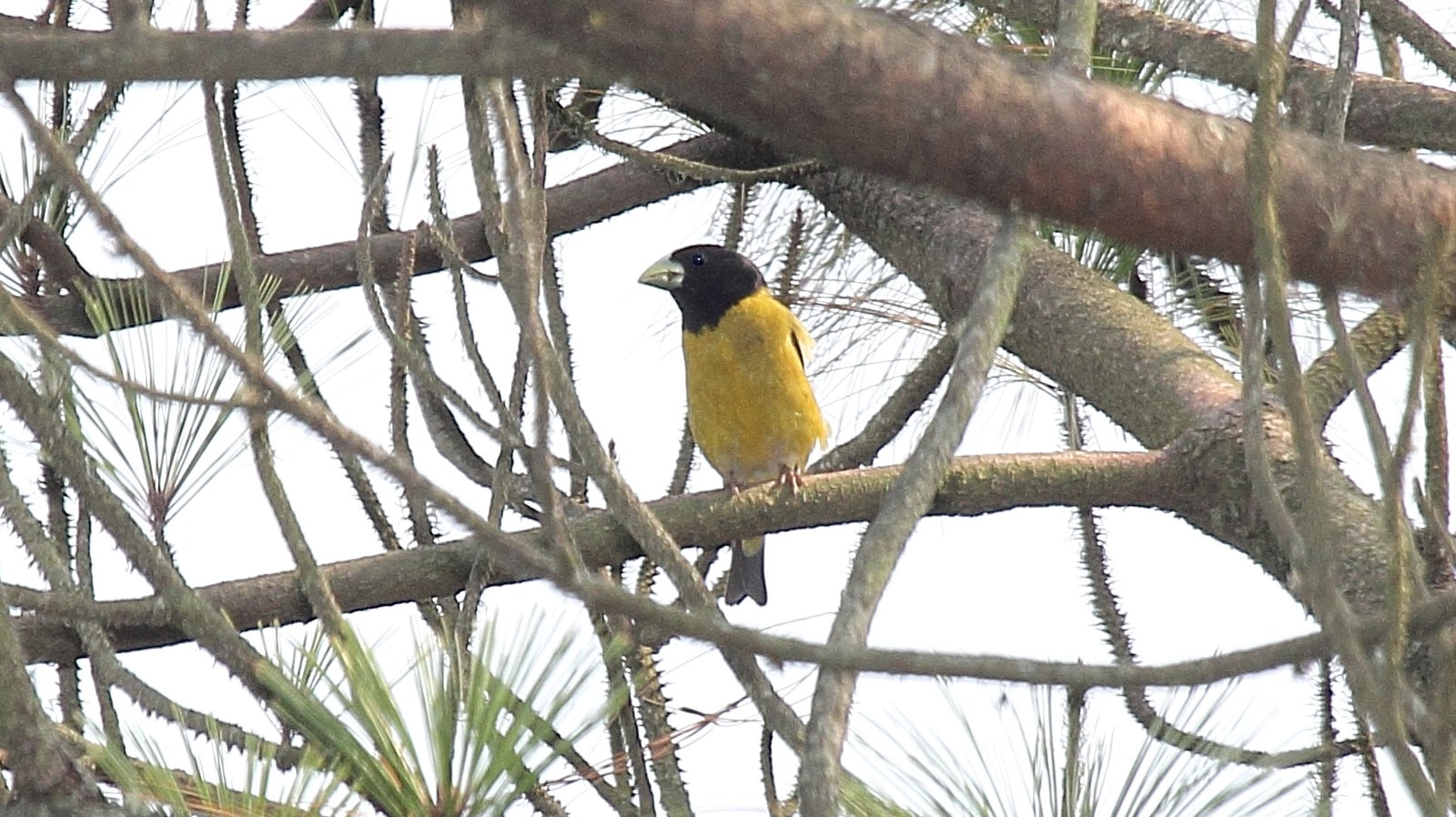
The Hooded Grosbeak is a large finch with a heavy, pale bill, found only in the montane forests of Mexico and Guatemala. It lives inconspicuously in the canopy and is heard more often than seen.
Voice
The call is a clear, whistled, slightly descending peeu or cheeu, sometimes also a dry, rolling sound. The song is a short, irregular series of whistled and chirping notes.
Recording: Richard E. Webster — CC BY-NC-SA 4.0 · converted to mono · xeno-canto
Identification
17–18 cm. Heavily built, with a conical, pale greenish horn-coloured bill. The male has an entirely black head and a bright yellow body; the back is olive-yellow. The wings are black with a large white patch on the inner secondaries and tertials, visible as a white shoulder patch; the tail is black. The female has a black crown, an olive back and yellowish olive underparts, and the same black-and-white wing pattern.
Confusion species
Evening Grosbeak Hesperiphona vespertina occurs locally in the same mountains. The male has a brown head with a yellow forehead band and supercilium; the female is grey, without a black crown. Yellow Grosbeak Pheucticus chrysopeplus has a yellow head and a dark bill. The male Black-headed Grosbeak Pheucticus melanocephalus has an orange-brown breast and white wing bars.
Habitat
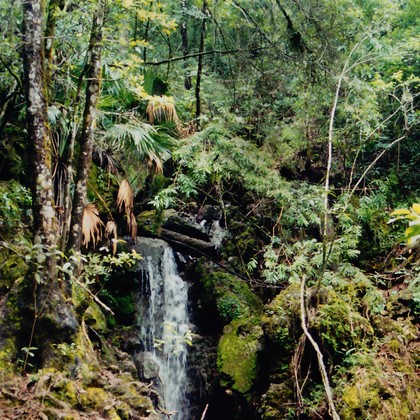
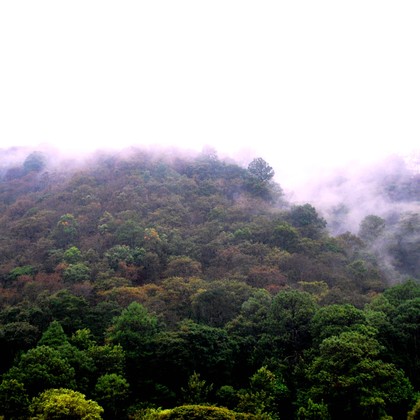
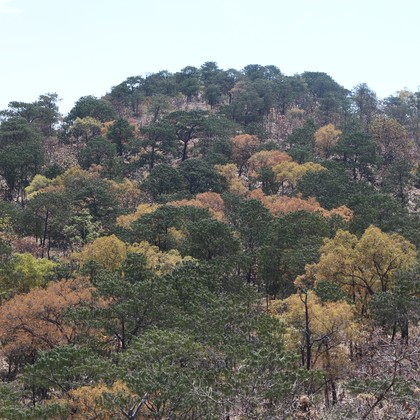
Humid cloud forest and pine-oak forest in the mountains, also forest edges and mature secondary forest, mostly between about 1,200 and 3,000 m. It lives in pairs or small groups in the canopy and rarely comes low. It eats seeds, buds and fruit.
Where the bird is most at home, classified by the vegetation units of Mexico and Central America.
Range and movements
Occurs only in the guide area, in the mountains of Mexico and Guatemala: in the Sierra Madre Occidental and Sierra Madre Oriental, the mountains of central Mexico, the Sierra Madre del Sur, Chiapas and the highlands of Guatemala.
- Resident
- dark = core range, pale = thinly spread
How and when to look
Most easily located by its whistled call, often given by birds high in the canopy or flying over the forest.
Conservation status
Not threatened (LC). Locally fairly common, but its habitat is being fragmented by logging and the conversion of montane forest to farmland.
Scientific name
Hesperiphona abeillei | (Lesson, 1839)
Lesson described the species in 1839 as Guiraca abeillei; because it was later moved to another genus, the author and year stand in brackets. The genus Hesperiphona was introduced in 1850 by Bonaparte. Hesperiphona is Greek, from hesperos 'evening' and phōnē 'voice, sound', after the old belief that the Evening Grosbeak sings at dusk. abeillei honours the French physician, ornithologist and collector Grégoire Abeillé (1798–1848). The specimen the first description was based on came from Mexico.