All species › Passerines › Finches, euphonias and allies › House Finch
Position in the tree Birds Aves › Birds with a flexible palate Neognathae › All other modern birds Neoaves › Landbirds Telluraves › Falcons, parrots and passerines Australaves › Falcons and passerines Eufalconimorphae › Parrots and passerines Psittacopasserae
House Finch | Haemorhous mexicanus
Mexicaanse roodmus | Pinzón mexicano
The House Finch is a slender, long-tailed finch of dry, open country that is equally at home in villages and towns. In northern and central Mexico it is one of the most widespread songbirds. It has been introduced by people to the eastern United States and Hawaii.
Voice
The song is a long, lively warble of mixed notes, often ending in a descending, nasal veeer. The call is a short, chirping cheep, often given in flight.
Recording: Andrew McCafferty — CC BY-NC-SA 4.0 · converted to mono · xeno-canto
Identification
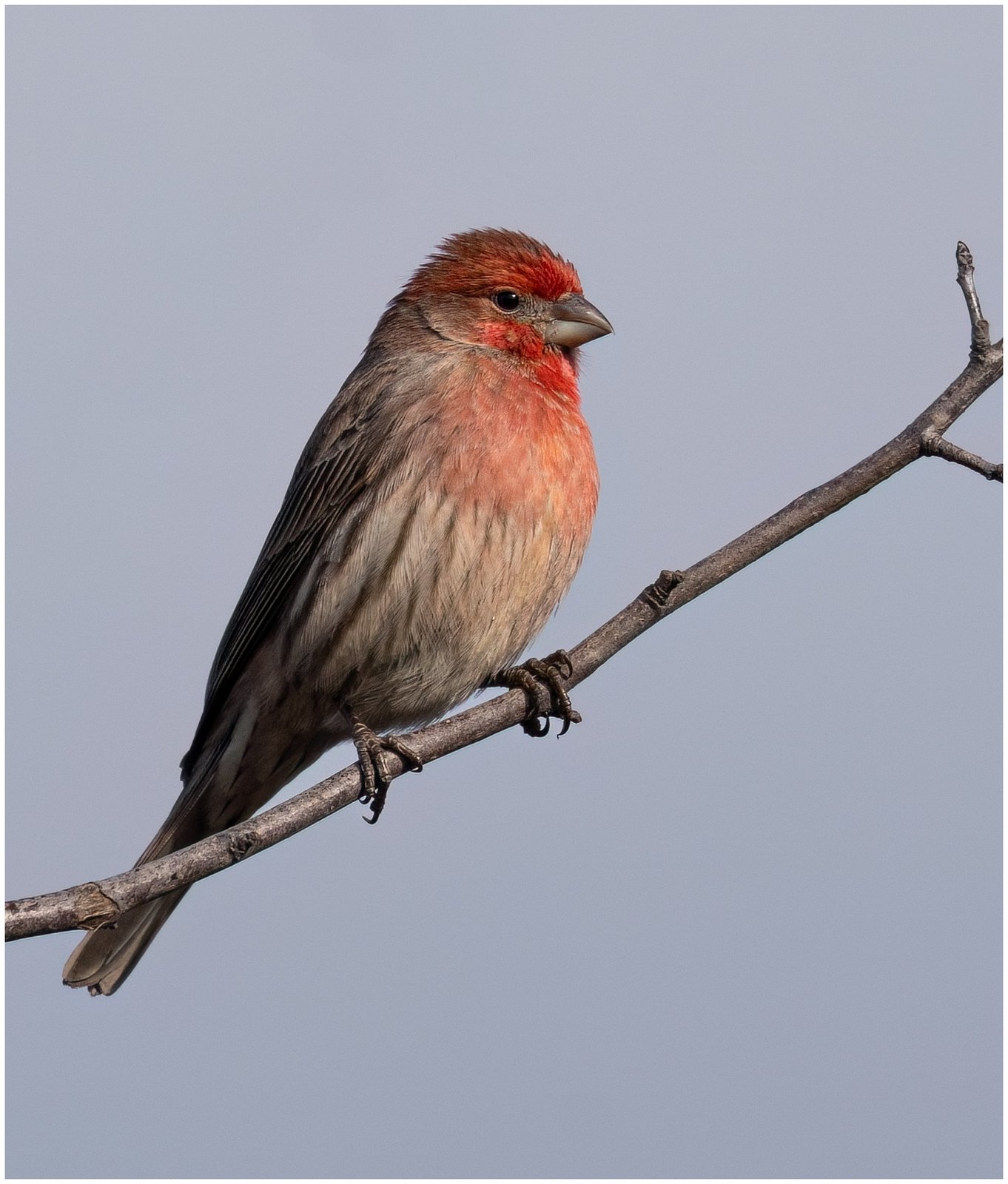
13–14 cm. Slender, with a short, slightly curved conical bill and a fairly long, square-ended tail. The male has a red forehead, red supercilium, throat and breast, and a red rump; the colour varies from orange or yellow to deep red. Crown and ear coverts are brown, the back is grey-brown and lightly streaked, and belly and flanks are white with broad brown streaks. The female is grey-brown with faint, blurry streaks below and an almost plain head.
Confusion species
The male Cassin's Finch Haemorhous cassinii has a sharply defined red crown, a pink rather than red breast and almost unstreaked flanks; the female is more crisply and finely streaked and has a more distinct head pattern. Purple Finch Haemorhous purpureus has a larger head and a shorter, notched tail, and the male is more pinkish red over the head and back with barely streaked flanks. The female House Finch lacks the white supercilium and dark cheek patch of both species.
Habitat
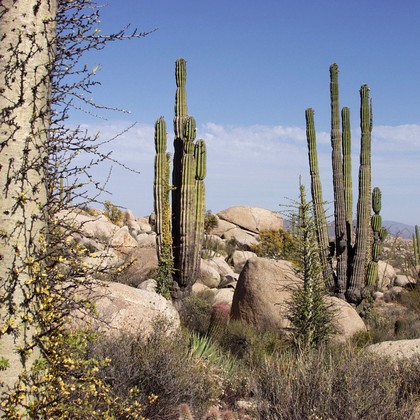
Dry, open and semi-open country: desert scrub, thornscrub, chaparral, cactus fields, farmland and pasture with hedgerows, and above all villages, towns and gardens. Often lives in flocks and feeds a great deal on the ground on seeds; also eats buds and fruit.
Where the bird is most at home, classified by the vegetation units of Mexico and Central America.





Range and movements
Native to the western United States and Mexico; introduced and now widespread in the eastern United States and southern Canada, and also in Hawaii. In the guide area across most of northern and central Mexico, including Baja California, south to Oaxaca; absent from the humid lowlands of the east and south.
- Resident
- dark = core range, pale = thinly spread
How and when to look
In villages and towns of the Mexican highlands it is often the first finch to draw attention, singing from roofs and power lines.
Conservation status
Not threatened (LC). Very widespread and common, and benefits from settlement and agriculture. In Mexico it is trapped and kept as a cage bird.
Scientific name
Haemorhous mexicanus | (Müller, 1776)
Müller described the species in 1776 as Fringilla mexicana; because it was later moved to another genus, the author and year stand in brackets. The genus Haemorhous was introduced in 1837 by Swainson. Haemorhous comes from the Greek haimorrhoos 'bleeding', from haima 'blood' and rhoos 'stream', after the red plumage of the males. mexicanus is Latin for 'of Mexico', the country where the species was first collected. The specimen the first description was based on came from Valley of Mexico, Mexico.