All species › Passerines › New World warblers › Hooded Warbler
Position in the tree Birds Aves › Birds with a flexible palate Neognathae › All other modern birds Neoaves › Landbirds Telluraves › Falcons, parrots and passerines Australaves › Falcons and passerines Eufalconimorphae › Parrots and passerines Psittacopasserae
Hooded Warbler | Setophaga citrina
Monnikszanger | Chipe encapuchado
The Hooded Warbler is a yellow warbler of the forest understorey. The male has a yellow face framed by a black hood and throat; both sexes show white spots in the tail when they open it. It breeds in eastern North America and winters in the guide area, mainly on the Caribbean slope.

Voice
The song is a loud, clear whistled phrase ending in an emphatic final note, roughly tawee-tawee-tawee-tee-tyoo; rarely heard in winter. The call is a metallic, fairly loud chink.
Recording: Jim Berry — CC BY-NC-SA 4.0 · shortened to the first 60 s, mono · xeno-canto
Identification
12–14 cm. Upperparts olive-green, underparts bright yellow, eyes large and dark. The male has a yellow forehead and cheeks, surrounded by a black hood extending over crown, nape, throat and upper breast. The female has a yellow face and dark lores; the hood varies from almost as extensive as in the male to just an olive crown. White spots on the inner webs of the outer tail feathers, visible as the tail is constantly opened and closed.
Confusion species
Wilson's Warbler Cardellina pusilla is smaller, has no white in the tail and in the male only a small black cap on the crown. Kentucky Warbler Geothlypis formosa has yellow spectacles with a black sideburn below the eye and lacks white in the tail. Females without a hood resemble those of Wilson's Warbler, but are larger and have white tail spots.
Habitat
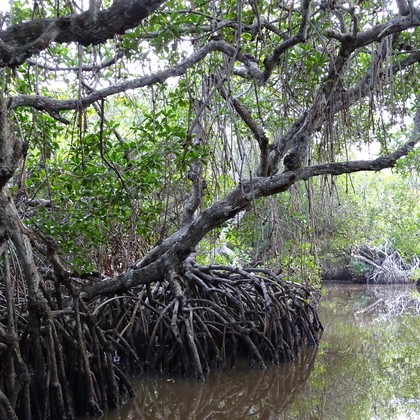
In winter the understorey of humid lowland and foothill forest, secondary forest, forest edges, mangroves and shade coffee, mainly below 1000 m. In winter males are found more often in tall, closed forest and females more often in scrub and young secondary forest. It defends its own winter feeding territory and catches insects low to the ground, often with short flights.
Where the bird is most at home, classified by the vegetation units of Mexico and Central America.




Range and movements
Breeds in the eastern United States and extreme south-eastern Canada. In the guide area it winters mainly on the Caribbean slope, from eastern Mexico and the Yucatán Peninsula through Belize, Guatemala, Honduras and Nicaragua to Costa Rica; scarce in Panama. Scarcer on the Pacific slope. On migration also in northern Mexico.
- Winter visitor (c. Oct–Mar)
- dark = core range, pale = thinly spread
How and when to look
Regular in the understorey of forest and forest edges on the Yucatán Peninsula and in the lowlands of Belize and Guatemala. The constant fanning of the tail with its white spots helps in finding it in the half-light.
Conservation status
Not threatened (LC). Widespread; the breeding population has been stable to increasing in recent decades. Clearance of lowland forest on the wintering grounds is a possible concern.
Scientific name
Setophaga citrina | (Boddaert, 1783)
Boddaert described the species in 1783 as Muscicapa citrina; because it was later moved to another genus, the author and year stand in brackets. The genus Setophaga was introduced in 1827 by Swainson. Setophaga is Greek, from sēs, sētos 'moth' and -phagos '-eating': 'moth-eater'. citrina is Latin for 'lemon-yellow', after the yellow face and underparts. The specimen the first description was based on came from Louisiana, United States.