All species › Passerines › Shrike-babblers, Erpornis and vireos › Hutton's Vireo
Position in the tree Birds Aves › Birds with a flexible palate Neognathae › All other modern birds Neoaves › Landbirds Telluraves › Falcons, parrots and passerines Australaves › Falcons and passerines Eufalconimorphae › Parrots and passerines Psittacopasserae
Hutton's Vireo | Vireo huttoni
Huttons vireo | Vireo reyezuelo
Hutton's Vireo is a small, olive-grey vireo of oak and pine-oak woodland. It closely resembles Ruby-crowned Kinglet but moves more slowly and has a thicker bill. In the guide area it lives in Baja California and in the highlands of Mexico to Guatemala.

Voice
The song is a monotonously repeated short phrase, such as zuwee zuwee zuwee, sometimes kept up for a long time. The call is a hoarse, harsh chatter.
Recording: Greg Irving — CC BY-NC-SA 4.0 · shortened to the first 60 s, mono · xeno-canto
Identification
12–13 cm. Upperparts olive-grey to olive-green, underparts dull olive-yellow to greyish. Whitish eye-ring broken above the eye, and pale lores. Two white wing bars. Bill fairly thick with a small hook; legs bluish grey and fairly sturdy.
Confusion species
Ruby-crowned Kinglet Corthylio calendula is smaller, with a thin bill, a dark bar below the lower wing bar and thin, dark legs, and flicks its wings constantly. Cassin's Vireo Vireo cassinii and Plumbeous Vireo Vireo plumbeus are larger and have complete, bold white spectacles.
Habitat
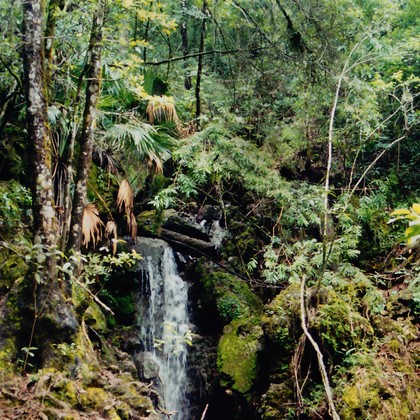
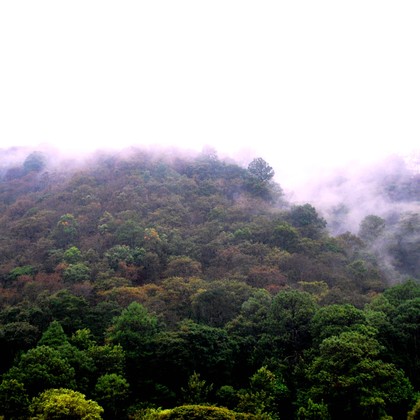
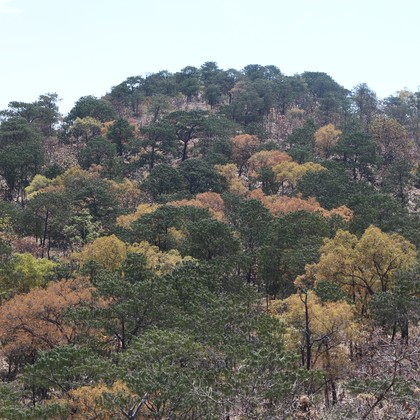
Oak woodland, pine-oak forest and cloud forest in the mountains; in Baja California also oak woodland and chaparral. It forages deliberately among the foliage for insects and outside the breeding season often joins mixed flocks.
Where the bird is most at home, classified by the vegetation units of Mexico and Central America.

Range and movements
In the guide area in northern Baja California and the Sierra de la Laguna in the south of the peninsula, and in the highlands of northern and central Mexico south to Guatemala. Outside the guide area along the west coast of North America north to south-western Canada and in the mountains of Arizona, New Mexico and Texas.
- Resident
- dark = core range, pale = thinly spread
How and when to look
Best found in mixed flocks in oak and pine-oak forest in the mountains. Note the broken eye-ring and the thick bill.
Conservation status
Not threatened. Fairly common in suitable woodland.
Scientific name
Vireo huttoni | Cassin, 1851
Cassin described the species in 1851 and placed it straight away in the genus where it still stands. The genus Vireo was introduced in 1808 by Vieillot. Vireo was used by Latin authors for a small, green, migratory bird, probably the Eurasian golden oriole, though the European greenfinch has also been suggested. huttoni honours the American surveyor, artist and naturalist William Rich Hutton (1826–1901), who worked in California. The specimen the first description was based on came from Monterey, California (USA).