All species › Waders, gulls and terns › Plovers and lapwings › Killdeer
Position in the tree Birds Aves › Birds with a flexible palate Neognathae › All other modern birds Neoaves › Birds of the elements Elementaves › Cranes and waders Gruimorphae
Killdeer | Charadrius vociferus
Killdeerplevier | Chorlitejo culirrojo
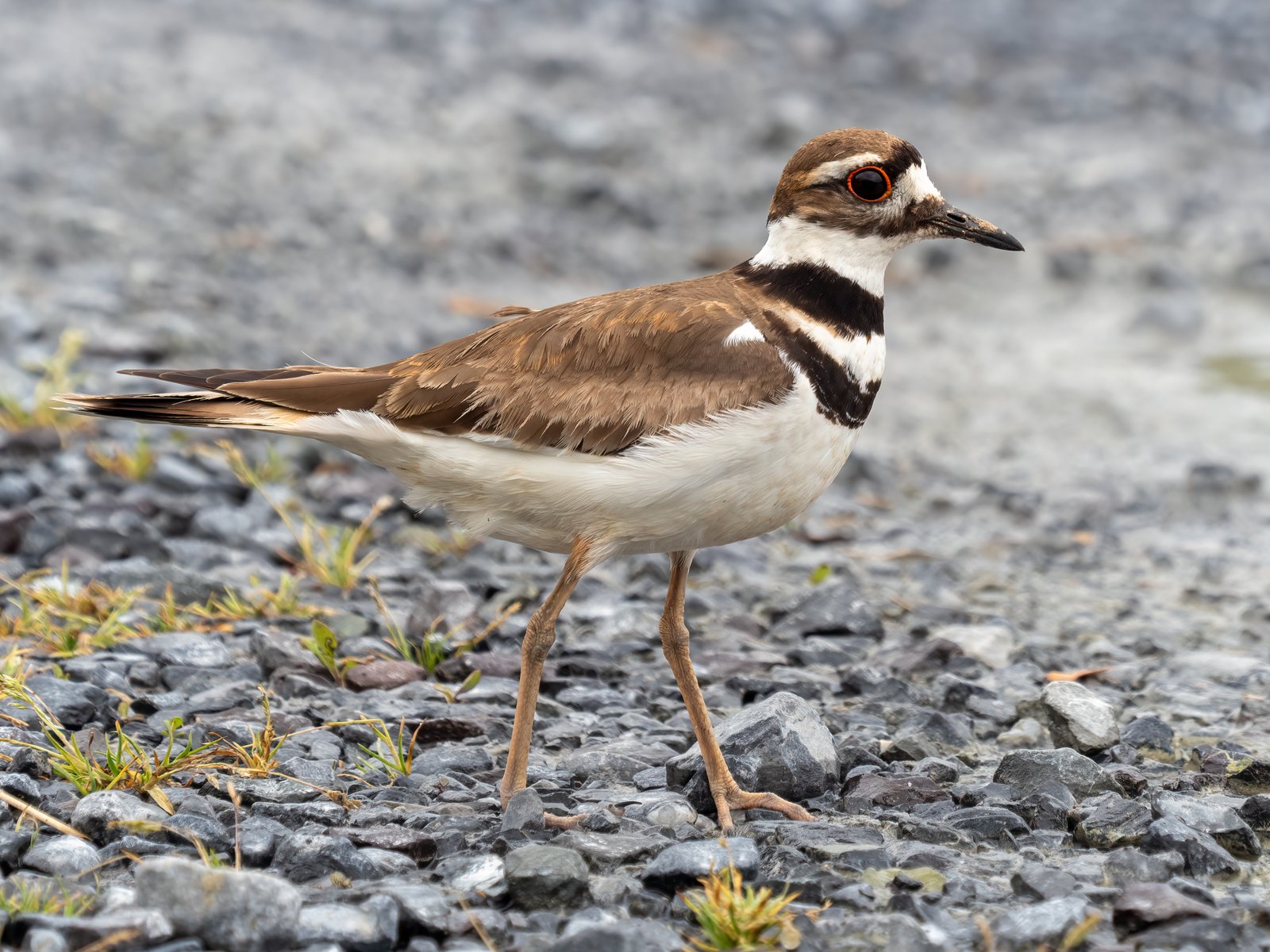
The Killdeer is a large, long-tailed plover with two black breast bands, the most widespread plover of North America. It lives not only by water but also on pastures, fields, sports grounds and waste ground. In northern and central Mexico it breeds and is present all year; further south, to Panama, it is mainly a winter visitor. Its shrill call, from which it takes its name, usually gives it away before it is seen.
Voice
Noisy and heard day and night: a shrill, repeated kill-dee or dee-ee, and when excited a rapid trilling ti-ti-ti-tirrr. When disturbed near the nest or young, it calls incessantly.
Recording: Rory Nefdt — CC BY-NC-SA 4.0 · converted to mono · xeno-canto
Identification
20–28 cm, with a fairly long tail. Upperparts plain brown, underparts white, with two black breast bands: a complete band around the neck and a second across the breast. The face shows a white forehead patch, a black band above the forehead and a white stripe behind the eye; the eye-ring is red. The bill is black, the legs flesh-grey. In flight the orange-rufous rump and tail base, a broad white wing bar and the dark tail band with white edges are distinctive. Juveniles have pale fringes to the feathers of the upperparts; downy chicks show only one breast band. At the nest the adult draws intruders away with a broken-wing display.
Confusion species
Semipalmated Plover Charadrius semipalmatus and Wilson's Plover Anarhynchus wilsonia have only one breast band and are smaller and shorter-tailed; the former has a short orange-and-black bill, the latter a heavy black bill. Collared Plover Anarhynchus collaris is much smaller, with a single narrow breast band and no rufous rump. No other plover in the guide area has two breast bands and an orange-rufous rump.
Habitat
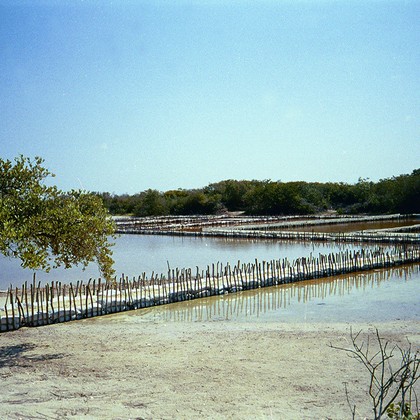
Open ground with bare soil or short grass, often but not always near water: pastures, fields, rice paddies, the shores of lakes, reservoirs and rivers, wet grassland, sports grounds, airfields and gravel roads; on the coast at lagoons and salt pans. It breeds on the plateau to above 2500 m. The nest is a bare scrape on the ground, sometimes on gravel beds or flat roofs.
Where the bird is most at home, classified by the vegetation units of Mexico and Central America.




Range and movements
As a breeding bird in Baja California and in the north and on the central plateau of Mexico, south to the states around Mexico City. In winter spread over almost all of Mexico and Central America, common in the north of the guide area and scarcer towards the south, to Panama; the winter visitors come from North America. Beyond the guide area it breeds from southern Alaska and Canada through the United States, on the Bahamas and the Greater Antilles, and with a separate subspecies along the coast of Ecuador, Peru and northern Chile.
- Resident
- dark = core range, pale = thinly spread
How and when to look
Pastures, sports fields and the shores of reservoirs on the Mexican plateau, for example around Mexico City and in the Bajío, are reliable year-round. In Central America in winter wet pastures and rice fields, such as around Palo Verde in Costa Rica, and the farmland of Petén and Belize are good places. The call is usually the first sign.
Conservation status
Near Threatened. The species is still common, but numbers in North America have been declining for decades, probably through changes in farming and the use of pesticides. In the guide area the Killdeer benefits from open farmland; there are no data on a trend.
Scientific name
Charadrius vociferus | Linnaeus, 1758
Linnaeus described the species in 1758 and placed it straight away in the genus where it still stands. He introduced the genus Charadrius in that same work. Charadrius is Late Latin, from Ancient Greek kharadrios, a plain-coloured nocturnal bird of ravines and river valleys, from kharadra 'ravine'. vociferus is Latin, from vox 'cry' and ferre 'to bear': loud-calling. The specimen the first description was based on came from South Carolina.