All species › Passerines › Finches, euphonias and allies › Lawrence's Goldfinch
Position in the tree Birds Aves › Birds with a flexible palate Neognathae › All other modern birds Neoaves › Landbirds Telluraves › Falcons, parrots and passerines Australaves › Falcons and passerines Eufalconimorphae › Parrots and passerines Psittacopasserae
Lawrence's Goldfinch | Spinus lawrencei
Maskergeelvink | Jilguero de Lawrence
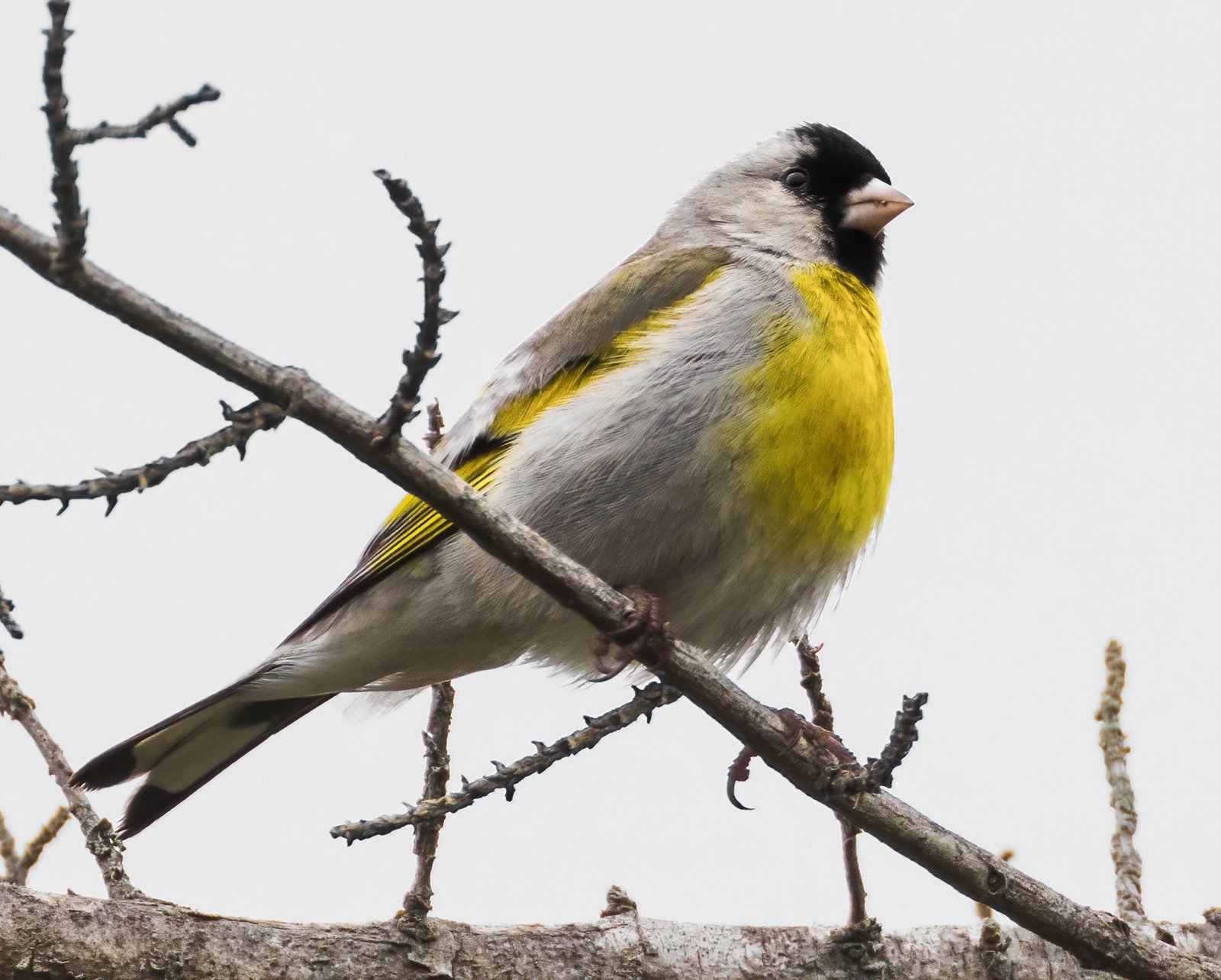
Lawrence's Goldfinch is a grey goldfinch with a black face and yellow on the breast and wings. It breeds in the dry oak woodland and chaparral of California and northern Baja California and wanders unpredictably beyond. In some winters it moves east as far as Sonora and Chihuahua.
Voice
It calls a clear, bell-like tinkle-oo or tink-oo. The song is a high, tinkling twitter, often with imitations of the calls of other birds.
Recording: Paul Marvin — CC BY-NC-SA 4.0 · shortened to the first 60 s, mono · xeno-canto
Identification
10–11 cm. Mainly grey, with a short, pinkish-grey bill. The male has a black forehead, face and chin, a yellow patch on the breast and black wings with broad yellow wing bars and yellow edges; the tail is black with a white band. The female lacks the black face, is browner grey and has less yellow on the breast and wings. In winter both sexes are duller.
Confusion species
Female Lesser Goldfinch Spinus psaltria is olive-green and yellow, never grey, and has a white wing patch. American Goldfinch Spinus tristis in winter is brownish olive with white undertail coverts and pale wing bars, without yellow on the breast.
Habitat
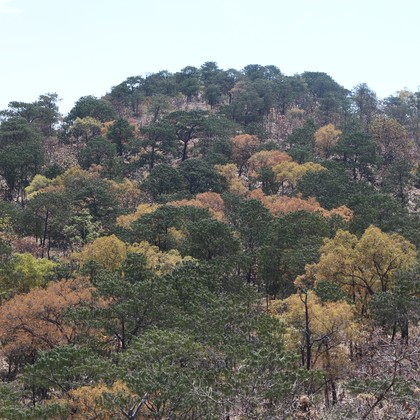
Dry oak woodland, chaparral, pinyon-juniper woodland and open woodland along streams in hills and low mountains, always near water. In winter also in weedy fields, desert washes and scrub. It eats mainly seeds of herbs.
Where the bird is most at home, classified by the vegetation units of Mexico and Central America.



Range and movements
Breeds in California and northern Baja California. Winters in California, Arizona and south-western New Mexico and irregularly in north-western Mexico, mainly in Sonora and northern Chihuahua. In the guide area therefore mainly in northern Baja California and, in winter, in the north-west of the mainland.
- Resident
- Summer visitor (c. Apr–Sep)
- Winter visitor (c. Oct–Mar)
- Passage (Mar–Apr, Oct–Nov)
- dark = core range, pale = thinly spread
How and when to look
In the breeding season best found at drinking spots in oak woodland and chaparral in the mountains of northern Baja California; listen for the tinkling call.
Conservation status
Not threatened (LC). Small and highly variable numbers; the birds shift from year to year, making trends hard to track. Development and the loss of oak woodland and water sources are the main threats.
Scientific name
Spinus lawrencei | (Cassin, 1850)
Cassin described the species in 1850 as Carduelis Lawrencei; because it was later moved to another genus, the author and year stand in brackets. The genus Spinus was introduced in 1816 by Koch. Spinus goes back to Ancient Greek spinos, a name for a small bird that can no longer be identified with certainty. lawrencei honours the American businessman and ornithologist George Newbold Lawrence (1806–1895). The specimen the first description was based on came from Sonoma, California (USA).