All species › Passerines › Finches, euphonias and allies › American Goldfinch
Position in the tree Birds Aves › Birds with a flexible palate Neognathae › All other modern birds Neoaves › Landbirds Telluraves › Falcons, parrots and passerines Australaves › Falcons and passerines Eufalconimorphae › Parrots and passerines Psittacopasserae
American Goldfinch | Spinus tristis
Treursijs | Jilguero canario
The American Goldfinch is a North American finch whose male is bright yellow in summer with a black forehead and black wings. In the guide area it is mainly a winter visitor to northern and central Mexico, then in a brownish-olive winter plumage. Flocks feed in weedy fields, along rivers and in gardens.

Voice
In flight a characteristic, undulating per-chick-o-ree, repeated on each bound; also a rising too-wee. The song is a long, lively series of twitters and trills, heard mainly towards the end of winter.
Recording: Don Profota — CC BY-NC-SA 4.0 · converted to mono · xeno-canto
Identification
11–13 cm. Bill conical, dark in winter, orange-pink in summer. Breeding male bright yellow with a black forehead, black wings with a white wing bar and a black tail with white. The female is olive-yellow with blackish wings. In winter plumage both sexes are brownish olive to grey-brown with a yellow wash on the throat and face, blackish wings with broad pale wing bars and white undertail coverts; the male has a yellow shoulder patch.
Confusion species
Lesser Goldfinch Spinus psaltria is smaller, has a white patch at the base of the primaries and yellow, not white, undertail coverts; females are greener and yellower. Lawrence's Goldfinch Spinus lawrencei is grey with yellow on the breast and yellow wing bars. Pine Siskin Spinus pinus is streaked throughout.
Habitat
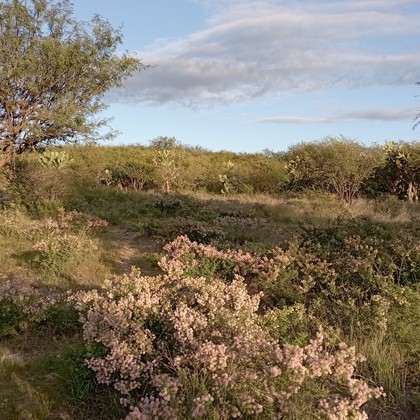
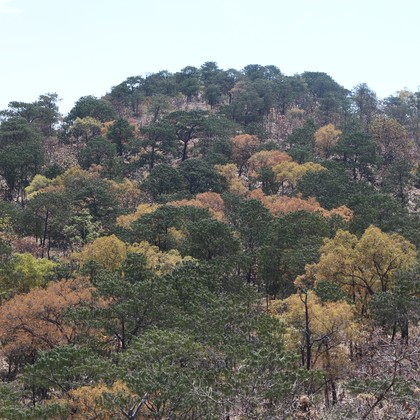
In winter open country with weeds and thistles, fields, riparian woodland along rivers, scrub, parks, gardens and feeders, from the lowlands to the highlands. In northern Baja California it breeds in riparian and open woodland. It eats almost exclusively seeds. It lives in flocks, often together with other goldfinches.
Where the bird is most at home, classified by the vegetation units of Mexico and Central America.


Range and movements
Breeds in southern Canada and much of the United States, and locally in northern Baja California. Winters in the United States and in northern and central Mexico, south to about Jalisco, Michoacán, the Valley of Mexico and Veracruz; rare further south.
- Winter visitor (c. Oct–Mar)
- dark = core range, pale = thinly spread
How and when to look
In winter often with flocks of Lesser Goldfinches in weedy fields and along rivers in northern Mexico; the undulating flight with its accompanying call makes it identifiable even at a distance.
Conservation status
Not threatened (LC). Very numerous in North America; in the guide area a fairly common winter visitor in the north, scarcer to the south. Numbers vary from winter to winter.
Scientific name
Spinus tristis | (Linnaeus, 1758)
Linnaeus described the species in 1758 as Fringilla tristis; because it was later moved to another genus, the author and year stand in brackets. The genus Spinus was introduced in 1816 by Koch. Spinus goes back to Ancient Greek spinos, a name for a small bird that can no longer be identified with certainty. tristis is Latin for 'sad, sorrowful'; why Linnaeus gave this bright yellow finch that name is unclear. The specimen the first description was based on came from South Carolina (USA).