All species › Tubenoses › Northern storm petrels › Leach's Storm-Petrel
Position in the tree Birds Aves › Birds with a flexible palate Neognathae › All other modern birds Neoaves › Birds of the elements Elementaves › Tropicbirds and waterbirds Phaethoquornithes › Core waterbirds Aequornithes
Leach's Storm-Petrel | Hydrobates leucorhous
Vaal stormvogeltje | Paíño boreal
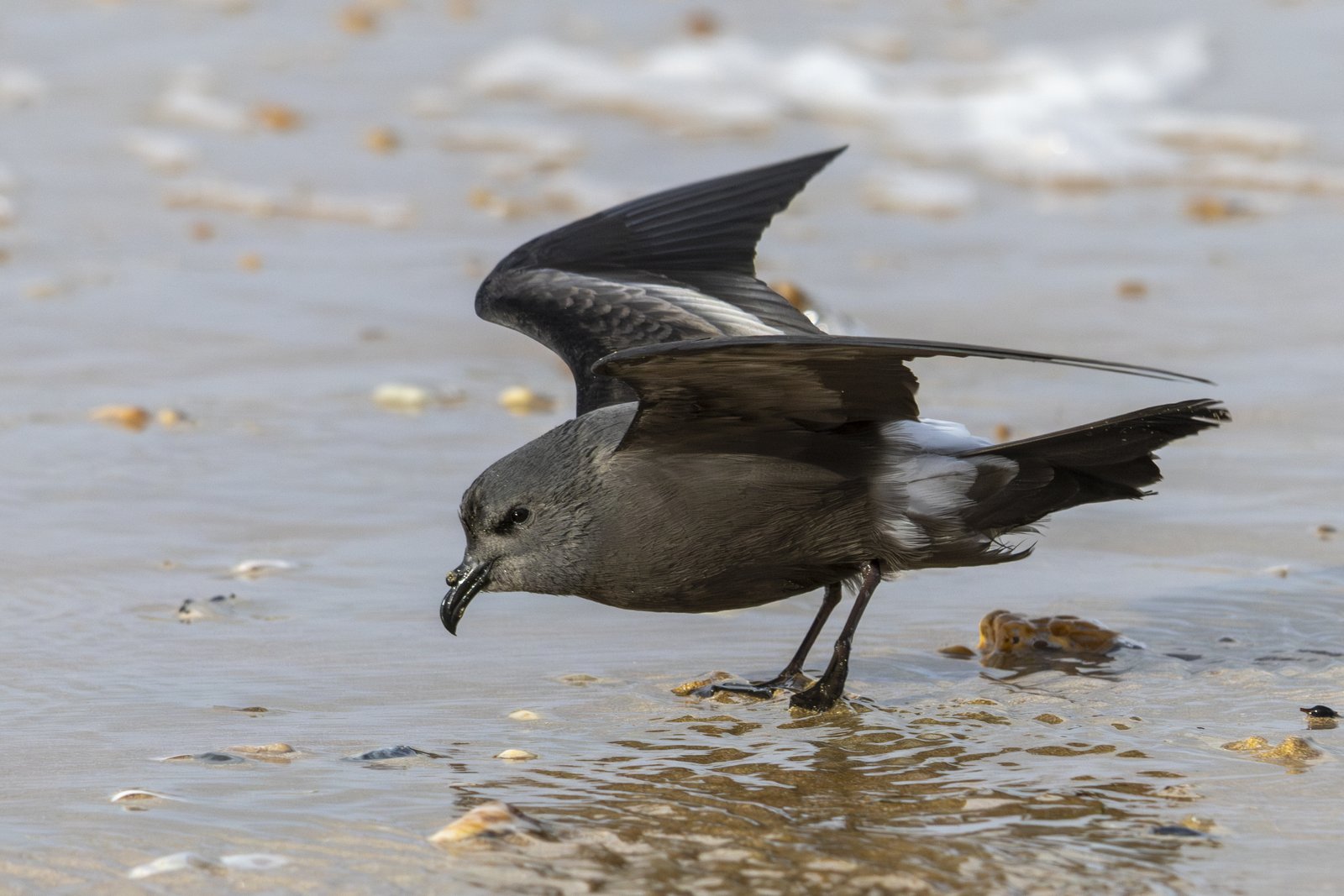
Leach's Storm-Petrel is a medium-sized, dark brown storm petrel with long, angled wings, a forked tail and a bounding, erratic flight. It breeds in the northern Atlantic and Pacific and winters on tropical seas. In the guide area small populations breed on islands off Baja California, partly with a dark rump; birds from the north migrate along the Pacific coast and winter far offshore to off Panama.
Voice
Almost silent at sea. At the colony a sustained, rhythmic purring comes from the burrows at night, and in flight an excited, rattling, laughing chatter.
Recording: Doug Hynes — CC BY-SA 4.0 · converted to mono · xeno-canto
Identification
18–22 cm. A medium-sized storm petrel with long, angular wings clearly bent at the wrist and a deeply forked tail. The plumage is sooty brown, with a conspicuous pale brown band across the upperwing coverts. In most birds the rump is white, usually divided by a grey central line and hardly extending onto the sides of the undertail coverts; in some of the breeding birds of Baja California the rump is grey or entirely dark. Male, female and young birds are alike. The flight is bounding and erratic, with deep beats and sudden changes of direction, recalling a nightjar.
Confusion species
Townsend's Storm Petrel Hydrobates socorroensis and Ainley's Storm Petrel Hydrobates cheimomnestes, both breeding off Guadalupe, are smaller, with shorter wings and a shallower tail fork; dark-rumped birds in particular often cannot be separated with certainty at sea. The Band-rumped Storm Petrel Hydrobates castro has a broad, undivided, square-cut rump band, a shallower tail fork and an even flight with stiff beats. The Wedge-rumped Storm Petrel Hydrobates tethys is smaller, with a much larger, wedge-shaped white rump patch. The Black Storm Petrel Hydrobates melania is larger, entirely dark and flies with slow, deep beats.
Habitat
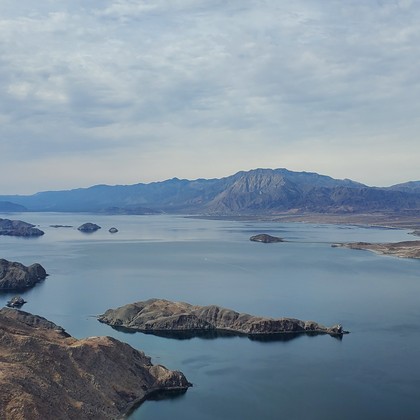
Open ocean beyond the continental shelf, often over the shelf edge and deep water; rarely comes close inshore. Takes small crustaceans, fish and small squid from the surface in flight, mainly at night. Breeds in self-dug burrows and rock crevices on islands.
Where the bird is most at home, classified by the vegetation units of Mexico and Central America.


Range and movements
Breeds in the northern Atlantic and in the northern Pacific, from Japan and the Aleutians to California. In the guide area the species breeds on the Coronado Islands and the San Benito Islands off the Pacific coast of Baja California; the breeders of the San Benito Islands belong to the subspecies H. l. chapmani, with mostly dark rumps. Birds from the north move south in autumn and winter on the open sea off the Pacific coast of Mexico and Central America to Panama and further south. Scarce in the Gulf of Mexico in summer, over deep water. Because little observation takes place on the open sea, the non-breeding distribution is incompletely known.
- Resident
- Summer visitor (c. Apr–Sep)
- Winter visitor (c. Oct–Mar)
- Passage (Mar–Apr, Oct–Nov)
- dark = core range, pale = thinly spread
How and when to look
The best chance is on boat trips far off Baja California in summer, and in winter on trips over deep water off the Pacific coast of southern Mexico and Central America. Look for the long, angled wings, the forked tail and the bounding flight.
Conservation status
Vulnerable. The world population is large, but has declined sharply in several of the largest colonies in the northern Atlantic. Causes include predation by gulls and introduced mammals, artificial light from ships, oil platforms and coastal towns, and plastic and oil at sea. Introduced cats and rats have been removed from several breeding islands off Baja California.
Scientific name
Hydrobates leucorhous | (Vieillot, 1818) (GBIF: Oceanodroma leucorhoa)
Vieillot described the species in 1818 as Procellaria leucorhoa; because it was later moved to another genus, the author and year stand in brackets. The genus Hydrobates was introduced in 1822 by Boie. Hydrobates is Greek, from hudro- 'water' and batēs 'walker': 'water walker'. leucorhous is Greek, from leukos 'white' and orrhos 'rump', after the white rump band. The specimen the first description was based on came from the coast of Picardy.