All species › Passerines › Shrikes › Loggerhead Shrike
Position in the tree Birds Aves › Birds with a flexible palate Neognathae › All other modern birds Neoaves › Landbirds Telluraves › Falcons, parrots and passerines Australaves › Falcons and passerines Eufalconimorphae › Parrots and passerines Psittacopasserae
Loggerhead Shrike | Lanius ludovicianus
Amerikaanse klapekster | Alcaudón verdugo
The Loggerhead Shrike is a grey, black and white songbird with a black mask and a hooked bill that hunts from a lookout perch. It impales prey on thorns or barbed wire. In the guide area it lives in open country in northern and central Mexico.

Voice
Usually silent. Calls with hoarse, rasping notes. The song consists of repeated short phrases and buzzy or grating notes.
Recording: Manuel Grosselet — CC BY-NC-SA 4.0 · shortened to the first 60 s, mono · xeno-canto
Identification
20–23 cm. Upperparts grey, underparts whitish. Broad black mask that continues across the forehead above the base of the bill. Wings black with a white patch at the base of the primaries, conspicuous in flight. Tail black with white sides. Bill short, black and hooked. Young birds browner grey with fine vermiculations on the underparts.
Confusion species
Northern Mockingbird Mimus polyglottos has similar grey and white plumage and white wing patches, but lacks the black mask, has a thin bill and a longer tail, and flies more floppily.
Habitat
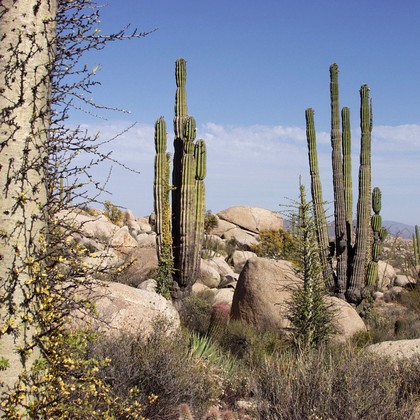
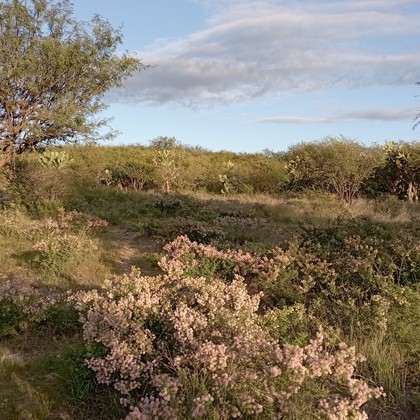
Open country with scattered shrubs, posts and wires as lookouts: grasslands, semi-desert, desert scrub, fields and pastures, also along roads and on the edges of villages. Hunts large insects, lizards, small rodents and small birds.
Where the bird is most at home, classified by the vegetation units of Mexico and Central America.





Range and movements
Resident in Baja California and northern and central Mexico, south to about Oaxaca. In winter it is joined by migrants from North America. Outside the guide area in much of the United States and southern Canada.
- Resident
- dark = core range, pale = thinly spread
How and when to look
Best seen on posts, wires and isolated shrubs along roads through open, dry country in northern Mexico.
Conservation status
Near Threatened. It has declined strongly over a long period in North America, probably through changes in farming and land use and through pesticides; in Mexico it is still locally fairly common.
Scientific name
Lanius ludovicianus | Linnaeus, 1766
Linnaeus described the species in 1766 and placed it straight away in the genus where it still stands. The genus Lanius was introduced in 1758 by Linnaeus. Lanius is Latin for 'butcher', from shrikes' habit of impaling prey on thorns and barbed wire. ludovicianus is Latin for 'of Louisiana' (named after Louis XIV, Ludovicus), where the type came from. The specimen the first description was based on came from Louisiana (USA).