All species › Passerines › Crows, jays and magpies › White-throated Jay
Position in the tree Birds Aves › Birds with a flexible palate Neognathae › All other modern birds Neoaves › Landbirds Telluraves › Falcons, parrots and passerines Australaves › Falcons and passerines Eufalconimorphae › Parrots and passerines Psittacopasserae
White-throated Jay | Cyanolyca mirabilis
Maskergaai | Chara garganta blanca
The White-throated Jay is a small, dark blue jay of the montane forest of the Sierra Madre del Sur, with a black head, a white band across the forehead and over the eye, and a white throat. It lives in small groups in humid, epiphyte-rich forest and occurs only in Guerrero and Oaxaca.

Voice
Various loud, somewhat nasal calls, used by groups to keep in contact as they move through the forest.
Recording: Matthew L. Brady — CC BY-NC-SA 4.0 · shortened to the first 60 s, mono · xeno-canto
Identification
23–25 cm, including the fairly long tail. Head mostly black, with a white band across the forehead continuing as a white stripe over the eye to the side of the head. Throat white, bordered by black. Back, wings, tail and underparts dark blue to bluish grey. Bill and legs black. Sexes alike.
Confusion species
Unicolored Jay Aphelocoma unicolor is larger and uniformly blue, without white on the head and throat. Steller's Jay Cyanocitta stelleri has a prominent crest and lacks the white throat. Dwarf Jay Cyanolyca nanus is smaller, has a pale throat without a white forehead band and lives further north in Oaxaca, Puebla and Veracruz.
Habitat
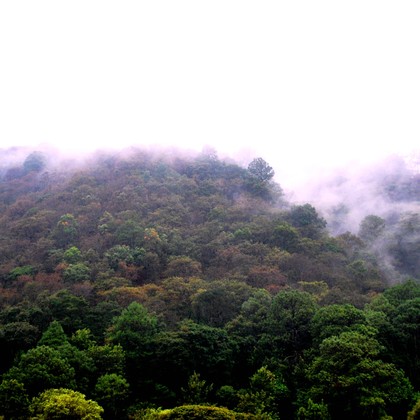
Humid pine-oak forest, cloud forest and fir forest high in the mountains, rich in mosses and epiphytes. It forages for insects and other invertebrates in the middle and upper levels of the forest, usually in pairs or small groups.
Where the bird is most at home, classified by the vegetation units of Mexico and Central America.

Range and movements
Endemic to Mexico: only in the Sierra Madre del Sur of Guerrero and southern Oaxaca. The entire range lies within the guide area.
- Resident
- dark = core range, pale = thinly spread
How and when to look
Omiltemi near Chilpancingo in Guerrero is a well-known site for this species. Groups are often detected first by their calls.
Conservation status
Vulnerable. The range is small and fragmented, and the montane forest on which the species depends is being lost to logging and clearance.
Scientific name
Cyanolyca mirabilis | Nelson, 1903
Nelson described the species in 1903 and placed it straight away in the genus where it still stands. The genus Cyanolyca was introduced in 1851 by Cabanis. Cyanolyca is Greek, from kuanos 'dark blue' and lukos, a crow-like bird (perhaps the jackdaw) in Aristotle and Hesychius. mirabilis is Latin for 'wonderful, marvellous', after the striking black-and-white head pattern. The specimen the first description was based on came from Omiltemi, Guerrero, Mexico.