All species › Swifts › Hummingbirds › Long-billed Hermit
Position in the tree Birds Aves › Birds with a flexible palate Neognathae › All other modern birds Neoaves › Birds of the elements Elementaves › Nightjars and swifts Strisores
Long-billed Hermit | Phaethornis longirostris
Westelijke langstaartheremietkolibrie | Ermitaño piquilargo
The Long-billed Hermit is the hermit most often seen, and above all heard, in the humid lowlands of the guide area. Males gather in leks in the understorey, where they repeat the same shrill note for hours. The species was formerly considered one species together with Long-tailed Hermit Phaethornis superciliosus of Amazonia and Mexican Hermit of western Mexico.
Voice
The call is a sharp squeek, often in flight. At the lek each male repeats a shrill, short squeek or skwee-ik for long periods while wagging its tail; a lek with dozens of males can be heard from afar.
Recording: Niels Krabbe — CC BY-NC-SA 4.0 · shortened to the first 60 s, mono · xeno-canto
Identification
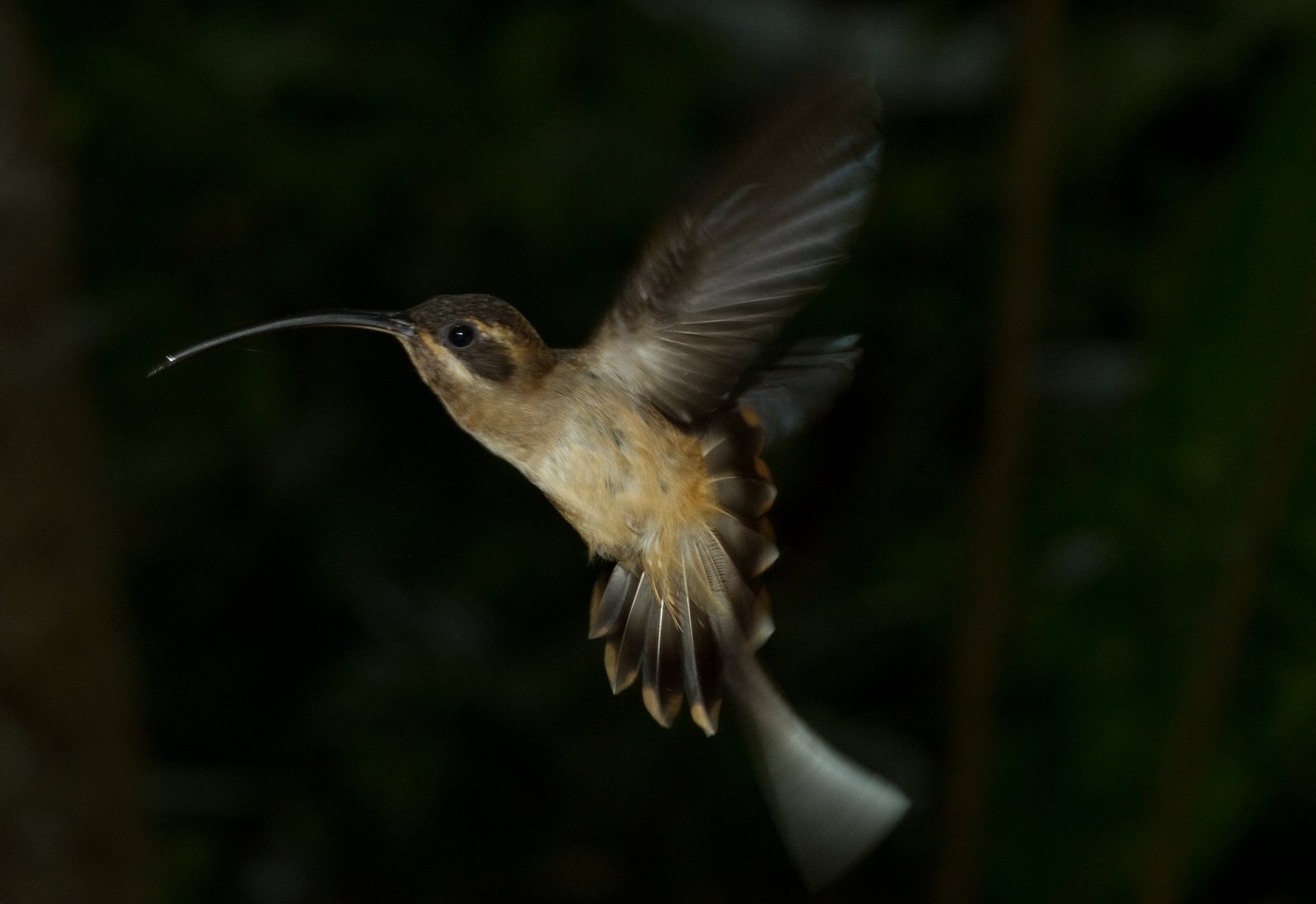
12–13 cm excluding the elongated, white-tipped central tail feathers, which project a further 2 cm or so beyond the tail. The bill is long, about 4 cm, and curved, with a black upper mandible and a yellow to orange lower mandible. The upperparts are bronze-green to olive, with a buff-scaled rump and uppertail coverts. The underparts are grey-brown to buff. A black mask runs through the eye, bordered by a buff stripe above and a buff moustachial stripe, with a dark throat stripe between them. The sexes are almost alike.
Confusion species
Green Hermit Phaethornis guy usually lives higher up, is dark green with a blue-green rump and has a red lower mandible. Stripe-throated Hermit Phaethornis striigularis is much smaller, cinnamon below, with a shorter bill. Pale-bellied Hermit Phaethornis anthophilus of eastern Panama has whitish underparts, a less curved bill and a less distinct mask. Bronzy Hermit Glaucis aeneus and Rufous-breasted Hermit Glaucis hirsutus are rufous below and lack elongated central tail feathers.
Habitat
Understorey of humid lowland forest, rainforest and foothill forest, gallery forest, old secondary forest and heliconia thickets along streams and forest edges, from sea level to about 1000 m, locally to 1500 m. Also in shady cacao and coffee plantations at the forest edge. It forages along a fixed route at heliconias, Costus and other flowers with a long corolla. The cone-shaped nest hangs from the underside of the tip of a palm or heliconia leaf.
Where the bird is most at home, classified by the vegetation units of Mexico and Central America.






Range and movements
In Mexico on the Gulf side from southern Veracruz and northern Oaxaca through Tabasco to Chiapas and southern Campeche, and on through Belize, Guatemala, Honduras and Nicaragua, as far as Nicaragua mainly on the Caribbean side. In Costa Rica and Panama on both sides of the country, on the Pacific side mainly in southern Costa Rica and on into Panama. Common. Outside the guide area in northern Colombia and Venezuela and along the Pacific side to western Ecuador and north-western Peru.
- Resident
- dark = core range, pale = thinly spread
How and when to look
A lek is usually heard before it is seen: the persistent squeek of the males rings out along forest trails such as Pipeline Road in the Canal Area of Panama, around La Selva in Costa Rica and in the forest of Tikal and Palenque. At flowering heliconias along a trail the bird returns regularly along its route.
Conservation status
Not threatened. Widespread and common; it tolerates secondary forest but disappears where the understorey disappears.
Scientific name
Phaethornis longirostris | (Delattre, 1843)
Delattre described the species in 1843 as Ornismya longirostris; because it was later moved to another genus, the author and year stand in brackets. The genus Phaethornis was introduced in 1827 by Swainson. Phaethornis is Greek, from phaethōn 'sun, shining' and ornis 'bird': 'sun-bird'. longirostris is Latin, from longus 'long' and rostrum 'bill', after the long, curved bill. The specimen the first description was based on came from Guatemala.