All species › Passerines › Silky-flycatchers › Long-tailed Silky-flycatcher
Position in the tree Birds Aves › Birds with a flexible palate Neognathae › All other modern birds Neoaves › Landbirds Telluraves › Falcons, parrots and passerines Australaves › Falcons and passerines Eufalconimorphae › Parrots and passerines Psittacopasserae
Long-tailed Silky-flycatcher | Ptiliogonys caudatus
Langstaartzijdevliegenvanger | Capulinero colilargo
The Long-tailed Silky-flycatcher is a slim, blue-grey bird with a bushy yellow crest and a long, graduated tail. It often sits in small groups in the tops of trees at forest edges and catches insects in flight from there. It occurs only in the highlands of Costa Rica and western Panama.

Voice
Groups call with dry, ticking chet and chirrup notes, also in flight.
Recording: Nick Talbot — CC BY-NC-SA 4.0 · converted to mono · xeno-canto
Identification
11–12 cm without the tail; with the long, graduated tail about 22–24 cm, shorter in the female. The male has a yellowish head with a bushy yellow crest, a blue-grey body, yellow-olive flanks and yellow undertail coverts. Wings and tail black, the tail with white patches on the underside. The female is duller and more olive-grey, with a shorter tail.
Confusion species
Black-and-yellow Phainoptila Phainoptila melanoxantha is stockier, has no crest, a much shorter tail and a black or olive-green back. No other long-tailed silky-flycatchers occur in Costa Rica and Panama.
Habitat
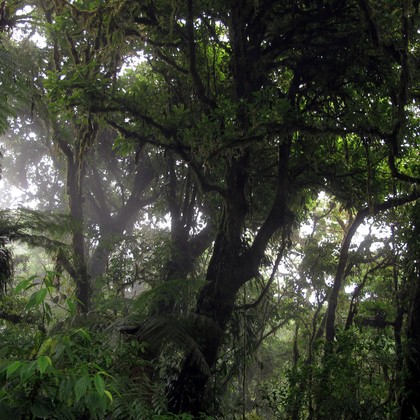
Edges of montane forest, clearings with tall trees, pasture with scattered trees and gardens in the highlands, mostly above about 1800 m up to the treeline. It eats berries, especially of mistletoe, and insects caught in flight. Outside the breeding season groups wander to places with fruit.
Where the bird is most at home, classified by the vegetation units of Mexico and Central America.


Range and movements
Only in the highlands of Costa Rica (Cordillera Central and Cordillera de Talamanca) and western Panama (mainly Chiriquí). Not outside the guide area.
- Resident
- dark = core range, pale = thinly spread
How and when to look
Often easy to see in the San Gerardo de Dota valley in Costa Rica and around Boquete and Volcán Barú in Panama, on dead branches in the tops of tall trees.
Conservation status
Not threatened. Fairly common in the mountains within a small range.
Scientific name
Ptiliogonys caudatus | Cabanis, 1861 (GBIF: Ptilogonys caudatus)
Cabanis described the species in 1861 and placed it straight away in the genus where it still stands. The genus Ptiliogonys was introduced in 1827 by Swainson. Ptiliogonys is Greek, from ptilon 'feather' and gonu 'knee': 'feathered knee', after the tuft of cottony feathers on the thighs. caudatus is Latin for 'tailed', from cauda 'tail', after the long tail. The specimen the first description was based on came from Irazú, Costa Rica.