All species › Passerines › Silky-flycatchers › Grey Silky-flycatcher
Position in the tree Birds Aves › Birds with a flexible palate Neognathae › All other modern birds Neoaves › Landbirds Telluraves › Falcons, parrots and passerines Australaves › Falcons and passerines Eufalconimorphae › Parrots and passerines Psittacopasserae
Grey Silky-flycatcher | Ptiliogonys cinereus
Grijze zijdevliegenvanger | Capulinero gris
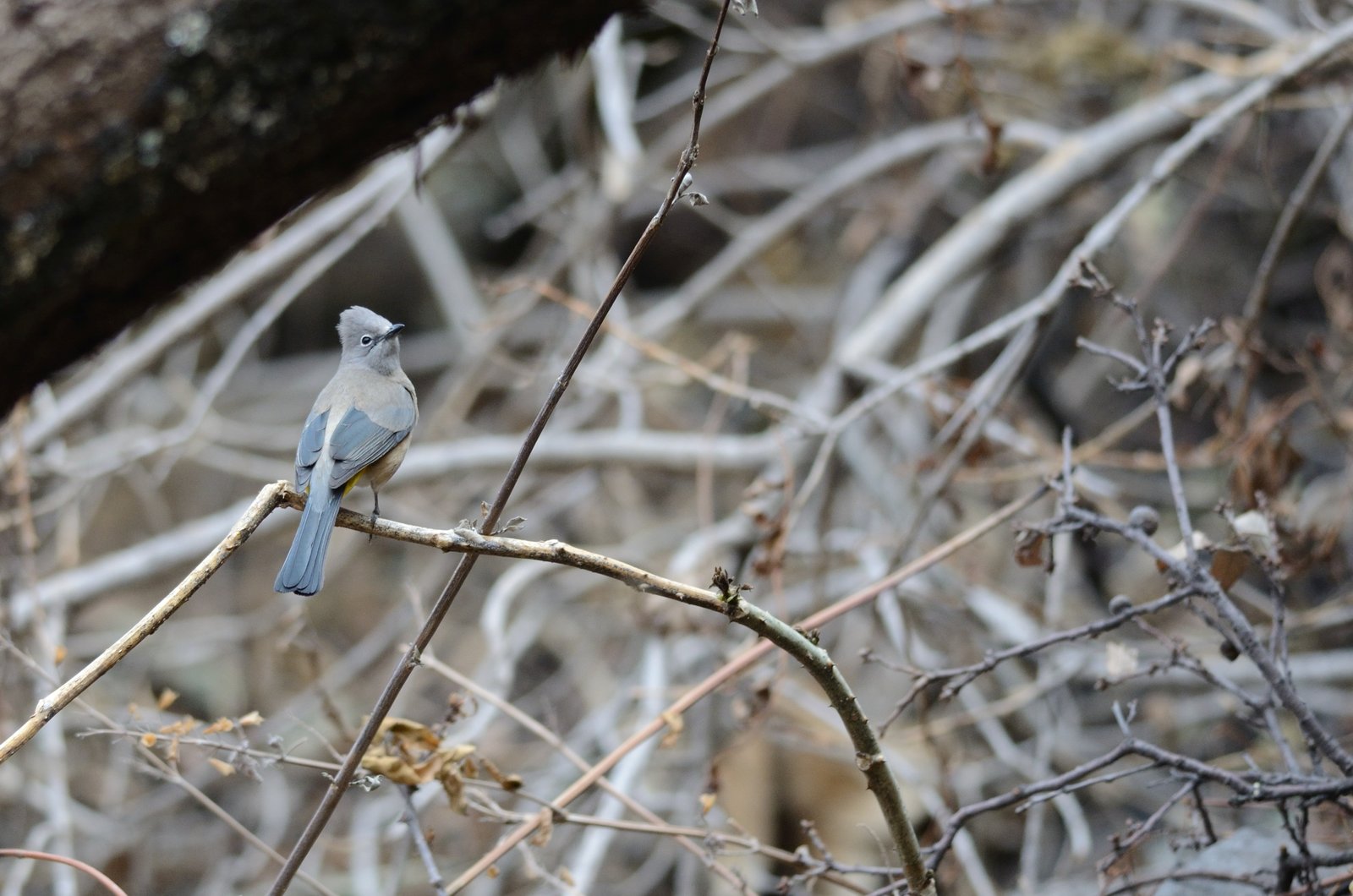
The Grey Silky-flycatcher is a slim, grey bird with a bushy crest, a fairly long tail and yellow undertail coverts. It moves in noisy small groups through montane forest and catches insects in flight from high branches. In the guide area it lives in the mountains of Mexico and further south to Honduras.
Voice
Dry, clicking calls such as che-chek or chi-chi-rup, especially in flight and in groups.
Recording: Matthew L. Brady — CC BY-NC-SA 4.0 · shortened to the first 60 s, mono · xeno-canto
Identification
18–21 cm, with a fairly long tail. The male is blue-grey, with a paler, grey-white head and crest and a broken white eye-ring; flanks olive-yellow, undertail coverts bright yellow. Wings and tail blackish, the tail with a broad white band halfway, best seen from below. The female is browner grey and duller, with the same pattern.
Confusion species
Cedar Waxwing Bombycilla cedrorum is brown-grey, with a black mask, a yellow belly and a yellow tail tip. The female Phainopepla Phainopepla nitens is plain dark grey with a red eye and lacks the yellow under the tail; it lives in dry lowlands, not in montane forest.
Habitat
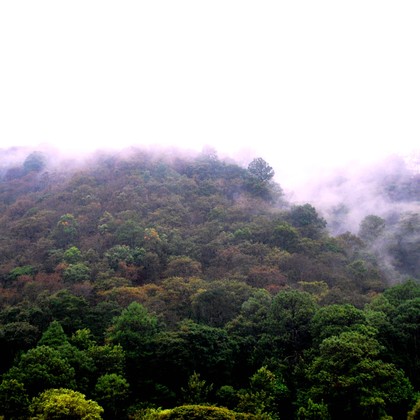
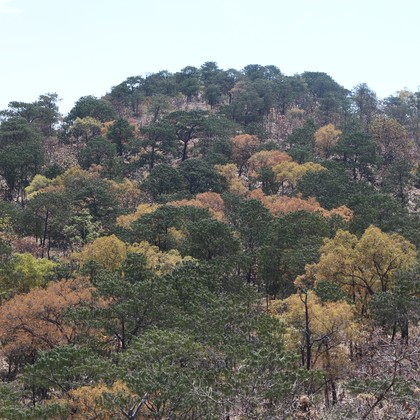
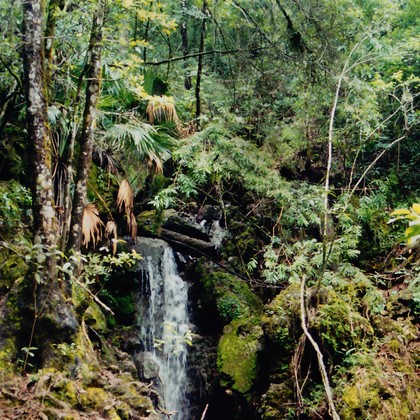
Pine-oak forest, cloud forest and coniferous forest in the mountains, with forest edges and clearings, also parks and gardens in mountain villages and towns. It eats berries, especially of mistletoe, and catches insects in flight. Outside the breeding season groups wander to places with fruit, partly also at lower elevations.
Where the bird is most at home, classified by the vegetation units of Mexico and Central America.


Range and movements
In the guide area in the Sierra Madre Occidental and Sierra Madre Oriental, the volcanic belt of central Mexico and the mountains of Guerrero, Oaxaca and Chiapas, and further south through the highlands of Guatemala and El Salvador to Honduras. Outside the guide area a rare vagrant to the southern United States.
- Resident
- dark = core range, pale = thinly spread
How and when to look
Groups often perch on dead branches at the top of tall trees or on wires along roads in montane forest, and are recognised by their dry calls.
Conservation status
Not threatened. Widespread and locally common in montane forest.
Scientific name
Ptiliogonys cinereus | Swainson, 1827 (GBIF: Ptilogonys cinereus)
Swainson described the species in 1827 and placed it straight away in the genus where it still stands. He introduced the genus Ptiliogonys in that same work. Ptiliogonys is Greek, from ptilon 'feather' and gonu 'knee': 'feathered knee', after the tuft of cottony feathers on the thighs. cinereus is Latin for 'ash-grey', from cinis 'ashes', after the grey plumage. The specimen the first description was based on came from Temascaltepec, State of México, Mexico.