All species › Swifts › Hummingbirds › Mangrove Hummingbird
Position in the tree Birds Aves › Birds with a flexible palate Neognathae › All other modern birds Neoaves › Birds of the elements Elementaves › Nightjars and swifts Strisores
Mangrove Hummingbird | Chrysuronia boucardi
Mangroveamazilia | Amazilia manglera
The Mangrove Hummingbird occurs only in the mangrove forests along the Pacific coast of Costa Rica. It is closely tied to the flowers of the mangrove species Pelliciera rhizophorae, of which it is an important pollinator. As a result it has one of the smallest ranges of any hummingbird in the guide area.
Voice
A dry, short chit, and in chases a sharp, rattling twitter.
Recording: Albert Lastukhin — CC BY-NC-SA 4.0 · converted to mono · xeno-canto
Identification
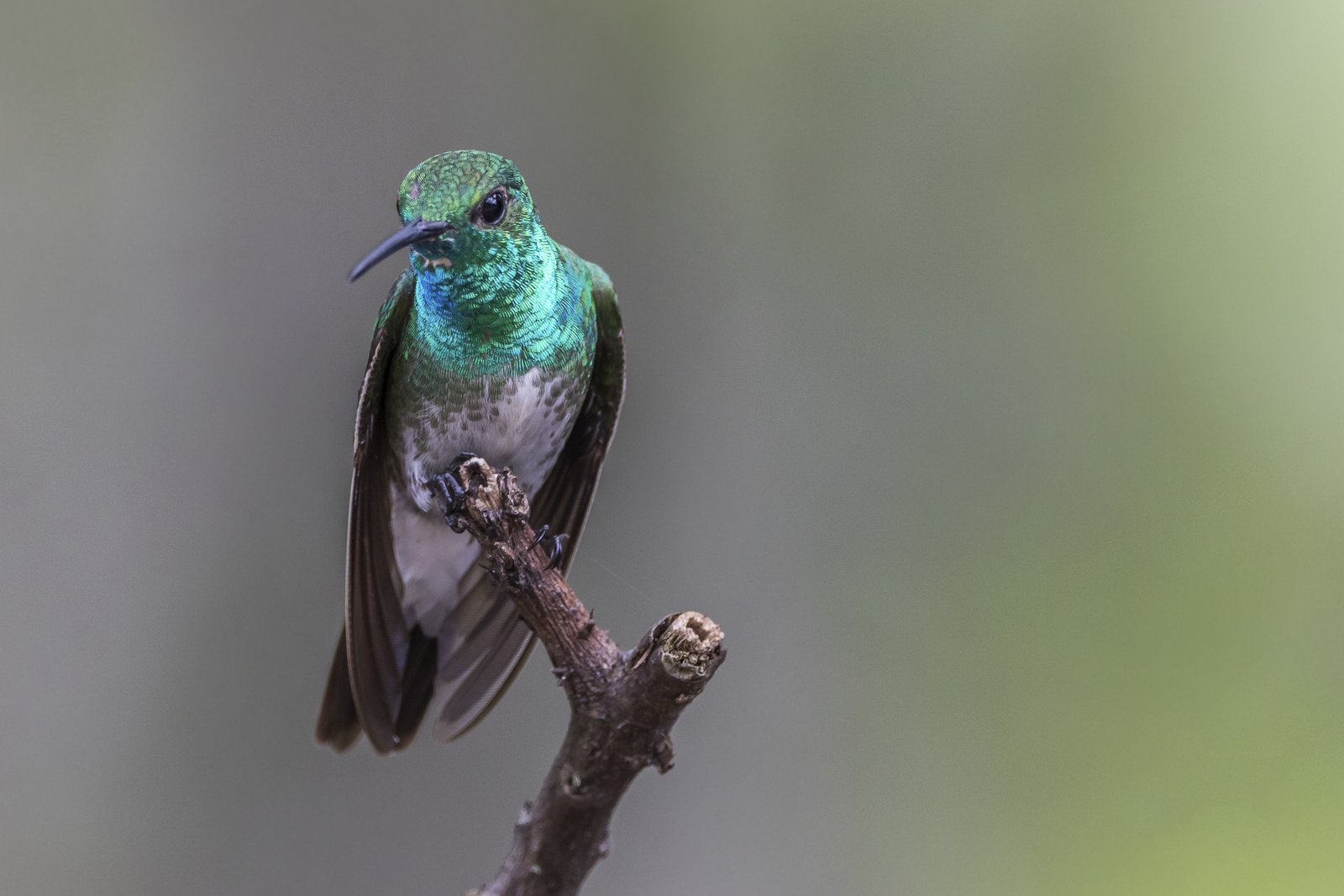
9–10 cm, with a straight bill: the upper mandible is black, the lower mandible pink with a dark tip. The upperparts are green, with a bronze-green tail; the outer tail feathers are darker. In the male the throat and breast are glittering green, the belly white with green flanks. The female has white underparts with green spots on the sides of the throat and breast and greyish tips to the outer tail feathers.
Confusion species
Snowy-bellied Hummingbird Saucerottia edward has a coppery-bronze rump and tail and a sharply demarcated white belly, and rarely enters mangroves. Rufous-tailed Hummingbird Amazilia tzacatl has a grey belly, a red bill and a rufous tail. Male Sapphire-throated Hummingbird Chrysuronia coeruleogularis has a blue throat and a forked, blue-black tail. Charming Hummingbird Polyerata decora has a blue breast.
Habitat
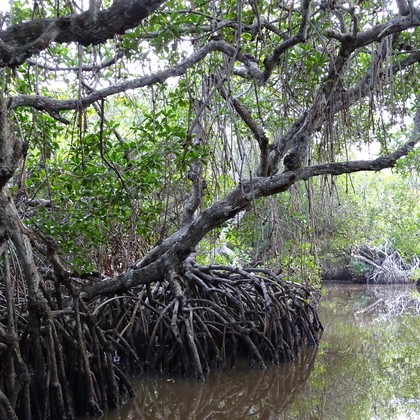
Mangrove forest, especially where Pelliciera rhizophorae grows, and adjacent forest edges, scrub and gardens just behind the mangroves, at sea level. It sometimes leaves the mangroves to feed at flowers close by.
Where the bird is most at home, classified by the vegetation units of Mexico and Central America.

Range and movements
Endemic to the guide area and to Costa Rica. In mangroves along the Pacific coast, from the Gulf of Nicoya via the Quepos area and the Térraba-Sierpe delta to the Golfo Dulce.
- Resident
- dark = core range, pale = thinly spread
How and when to look
In mangroves along the Gulf of Nicoya and at the mouth of the Río Tárcoles, in the mangroves of Isla Damas near Quepos and in the mangroves of the Térraba-Sierpe delta; best by boat at flowering Pelliciera.
Conservation status
Endangered. The world population is small and confined to a narrow coastal strip. Mangroves are being lost to shrimp farms and salt pans, logging and coastal development.
Scientific name
Chrysuronia boucardi | (Mulsant, 1877)
Mulsant described the species in 1877 as Arena Boucardi; because it was later moved to another genus, the author and year stand in brackets. The genus Chrysuronia was introduced in 1850 by Bonaparte. Chrysuronia is Greek, from khrusos 'gold' and oura 'tail', after the golden-glossed tail. boucardi honours the French naturalist and natural-history dealer Adolphe Boucard (1839–1905), who collected in Central America. The specimen the first description was based on came from Puntarenas, Costa Rica.