All species › Cranes, rails and allies › Rails, gallinules and coots › Mangrove Rail
Position in the tree Birds Aves › Birds with a flexible palate Neognathae › All other modern birds Neoaves › Birds of the elements Elementaves › Cranes and waders Gruimorphae
Mangrove Rail | Rallus longirostris
Grijze ral | Rascón manglero
The Mangrove Rail is a large, dull-coloured rail of mangroves, with a long, slightly decurved bill and black-and-white barred flanks. It was long included in Clapper Rail, but has been treated as a separate species since a genetic study in 2013. In the guide area it lives only along the Pacific coast from El Salvador to Costa Rica, at the northern edge of a range that otherwise lies mainly along the coasts of South America.

Voice
A loud, dry, clattering series kek-kek-kek-kek, first accelerating and then slowing, often answered by other birds nearby; heard mainly at dusk, at night and at the turn of the tide.
Recording: Carlos Henrique Luz Nunes de Almeida — CC BY-NC-SA 4.0 · converted to mono · xeno-canto
Identification
About 33 cm, with a long, slender, slightly decurved bill: the upper mandible brownish, the lower orange-yellow. The upperparts are dull grey-brown with dark feather centres; the cheek and side of the neck are grey. The throat and a narrow supercilium are whitish. Neck and breast are dull grey-brown to pale cinnamon. Flanks and belly are blackish with narrow white bars; the undertail is white. The legs are grey-brown to dull orange. The sexes are alike. Walks among the mangrove roots with short flicks of the tail and rarely flies.
Confusion species
Clapper Rail Rallus crepitans and Ridgway's Rail Rallus obsoletus closely resemble Mangrove Rail but live on other coasts: Clapper Rail on the Gulf and Caribbean coasts of Mexico and Belize, Ridgway's Rail on the Pacific coast of north-western Mexico; in the Pacific mangroves from El Salvador to Costa Rica a large rail of this type is a Mangrove Rail. Rufous-necked Wood Rail Aramides axillaris, which also lives in mangroves, is larger and bulkier, with a rufous head and neck, a grey mantle, a black rear end and red legs. Sora Porzana carolina, a winter visitor, is much smaller, with a short, thick yellow bill.
Habitat
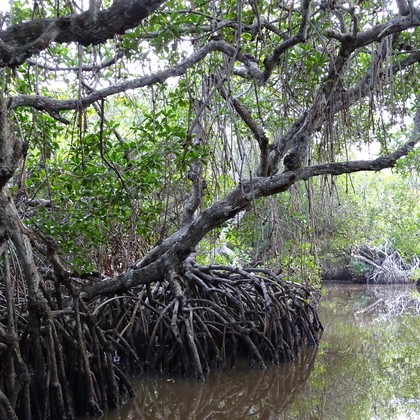
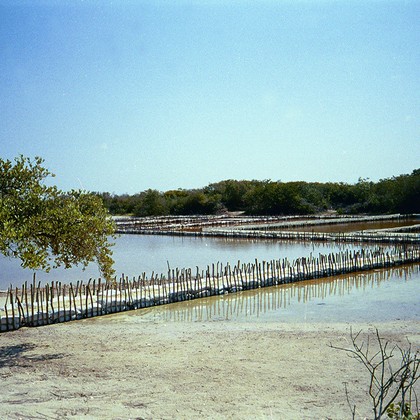
Mangroves and adjoining brackish and salt marshes, tidal creeks and mudflat edges; also the edges of salt pans and shrimp ponds built in or beside the mangroves. Forages on mud and in shallow water under and among the mangrove roots, mainly at low tide, on crabs, other crustaceans, molluscs and small fish. The nest is hidden in the mangroves or in dense marsh vegetation, just above the high-water line.
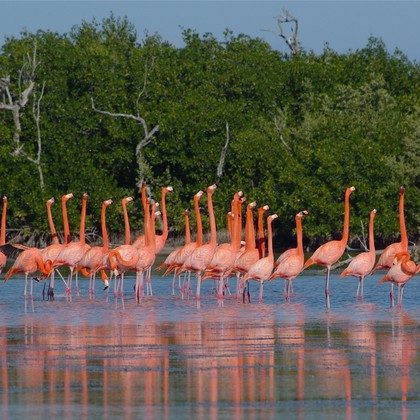
Where the bird is most at home, classified by the vegetation units of Mexico and Central America.

Range and movements
In the guide area only along the Pacific coast: in El Salvador in the Bahía de Jiquilisco and the Bahía de La Unión, around the Gulf of Fonseca in Honduras and Nicaragua, along the Nicaraguan coast to the surroundings of León, and in Costa Rica around the Gulf of Nicoya and at Puerto Soley in the far north-west. Absent from the Caribbean coast and from Panama. Outside the guide area along the coasts of South America, from Colombia and Venezuela through the Guianas to Brazil, and on the Pacific coast from Colombia to Peru.
- Resident
- Summer visitor (c. Apr–Sep)
- Winter visitor (c. Oct–Mar)
- dark = core range, pale = thinly spread
How and when to look
In Costa Rica at Chomes and Punta Morales on the Gulf of Nicoya, in Honduras in the mangroves and salt pans around the Gulf of Fonseca, for example at El Jicarito. At low tide the birds sometimes walk along the open mud edge or the dykes of salt pans; the clattering call usually gives them away first.
Conservation status
Not threatened. In the guide area it depends on mangroves, which along the Pacific coast have been converted on a large scale into salt pans and shrimp farms and are also under pressure from cutting and pollution. Little is known about the size of the populations in Central America.
Scientific name
Rallus longirostris | Boddaert, 1783
Boddaert described the species in 1783 and placed it straight away in the genus where it still stands. The genus Rallus was introduced in 1758 by Linnaeus. Rallus is the name English ornithologists such as Willughby and Albin already used for the water rail before Linnaeus; the precise origin of the word is uncertain. longirostris is Latin, from longus 'long' and rostrum 'bill', after the long bill. The specimen the first description was based on came from Cayenne, French Guiana.