All species › Cranes, rails and allies › Rails, gallinules and coots › Aztec Rail
Position in the tree Birds Aves › Birds with a flexible palate Neognathae › All other modern birds Neoaves › Birds of the elements Elementaves › Cranes and waders Gruimorphae
Aztec Rail | Rallus tenuirostris
Mexicaanse ral | Rascón azteca
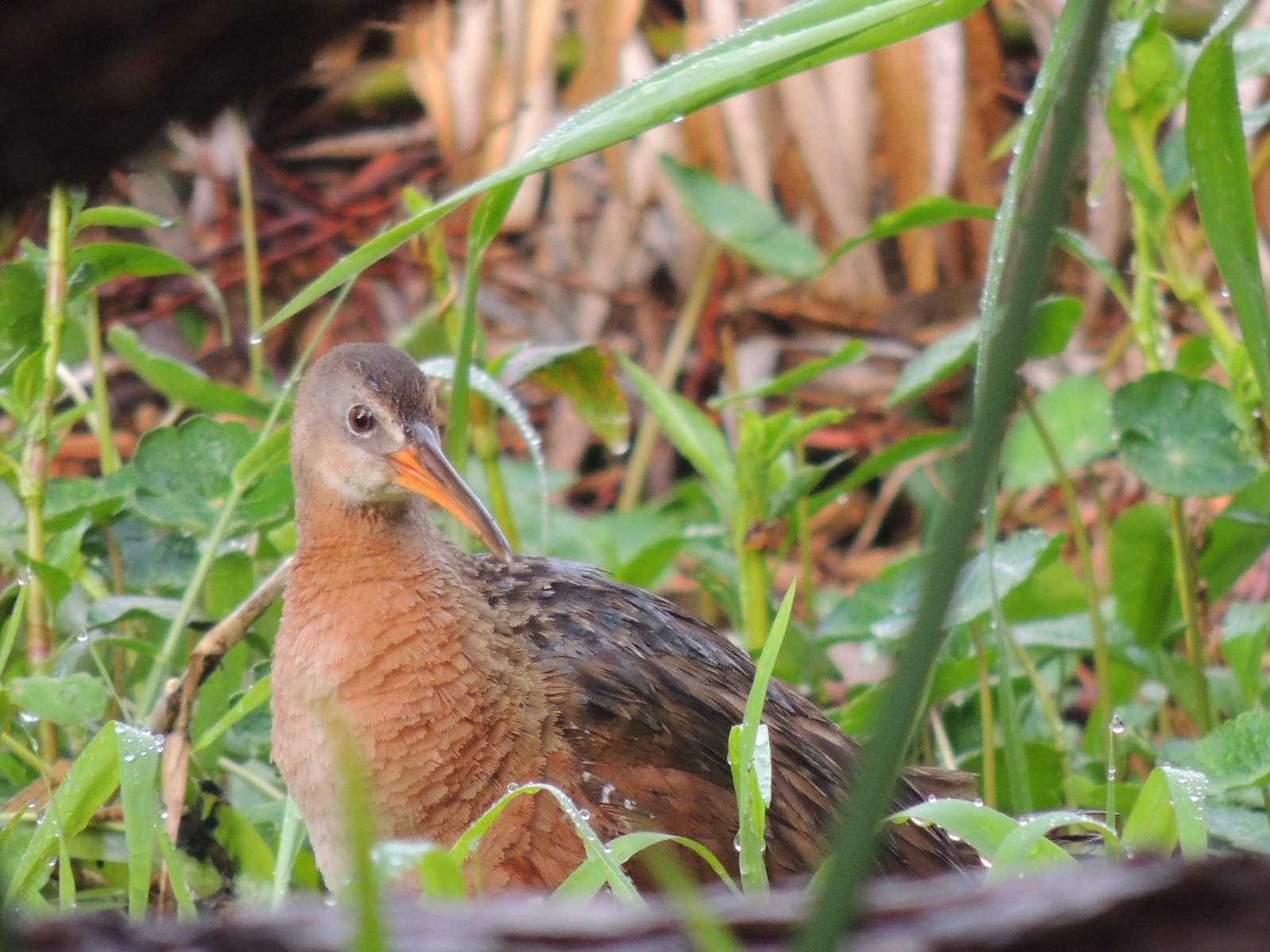
The Aztec Rail is a large, warm brown rail with a long bill, a cinnamon neck and breast and black-and-white barred flanks. It lives in freshwater marshes of the central plateau of Mexico and does not occur outside Mexico. It was long included in King Rail or Clapper Rail and is now treated as a separate species. Its hidden life in dense marsh means that little is known about it.
Voice
A series of hard, grunting or clattering notes, kek-kek-kek-kek or jup-jup-jup, often accelerating and slowing again, and a grunting kek-burr. Calls mainly at dusk and at night, and most in the breeding season during the rains.
Recording: Manuel Grosselet — CC BY-NC-SA 4.0 · shortened to the first 60 s, mono · xeno-canto
Identification
32–40 cm; the male is larger than the female. A long-legged rail with a long, slightly decurved bill, orange-yellow at the base and darker towards the tip. The upperparts are brown with blackish feather centres and rufous edges, the wing coverts warm rusty brown. Cheeks greyish brown, throat white; neck and breast warm cinnamon. Flanks and belly are blackish with white bars; the undertail coverts white. The legs are brownish to grey. Juveniles are darker and less colourful. Walks with the tail cocked.
Confusion species
King Rail Rallus elegans, in the guide area mainly in eastern Mexico, is very similar and best distinguished by habitat and range. Ridgway's Rail Rallus obsoletus is greyer on the back and cheeks and lives in coastal marshes. Virginia Rail Rallus limicola, which occurs in the same marshes, is much smaller, with grey cheeks and a red bill. Sora Porzana carolina is small, with a short yellow bill.
Habitat
Freshwater marshes with tall, dense vegetation of cattail, bulrush and reed, edges of lakes and shallow pools, wet grassland and ditches between fields; on the plateau to well above 2500 m. Forages in shallow water and on mud at the edge of vegetation for aquatic insects, crustaceans, snails, small fish and seeds. The nest is a cup of stems and leaves in dense marsh vegetation, just above the water.
Where the bird is most at home, classified by the vegetation units of Mexico and Central America.


Range and movements
Only in Mexico, in the freshwater marshes of the central plateau and surrounding areas: from southern Chihuahua and Durango through Jalisco, Michoacán and Guanajuato to the State of Mexico, Mexico City, Tlaxcala and Puebla. Known strongholds are the marshes of the upper Lerma and the lakes of Jalisco and Michoacán. Fragmentation of the marshes has made its distribution highly discontinuous.
- Resident
- dark = core range, pale = thinly spread
How and when to look
The marshes of the upper Lerma in the State of Mexico offer the best chance, especially at dusk, when birds call and sometimes appear at the edge of the cattail. Also at the edges of lakes and pools with dense shoreline vegetation in Jalisco and Michoacán.
Conservation status
Near Threatened. The species has a small range and depends on freshwater marshes on the central plateau, which have declined sharply through drainage, water extraction for cities, pollution and urbanisation. Much of the original marshland of the Valley of Mexico and the Lerma has disappeared.
Scientific name
Rallus tenuirostris | Ridgway, 1874
Ridgway described the species in 1874 and placed it straight away in the genus where it still stands. The genus Rallus was introduced in 1758 by Linnaeus. Rallus is the name English ornithologists such as Willughby and Albin already used for the water rail before Linnaeus; the precise origin of the word is uncertain. tenuirostris is Latin, from tenuis 'slender' and rostrum 'bill', after the slender bill. The specimen the first description was based on came from Mexico City.