All species › Parrots › African and New World parrots › Maroon-fronted Parrot
Position in the tree Birds Aves › Birds with a flexible palate Neognathae › All other modern birds Neoaves › Landbirds Telluraves › Falcons, parrots and passerines Australaves › Falcons and passerines Eufalconimorphae › Parrots and passerines Psittacopasserae
Maroon-fronted Parrot | Rhynchopsitta terrisi
Grote araparkiet | Cotorra serrana oriental
The Maroon-fronted Parrot is the eastern counterpart of the Thick-billed Parrot: a large, dark green parrot with a heavy black bill, found only in the conifer forests of the Sierra Madre Oriental in north-eastern Mexico. It breeds colonially in cavities in sheer limestone cliffs, which is unusual for a parrot.

Voice
A loud, raw, rolling krraa or karrr, in flocks building to a continuous chatter; carries far between the cliff faces.
Recording: Leonardo Guzman Hernandez — CC BY-NC-SA 4.0 · converted to mono · xeno-canto
Identification
40–45 cm. Dark green with a long, pointed tail and long, pointed wings. The forehead and a stripe above the eye are dark maroon-brown; the bend of the wing and the thighs are dark red. The bill is black and heavy, the bare eye-ring yellowish. The underwing is grey without a yellow band. Young birds have a pale bill and less red. The sexes are alike. Flight is fast and direct, often in flocks.
Confusion species
Thick-billed Parrot Rhynchopsitta pachyrhyncha of the Sierra Madre Occidental is slightly smaller and paler green, has a red forehead and a yellow band under the wing; the ranges do not overlap. Military Macaw Ara militaris is much larger, with a long tail, a red forehead and a bare, pale pink face. Green Parakeet Psittacara holochlorus is smaller, all green and has a pale bill.
Habitat
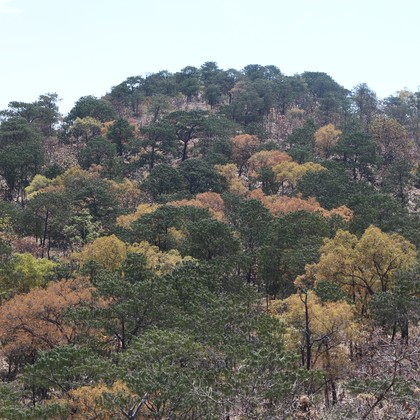
Conifer and pine-oak forest in the high mountains, with pines, spruces and firs, mostly between 1300 and 3500 m. It nests colonially in holes and crevices in high limestone cliffs and feeds in the surrounding forests. It eats mainly pine seeds, as well as acorns, buds and agave nectar.
Where the bird is most at home, classified by the vegetation units of Mexico and Central America.


Range and movements
Only in Mexico, in a narrow strip of the Sierra Madre Oriental in south-eastern Coahuila, central and southern Nuevo León and south-western Tamaulipas. It breeds mainly in the north of that area; outside the breeding season flocks wander south and to lower slopes.
- Resident
- Summer visitor (c. Apr–Sep)
- dark = core range, pale = thinly spread
How and when to look
In the mountains south and south-west of Monterrey, including Cumbres de Monterrey National Park, and near Arteaga in Coahuila, flocks fly calling loudly between the cliffs and the forests early in the morning.
Conservation status
Endangered. The range is small and the population depends on a small number of breeding cliffs. Forest fires, logging, drought and pine die-off caused by bark beetles reduce the food supply. Some of the breeding sites are protected.
Scientific name
Rhynchopsitta terrisi | Moore, 1947
Moore described the species in 1947 and placed it straight away in the genus where it still stands. The genus Rhynchopsitta was introduced in 1854 by Bonaparte. Rhynchopsitta is Greek, from rhunkhos 'bill' and psitta 'parrot': 'bill-parrot', after the heavy bill. terrisi honours the American mountaineer and explorer Terris Moore (1908–1993), son of the describer, ornithologist Robert T. Moore. The specimen the first description was based on came from northeastern Mexico (not specified).