All species › Passerines › New World blackbirds, troupials and allies › Mexican Cacique
Position in the tree Birds Aves › Birds with a flexible palate Neognathae › All other modern birds Neoaves › Landbirds Telluraves › Falcons, parrots and passerines Australaves › Falcons and passerines Eufalconimorphae › Parrots and passerines Psittacopasserae
Mexican Cacique | Cassiculus melanicterus
Geelvleugelbuidelspreeuw | Cacique mexicano
The Mexican Cacique is a slender, black cacique with yellow wing patches and a long, shaggy crest. It occurs only on the Pacific side of Mexico and in the far west of Guatemala, where it is the only cacique. It nests in colonies and hangs its long, pouch-shaped nests from the tips of branches.

Voice
Highly varied: loud, liquid whistles, gurgling and creaking sounds, mewing notes and a dry, harsh chek. Heard almost constantly at the colony.
Recording: Étienne Leroy — CC BY-NC-SA 4.0 · converted to mono · xeno-canto
Identification
25–32 cm. Male glossy black with a long, shaggy crest on the crown. Large yellow patch on the wing coverts; rump, undertail coverts and outer tail feathers yellow, central tail feathers black, so that in flight the tail is yellow with a black centre. Bill long, pointed and pale ivory; eye dark. Female distinctly smaller, duller blackish brown, with a shorter crest and less yellow. Young birds resemble the female.
Confusion species
No other cacique occurs within its range. Great-tailed Grackle Quiscalus mexicanus is all black, without yellow and without a crest, with a dark bill, a yellow eye and a long, keel-shaped tail. Bronzed Cowbird Molothrus aeneus is smaller and stockier, all black with a red eye and a short, conical bill.
Habitat
Tropical dry forest, thorn scrub and riparian woodland along rivers, and open country with scattered tall trees, palms and plantations, also near villages. Mainly in the lowlands and foothills up to about 1,200 m. It lives in small groups and searches the treetops for insects, fruit and nectar. It nests in colonies in isolated trees, often close to wasp nests.
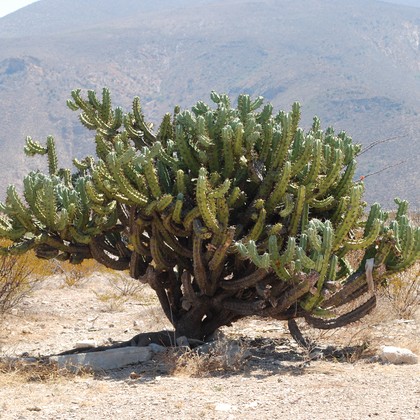
Where the bird is most at home, classified by the vegetation units of Mexico and Central America.



Range and movements
Occurs only on the Pacific side of Mexico and Guatemala: from southern Sonora south through Sinaloa, Nayarit, Jalisco, Colima, Michoacán, Guerrero and Oaxaca to Chiapas and the Pacific lowlands of western Guatemala. Also inland in the Río Balsas basin. Resident.
- Resident
- dark = core range, pale = thinly spread
How and when to look
Search in the early morning near isolated tall trees with hanging nests. The birds commute between the colony and the surrounding woodland and can be recognised in flight by the yellow wing patches and yellow tail sides.
Conservation status
Not threatened (LC). Common in most of its range. It persists in semi-open farmland with tall trees, although clearance of dry forest and riparian woodland reduces its habitat.
Scientific name
Cassiculus melanicterus | (Bonaparte, 1825) (GBIF: Cacicus melanicterus)
Bonaparte described the species in 1825 as Icterus melanicterus; because it was later moved to another genus, the author and year stand in brackets. The genus Cassiculus was introduced in 1827 by Swainson. Cassiculus is a diminutive of the genus Cassicus (caciques): 'little cacique'. melanicterus is Greek, from melas 'black' and ikteros 'jaundice, yellow', after the black-and-yellow plumage. The specimen the first description was based on came from Temascaltepec, State of Mexico, Mexico.