All species › Parrots › African and New World parrots › Monk Parakeet
Position in the tree Birds Aves › Birds with a flexible palate Neognathae › All other modern birds Neoaves › Landbirds Telluraves › Falcons, parrots and passerines Australaves › Falcons and passerines Eufalconimorphae › Parrots and passerines Psittacopasserae
Monk Parakeet | Myiopsitta monachus
Monniksparkiet | Cotorra argentina
The Monk Parakeet is an introduced species in the guide area: it does not occur here naturally. Escaped and released cage birds became established in Mexican cities from the beginning of this century, and it now breeds across much of Mexico. It is the only parrot that does not use a cavity but builds large, communal stick nests, in trees, palms and on electricity pylons.
Voice
Loud, shrill and screeching: a harsh kweek or kree-kree; at the nests and in flying flocks a continuous screeching and chattering.
Recording: Joan Theng — CC BY-NC-SA 4.0 · shortened to the first 60 s, mono · xeno-canto
Identification
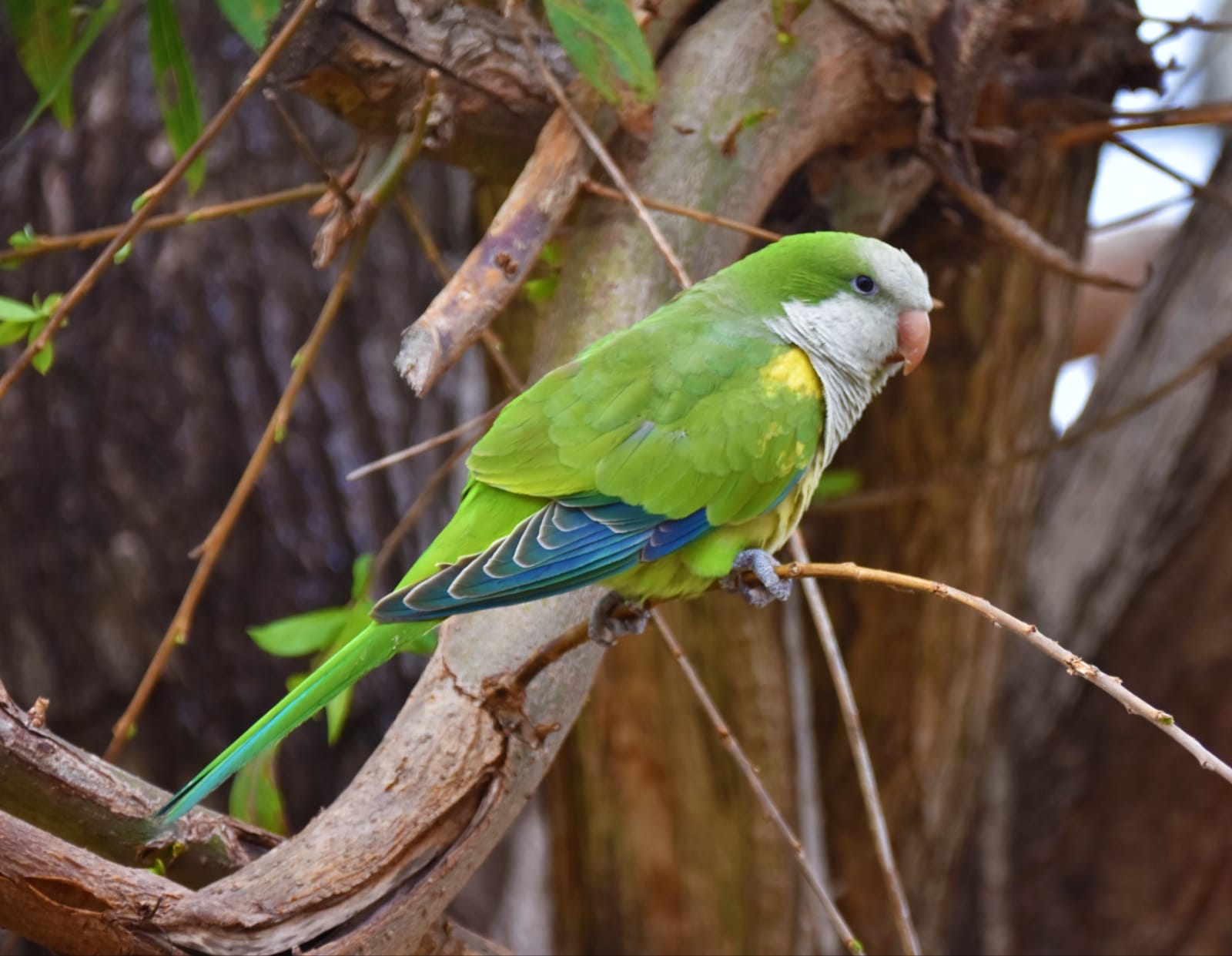
28–30 cm, with a long, pointed tail. The forehead, face, throat and breast are pale grey, with a fine scaly pattern on the breast. The upperparts are bright green, the belly and undertail coverts yellowish green. The flight feathers are blue, clearly visible in flight. The bill is pale orangey horn. The sexes are alike.
Confusion species
The grey face and breast rule out confusion with any native parakeet. Green Parakeet Psittacara holochlorus and Orange-fronted Parakeet Eupsittula canicularis are entirely green or have an orange forehead, with no grey.
Habitat
Towns, villages, parks, gardens and sports grounds, also farmland with trees, plantations and orchards around towns. It eats seeds, fruit, buds and flowers, also at feeders and in fields. It builds its stick nest, often with several chambers and used by several pairs at once, in trees, palms, on pylons and on buildings; the nest is used year-round for roosting.
Where the bird is most at home, classified by the vegetation units of Mexico and Central America.


Range and movements
Established in Mexico in and around many towns and cities, including Mexico City and México state, Veracruz, Jalisco, Sonora, Baja California Sur, Nuevo León, Coahuila, Guanajuato, Querétaro, Puebla, Oaxaca and Chiapas, and still spreading. In Central America only scattered birds, probably escapes. Native to southern South America, from Bolivia and southern Brazil to Argentina; also introduced to the United States and Europe, among other regions.
- Resident
- dark = core range, pale = thinly spread
How and when to look
In parks and along avenues in Mexico City and other Mexican cities; the large stick nests in palms and on pylons are visible from afar and are occupied year-round.
Conservation status
Not globally threatened. In the guide area an introduced species that is spreading fast. Nests on pylons locally cause power outages; little is known about its effects on native species.
Scientific name
Myiopsitta monachus | (Boddaert, 1783)
Boddaert described the species in 1783 as Psittacus monachus; because it was later moved to another genus, the author and year stand in brackets. The genus Myiopsitta was introduced in 1854 by Bonaparte. Myiopsitta combines Greek mus, muos 'mouse' with New Latin psitta 'parrot', alluding to the mouse-grey face and underparts. monachus is Late Latin for 'monk'. The specimen the first description was based on came from Montevideo, Uruguay.