All species › Passerines › Tits, chickadees and titmice › Mountain Chickadee
Position in the tree Birds Aves › Birds with a flexible palate Neognathae › All other modern birds Neoaves › Landbirds Telluraves › Falcons, parrots and passerines Australaves › Falcons and passerines Eufalconimorphae › Parrots and passerines Psittacopasserae
Mountain Chickadee | Poecile gambeli
Gambels mees | Carbonero ceja blanca
The Mountain Chickadee is a chickadee with a black cap and throat and a white eyebrow that lives in coniferous forest in western North America. In the guide area it occurs only in the high mountains of northern Baja California.

Voice
The song is a clear, descending whistled series of three or four notes. The call is a hoarse chick-a-dee-dee-dee, huskier than in related chickadees.
Recording: Andrew McCafferty — CC BY-NC-SA 4.0 · converted to mono · xeno-canto
Identification
13–14 cm. Cap and throat patch black, with a narrow white stripe over the eye through the black cap. Cheeks white. Upperparts grey, underparts pale grey to greyish white with greyish flanks. Short black bill. Sexes alike.
Confusion species
Mexican Chickadee Poecile sclateri lacks the white eyebrow, has a larger black throat patch reaching onto the breast and dark grey flanks; it does not occur in Baja California. American Bushtit Psaltriparus minimus has no black cap and a long tail.
Habitat
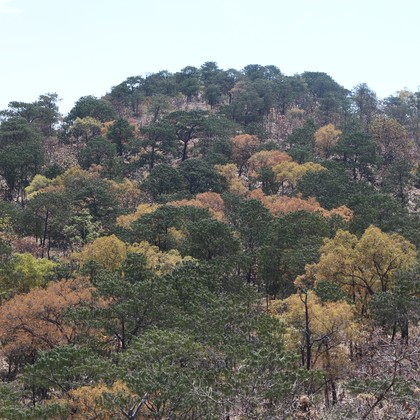
Open coniferous forest in the mountains, especially with pines and firs, and the transition to pine-oak woodland. It searches for insects and spiders in the canopy and among the needles and in winter eats many conifer seeds. It nests in a tree cavity or an old woodpecker hole.
Where the bird is most at home, classified by the vegetation units of Mexico and Central America.

Range and movements
In the guide area only in the high mountains of northern Baja California, mainly the Sierra de San Pedro Mártir and the Sierra de Juárez. Outside the guide area in the mountains of the western United States and Canada.
- Resident
- dark = core range, pale = thinly spread
How and when to look
In the Sierra de San Pedro Mártir it is one of the common birds of the pine forest; often in mixed flocks with Pygmy Nuthatches.
Conservation status
Not threatened. In the guide area restricted to a few mountain ranges in northern Baja California.
Scientific name
Poecile gambeli | (Ridgway, 1886)
Ridgway described the species in 1886 as Parus gambeli; because it was later moved to another genus, the author and year stand in brackets. The genus Poecile was introduced in 1829 by Kaup. Poecile is Greek, from poikilos 'many-coloured'. gambeli honours the American naturalist William Gambel (1823–1849), who collected birds in the south-western United States and California. The specimen the first description was based on came from about one day's journey west of Santa Fe, New Mexico, USA.