All species › Passerines › Tits, chickadees and titmice › Mexican Chickadee
Position in the tree Birds Aves › Birds with a flexible palate Neognathae › All other modern birds Neoaves › Landbirds Telluraves › Falcons, parrots and passerines Australaves › Falcons and passerines Eufalconimorphae › Parrots and passerines Psittacopasserae
Mexican Chickadee | Poecile sclateri
Grijsflankmees | Carbonero mexicano
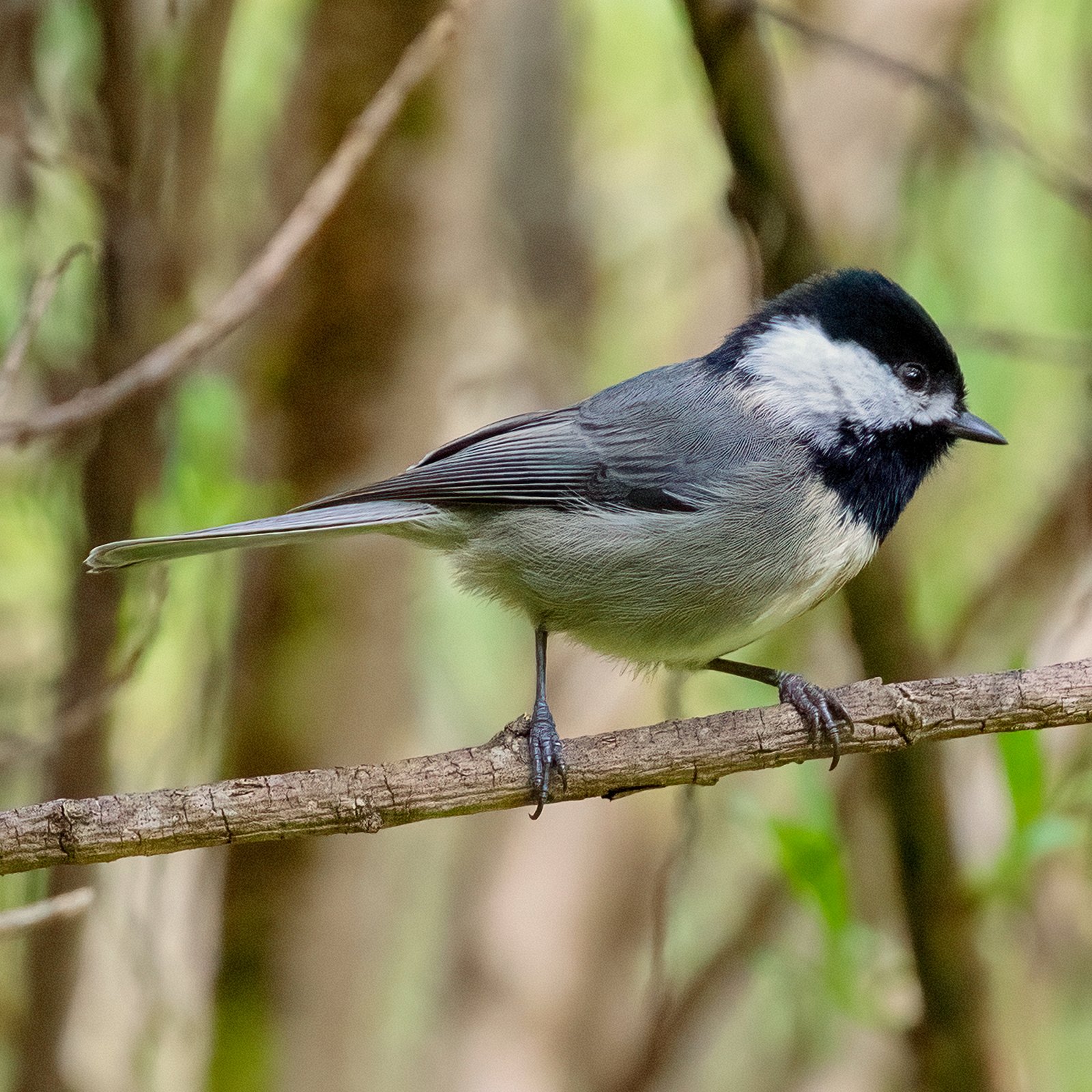
The Mexican Chickadee is a chickadee with a black cap and a large black throat patch that lives in high coniferous and pine-oak forest in the Mexican mountains. Outside Mexico it occurs only in a few mountain ranges just across the border in the United States.
Voice
The calls are husky, buzzy dzeer notes and short, dry series. The song is a rapid, varied twittering; the typical whistled song of other chickadees is lacking.
Recording: Manuel Grosselet — CC BY-NC-SA 4.0 · converted to mono · xeno-canto
Identification
12–13 cm. Cap black; black throat patch large, extending onto the upper breast. Cheeks white, without a white stripe over the eye. Upperparts grey, centre of the belly greyish white, flanks dark slate-grey. Short black bill. Sexes alike.
Confusion species
Mountain Chickadee Poecile gambeli has a white eyebrow, a smaller black throat patch and paler flanks; in the guide area it occurs only in Baja California, where Mexican Chickadee is absent. Bridled Titmouse Baeolophus wollweberi has a grey crest and a black-and-white face pattern.
Habitat
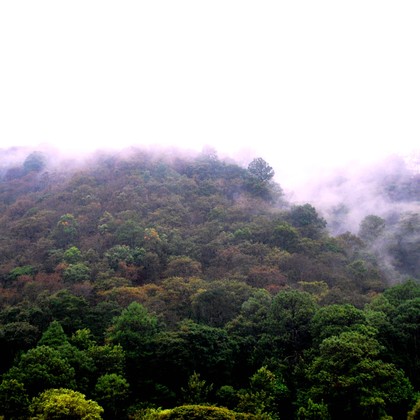
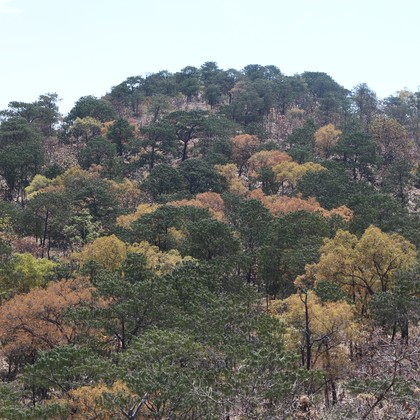
Coniferous forest with pines, spruces and firs and high-elevation pine-oak forest in the mountains, mostly above 2000 m. It searches for insects and spiders in the canopy and among the needles and outside the breeding season moves with mixed flocks of small songbirds. It nests in a tree cavity.
Where the bird is most at home, classified by the vegetation units of Mexico and Central America.

Range and movements
In the guide area in the mountains of Mexico: the Sierra Madre Occidental from Sonora and Chihuahua southwards, the higher parts of the Sierra Madre Oriental in Coahuila and Nuevo León, the volcanic belt of central Mexico and the mountains of Guerrero and Oaxaca. Outside the guide area only in extreme south-eastern Arizona and south-western New Mexico.
- Resident
- dark = core range, pale = thinly spread
How and when to look
In high pine forest it is often the core of mixed flocks with nuthatches, treecreepers and warblers; listen for the husky, buzzy call.
Conservation status
Not threatened. Fairly common in high montane forest in Mexico; the small populations in the United States are local.
Scientific name
Poecile sclateri | (Kleinschmidt, 1897)
Kleinschmidt described the species in 1897 as P[arus] sclateri; because it was later moved to another genus, the author and year stand in brackets. The genus Poecile was introduced in 1829 by Kaup. Poecile is Greek, from poikilos 'many-coloured'. sclateri honours the British ornithologist Philip Lutley Sclater (1829–1913), who first described the species in 1857 under a name that was already preoccupied. The specimen the first description was based on came from El Jacale, Veracruz or Puebla, Mexico.