All species › Passerines › Tyrant flycatchers and allies › Northern Beardless Tyrannulet
Position in the tree Birds Aves › Birds with a flexible palate Neognathae › All other modern birds Neoaves › Landbirds Telluraves › Falcons, parrots and passerines Australaves › Falcons and passerines Eufalconimorphae › Parrots and passerines Psittacopasserae
Northern Beardless Tyrannulet | Camptostoma imberbe
Chaparralvliegenpikker | Mosquero lampiño
The Northern Beardless Tyrannulet is a small, greyish-olive tyrant flycatcher with a scruffy little crest, a faint pale eyebrow and a small bill with a pale base. It moves through shrubs and tree canopies more like a warbler than a flycatcher and is noticed mainly by its clear whistled series. In the guide area it lives from northern Mexico to north-western Costa Rica.

Voice
A series of clear, descending whistled notes that speeds up, and a clear, rising pee-ee-eet.
Recording: Richard E. Webster — CC BY-NC-SA 4.0 · shortened to the first 60 s, mono · xeno-canto
Identification
10–11 cm, with a fairly long tail and a short, small bill with an orangey to pinkish base to the lower mandible. Crown brownish-grey with a small, often raised crest. Narrow pale eyebrow and a pale eye-ring. Upperparts greyish-olive; wings darker with two dull buff to yellowish wing-bars. Throat and breast pale grey, belly dull yellow to whitish. Male and female are alike.
Confusion species
Southern Beardless Tyrannulet Camptostoma obsoletum of Costa Rica and Panama has yellower underparts, a more obvious crest and more prominent wing-bars; the two species barely overlap. Mouse-colored Tyrannulet Nesotriccus murinus is larger, with a longer bill and no crest. Northern Scrub Flycatcher Sublegatus arenarum is larger, with a darker, stubby bill and a greyer breast contrasting sharply with the yellow belly.
Habitat
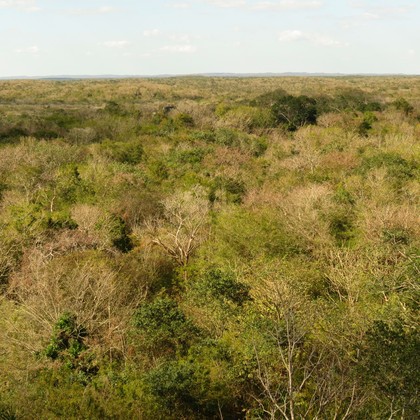
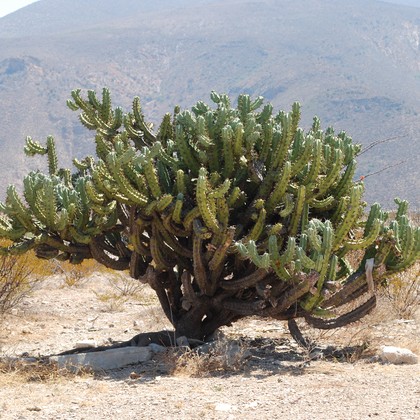
Semi-open dry country with shrubs and trees: dry forest, thorn scrub, mesquite and riparian woodland, forest edges, gallery forest and gardens. It gleans insects and spiders from leaves and twigs, often while fluttering; it also eats small berries.
Where the bird is most at home, classified by the vegetation units of Mexico and Central America.





Range and movements
From northern Mexico, from Sonora and Tamaulipas, along both coasts and through the lowlands southwards, including the Yucatán Peninsula, through Belize, Guatemala, El Salvador, Honduras and Nicaragua to north-western Costa Rica. Outside the guide area in southern Arizona and southern Texas, where some birds move away in winter.
- Resident
- dark = core range, pale = thinly spread
How and when to look
Common in much of lowland Mexico in dry scrub and along rivers. The clear, descending whistled series is often the first clue; the crested bird with the pale bill base can then be found in the lower canopy.
Conservation status
Not threatened. Common and widespread in dry, semi-open country and tolerant of man-made landscapes.
Scientific name
Camptostoma imberbe | Sclater, 1857
Sclater described the species in 1857 and placed it straight away in the genus where it still stands. He introduced the genus Camptostoma in that same work. Camptostoma is Greek, from kamptos 'bent' and stoma 'mouth', after the curved culmen. imberbe is Latin for 'beardless' (imberbis), after the lack of distinct rictal bristles at the base of the bill. The specimen the first description was based on came from near San Andrés Tuxtla, Veracruz, Mexico.