All species › Passerines › New World warblers › Northern Parula
Position in the tree Birds Aves › Birds with a flexible palate Neognathae › All other modern birds Neoaves › Landbirds Telluraves › Falcons, parrots and passerines Australaves › Falcons and passerines Eufalconimorphae › Parrots and passerines Psittacopasserae
Northern Parula | Setophaga americana
Brilparulazanger | Parula norteña
The Northern Parula is one of the smallest warblers in the guide area: blue-grey above, with a yellow throat and breast, two white wing bars and white arcs above and below the eye. It breeds in eastern North America and winters mainly in eastern Mexico and northern Central America.

Voice
The song is a rising, buzzy trill ending in a sharp final note, roughly zzzzzzzee-tsup; in the guide area heard mainly in spring. The call is a clear chip.
Recording: Mario Reyes Jr — CC BY-NC-SA 4.0 · converted to mono · xeno-canto
Identification
11–12 cm. Small and short-tailed. Upperparts blue-grey, with a yellow to olive-green patch in the centre of the back and two white wing bars. A white arc above and below the eye, forming a broken eye-ring; lores dark. Throat and breast yellow, belly white. The male has a band of blue-black and rufous across the breast; in the female this band is absent or faint. Lower mandible yellow.
Confusion species
Tropical Parula Setophaga pitiayumi, a resident in the guide area, lacks the white eye-arcs, has a darker face with a blackish mask and more extensive yellow underparts with an orange wash on the breast and no breast band. The female Cerulean Warbler Setophaga cerulea has an eyebrow, no yellow throat and no green back patch.
Habitat
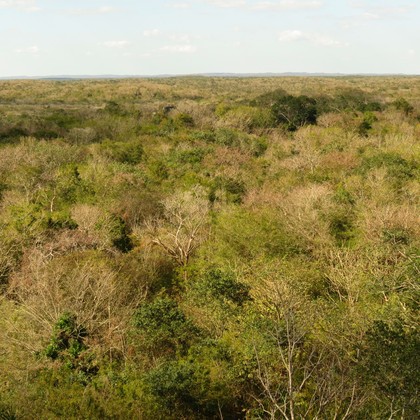
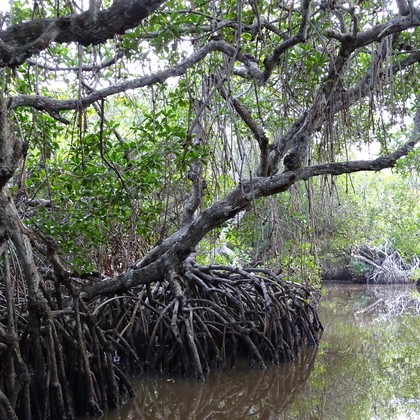
In winter forest edges, secondary forest, dry and humid lowland forest, mangroves, shade coffee and wooded gardens, from sea level into the foothills. It searches the canopy and outer branches for insects, often in mixed flocks.
Where the bird is most at home, classified by the vegetation units of Mexico and Central America.



Range and movements
Breeds in south-eastern Canada and the eastern United States. In the guide area it winters mainly on the Caribbean slope, from Tamaulipas and Veracruz through the Yucatán Peninsula to Belize, Guatemala and Honduras; scarcer further south to Costa Rica and rare in Panama and on the Pacific slope. Also in Florida and the Caribbean.
- Winter visitor (c. Oct–Mar)
- dark = core range, pale = thinly spread
How and when to look
In winter often in mixed flocks in gardens, parks and forest edges on the Yucatán Peninsula and in Veracruz, where it regularly searches flowering trees for insects.
Conservation status
Not threatened (LC). Widespread and common; the breeding population has been stable to slightly increasing in recent decades.
Scientific name
Setophaga americana | (Linnaeus, 1758)
Linnaeus described the species in 1758 as Parus americanus; because it was later moved to another genus, the author and year stand in brackets. The genus Setophaga was introduced in 1827 by Swainson. Setophaga is Greek, from sēs, sētos 'moth' and -phagos '-eating': 'moth-eater'. americana is Latin for 'American', after its range in North America. The specimen the first description was based on came from South Carolina, United States.