All species › Passerines › New World warblers › Tropical Parula
Position in the tree Birds Aves › Birds with a flexible palate Neognathae › All other modern birds Neoaves › Landbirds Telluraves › Falcons, parrots and passerines Australaves › Falcons and passerines Eufalconimorphae › Parrots and passerines Psittacopasserae
Tropical Parula | Setophaga pitiayumi
Maskerparulazanger | Parula tropical
The Tropical Parula is a small, compact warbler with blue-grey upperparts, an olive-green back patch and yellow underparts. It forages among leaves and epiphytes in the canopy and often joins mixed flocks. In the guide area it is a resident from Mexico to Panama.

Voice
The song is a fast, buzzy series that rises and ends in a short trill, often varying in structure. The call is a sharp, short tsip.
Recording: Étienne Leroy — CC BY-NC-SA 4.0 · converted to mono · xeno-canto
Identification
10–11 cm. Upperparts blue-grey with an olive-green patch in the centre of the back; two white wing bars, which are narrow or absent on some islands. Lores and area around the eye dark, giving the head a small mask; no white eye-ring. Throat and breast yellow, in the male with an orange-yellow to ochre wash across the breast; belly and undertail coverts white. The female is duller, with a less dark mask and little or no orange on the breast. Bill short and pointed, lower mandible yellowish.
Confusion species
Northern Parula Setophaga americana, a winter visitor from North America mainly in eastern Mexico, has white arcs above and below the eye, broader white wing bars and, in the male, a dark and rufous band across the breast. Crescent-chested Warbler Oreothlypis superciliosa of montane forest has a white supercilium, a plain grey back without wing bars and a rufous crescent on the breast.
Habitat
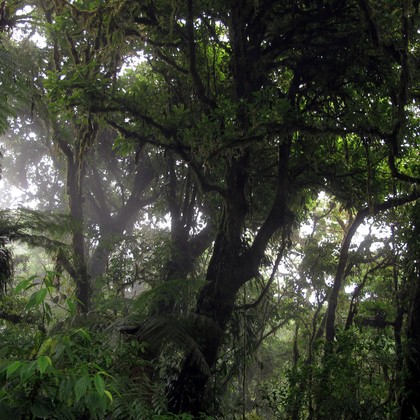
Humid and semi-humid forest, mainly in foothills and lower mountains, also cloud forest, gallery forest, forest edges, mature secondary forest and shade coffee; mostly from about 500 to 2000 m, in Mexico and on islands also lower. It lives high in the trees, often among mosses, epiphytes and beard moss (Tillandsia), in which the nest is also built. It eats small insects and spiders.
Where the bird is most at home, classified by the vegetation units of Mexico and Central America.






Range and movements
In Mexico on the Pacific slope from southern Sonora and Sinaloa and on the Atlantic slope from Nuevo León and Tamaulipas southwards, also on the Islas Marías and Socorro Island; further through all of Central America to Panama. Outside the guide area in extreme southern Texas and in South America to northern Argentina.
- Resident
- dark = core range, pale = thinly spread
How and when to look
Best found in mixed flocks of warblers and tanagers in the canopy of foothill and cloud forest; the buzzy, rising song often gives the bird away before it is seen.
Conservation status
Not threatened (LC). Common in suitable forest; locally declining where forest with epiphytes disappears. The forms on Socorro and the Islas Marías have small ranges.
Scientific name
Setophaga pitiayumi | (Vieillot, 1817)
Vieillot described the species in 1817 as Sylvia pitiayumi; because it was later moved to another genus, the author and year stand in brackets. The genus Setophaga was introduced in 1827 by Swainson. Setophaga is Greek, from sēs, sētos 'moth' and -phagos '-eating': 'moth-eater'. pitiayumi derives from 'Pitiayumí', the Guaraní name for this bird recorded by Félix de Azara in Paraguay. The specimen the first description was based on came from Paraguay.