All species › Passerines › New World warblers › Magnolia Warbler
Position in the tree Birds Aves › Birds with a flexible palate Neognathae › All other modern birds Neoaves › Landbirds Telluraves › Falcons, parrots and passerines Australaves › Falcons and passerines Eufalconimorphae › Parrots and passerines Psittacopasserae
Magnolia Warbler | Setophaga magnolia
Magnoliazanger | Chipe de magnolia
The Magnolia Warbler is a small warbler with a yellow rump, yellow underparts and a white band across the middle of the tail. It breeds in coniferous forest in Canada and the north-eastern United States. In the guide area it is a common winter visitor to the lowlands, mainly on the Caribbean slope from southern Mexico to Panama.

Voice
The song is short and melodious, a few clear, whistled notes that rise, roughly weeta weeta weetchy; in the guide area heard mainly in spring. The call is a nasal tlep or enk, the flight call a high, buzzy tseep.
Recording: Scott Olmstead — CC BY-NC-SA 4.0 · shortened to the first 60 s, mono · xeno-canto
Identification
11–13 cm. In every plumage a yellow rump and, from below, a white tail with a broad black terminal band; the white spots lie in the middle of the tail feathers. The breeding male has a blue-grey crown, a black mask with a white stripe behind the eye, a black back, a large white wing patch and yellow underparts with a black breast band and black streaks on the flanks. In winter plumage, as usually seen in the guide area: grey head with a white eye-ring, olive-green back, two narrow white wing bars, yellow underparts with a faint grey band across the breast and fine streaks on the flanks.
Confusion species
Yellow-rumped Warbler Setophaga coronata also has a yellow rump, but a white or pale brownish throat and no white band across the middle of the tail. Prairie Warbler Setophaga discolor has a yellow head with a dark cheek stripe, black flank streaks and an olive-green rump and often wags its tail. Cape May Warbler Setophaga tigrina, a scarce winter visitor mainly on the Yucatán Peninsula, has a yellowish-green rump and fine streaks across the whole breast, without a white tail band.
Habitat
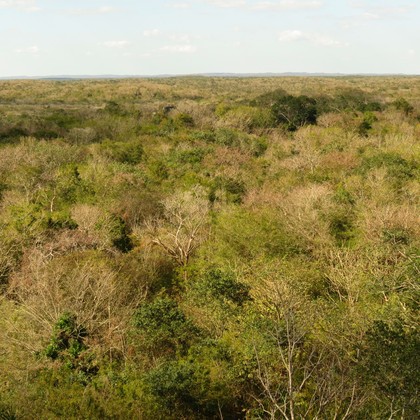
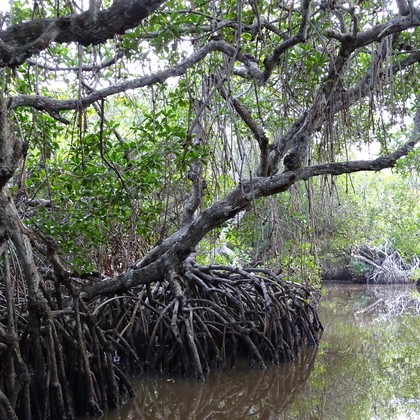
In winter humid and semi-humid lowland forest, especially forest edges, secondary forest, clearings with scrub, shade coffee and cacao, gardens and mangroves; mostly below 1500 m. It searches for insects low to mid-level in the vegetation, often with the tail fanned, and joins mixed flocks.
Where the bird is most at home, classified by the vegetation units of Mexico and Central America.





Range and movements
Breeds in Canada and the north-eastern United States, south along the Appalachians. Winters from eastern and southern Mexico (from southern Veracruz and Oaxaca and the Yucatán Peninsula) through Central America to Panama, and in the Greater Antilles; in smaller numbers on the Pacific slope. On migration also elsewhere in eastern Mexico.
- Winter visitor (c. Oct–Mar)
- dark = core range, pale = thinly spread
How and when to look
In winter regularly seen in gardens, parks and along forest edges in the Caribbean lowlands, often in mixed flocks with other warblers; the nasal call helps to find it.
Conservation status
Not threatened (LC). Common and widespread; the breeding population in North America is large and appears stable.
Scientific name
Setophaga magnolia | (Wilson, 1811)
Wilson described the species in 1811 as Sylvia magnolia; because it was later moved to another genus, the author and year stand in brackets. The genus Setophaga was introduced in 1827 by Swainson. Setophaga is Greek, from sēs, sētos 'moth' and -phagos '-eating': 'moth-eater'. magnolia refers to the magnolia trees in which Alexander Wilson found the first specimens. The specimen the first description was based on came from Fort Adams, Mississippi, United States.