All species › Passerines › Ovenbirds and woodcreepers › Northern Plain Xenops
Position in the tree Birds Aves › Birds with a flexible palate Neognathae › All other modern birds Neoaves › Landbirds Telluraves › Falcons, parrots and passerines Australaves › Falcons and passerines Eufalconimorphae › Parrots and passerines Psittacopasserae
Northern Plain Xenops | Xenops mexicanus
Noordelijke effen xenops | Picolezna liso mexicano
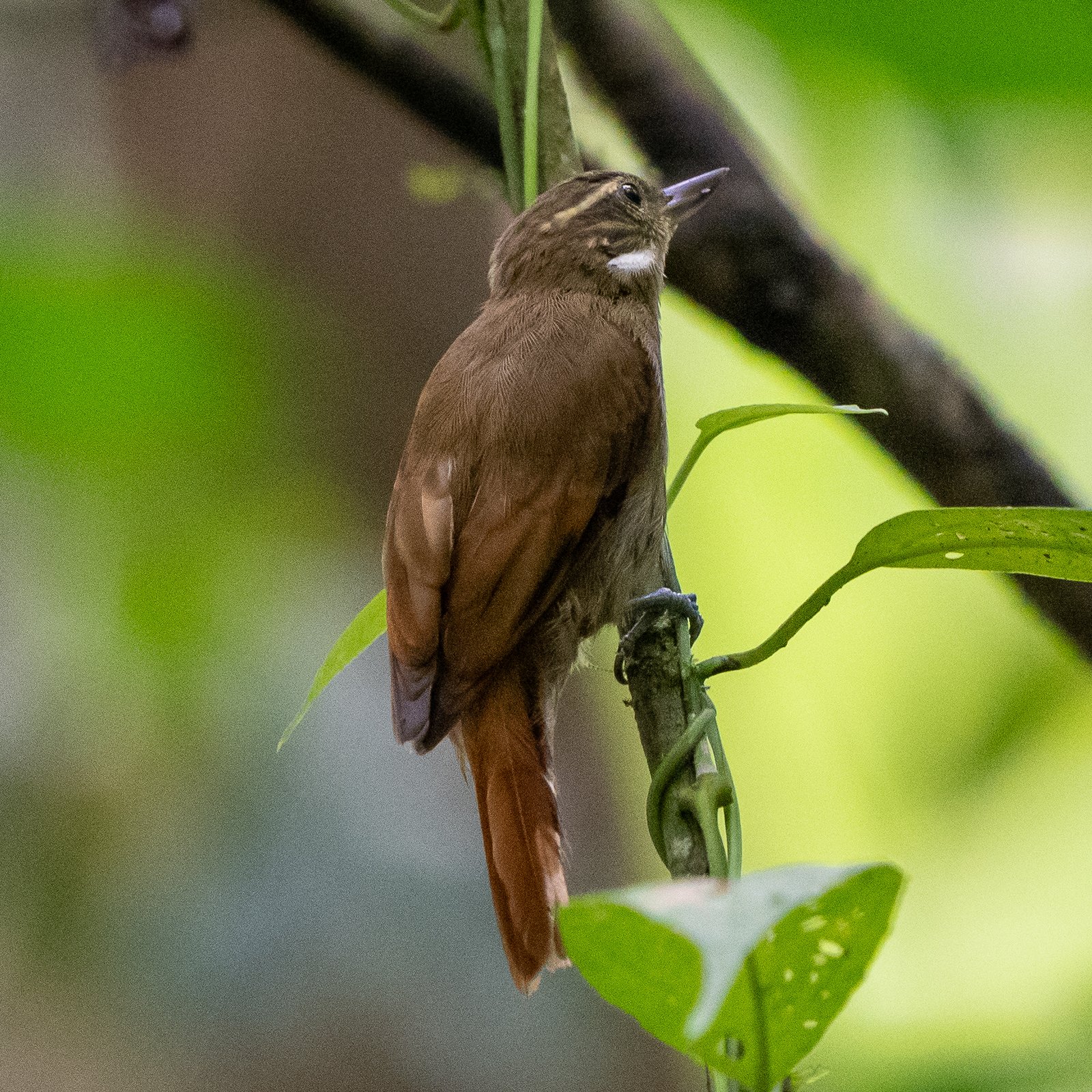
The Northern Plain Xenops is a small, brown ovenbird with a short, wedge-shaped, upturned bill and a conspicuous silvery-white stripe below the eye. It was long included in Plain Xenops Xenops minutus, but is now treated as a separate species.
Voice
A short series of high, sharp notes that first rise and then fall. Also a single sharp call.
No recording with a suitable Creative Commons licence is available for this species yet.
Identification
11–12 cm. Bill short and laterally compressed, with a straight upper mandible and an upturned lower mandible. Upperparts plain olive-brown with a pale buff supercilium and a silvery-white malar stripe. Underparts plain brownish, without streaks. Wings with a cinnamon band, tail rufous and black. Male and female are alike.
Confusion species
Streaked Xenops Xenops rutilans has a streaked head, mantle and underparts and lives mainly in the foothills and mountains of Costa Rica and Panama. Woodcreepers are larger, climb trunks using the tail as a prop and lack the white malar stripe.
Habitat
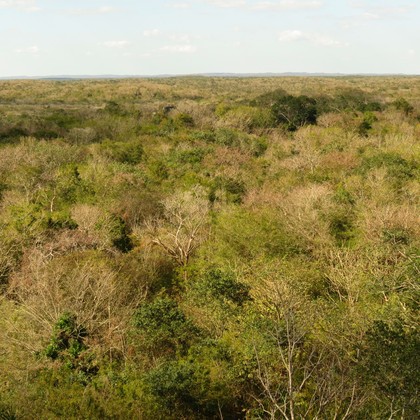
Humid lowland and foothill forest, forest edge, secondary forest and old plantations with trees; on the Yucatán Peninsula also in seasonal forest. It clambers acrobatically along thin branches and vines, often upside down, chipping and tugging at dead twigs and bark to find insects. It often joins mixed-species foraging flocks. It nests in a hole it excavates in rotten wood.
Where the bird is most at home, classified by the vegetation units of Mexico and Central America.




Range and movements
From south-eastern Mexico, including the Yucatán Peninsula, throughout Central America to Panama. Outside the guide area in north-western South America.
- Resident
- dark = core range, pale = thinly spread
How and when to look
Look for it in mixed flocks in forest and along forest edges, for example at Tikal in Guatemala and along Pipeline Road (Camino del Oleoducto) in Panama; listen for the tapping and rummaging on thin twigs.
Conservation status
Not evaluated as a separate species; the IUCN includes it in Plain Xenops Xenops minutus, which is not threatened globally. In the guide area fairly common in humid forest, but dependent on forest.
Scientific name
Xenops mexicanus | Sclater, 1857
Sclater described the species in 1857 and placed it straight away in the genus where it still stands. The genus Xenops was introduced in 1811 by Illiger. Xenops is Greek, from xenos 'strange' and ōps 'face', after the odd, upturned bill. mexicanus is Latin for 'Mexican', after Mexico, where the species was described. The specimen the first description was based on came from Córdoba, Veracruz, Mexico.