All species › Passerines › Ovenbirds and woodcreepers › Ochre-throated Foliage-gleaner
Position in the tree Birds Aves › Birds with a flexible palate Neognathae › All other modern birds Neoaves › Landbirds Telluraves › Falcons, parrots and passerines Australaves › Falcons and passerines Eufalconimorphae › Parrots and passerines Psittacopasserae
Ochre-throated Foliage-gleaner | Automolus ochrolaemus
Okerkeelbladspeurder | Breñero garganta pálida
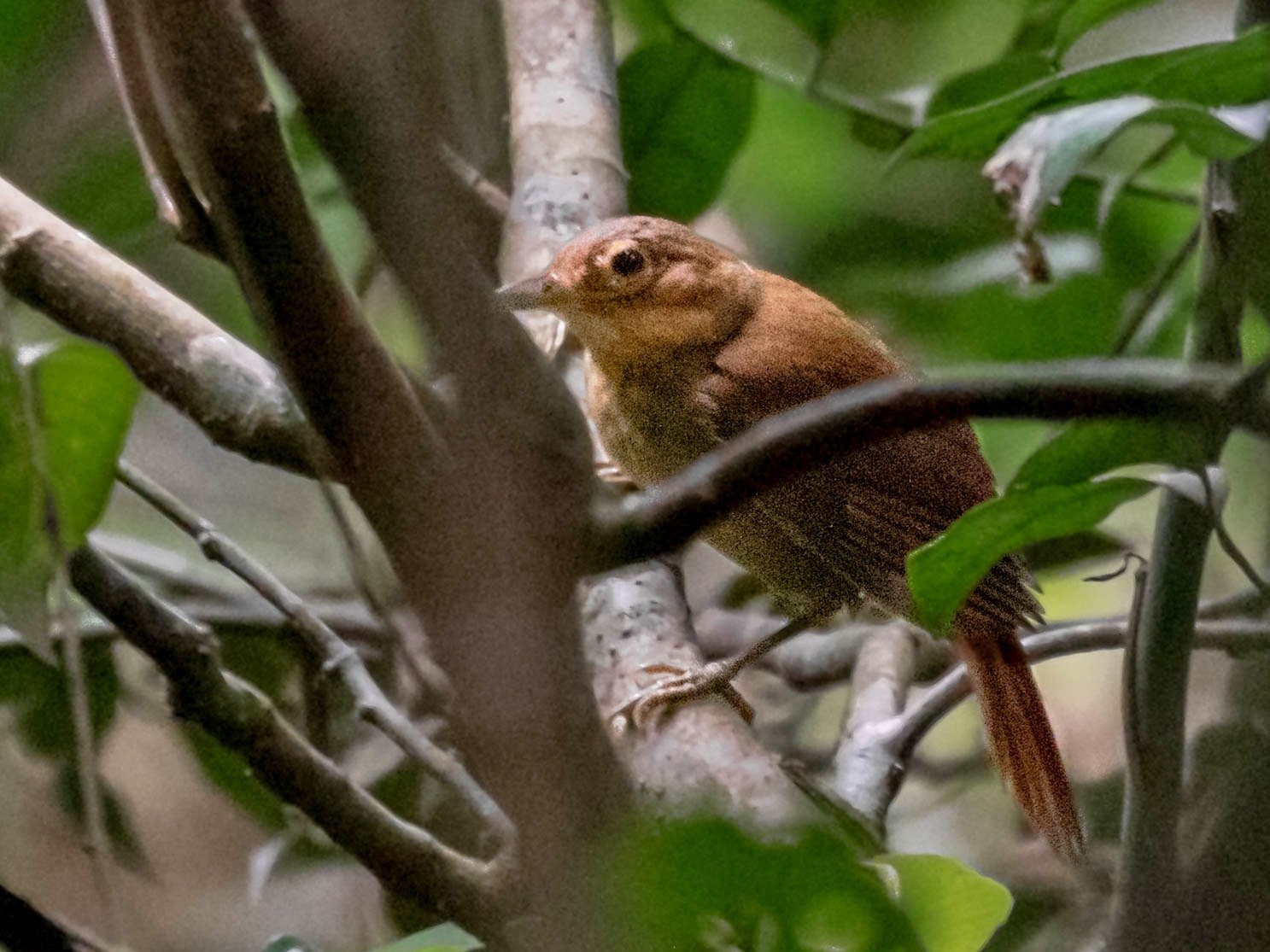
The Ochre-throated Foliage-gleaner is a brown foliage-gleaner with a pale buffy throat and rufous tail that lives in the understorey of humid lowland forest. The core of its range is in South America; in the guide area it occurs only in eastern Panama. It was long treated as one species together with Fawn-throated and Chiriqui Foliage-gleaners.
Voice
The song is a fast, rattling series of harsh notes. Also short, harsh calls.
Recording: Juan Freile — CC BY-NC-SA 4.0 · shortened to the first 60 s, mono · xeno-canto
Identification
18–19 cm. Upperparts plain olive-brown, tail rufous. A buffy eyering and line behind the eye. Throat pale buff to whitish, rest of the underparts browner. Bill fairly stout and straight.
Confusion species
Fawn-throated Foliage-gleaner Automolus cervinigularis is barely separable in the field; where both occur, range and song are decisive. Western Woodhaunter Automolus virgatus is smaller and finely streaked on the head and underparts.
Habitat
Understorey of humid evergreen lowland and foothill forest, also mature secondary forest and edges with dense vines. Forages singly or in pairs among dead leaves and vines for insects, often with mixed flocks. Nests in a burrow in an earth bank.
Where the bird is most at home, classified by the vegetation units of Mexico and Central America.




Range and movements
In the guide area only in eastern Panama; the boundary with Fawn-throated Foliage-gleaner is not precisely known. Outside the guide area widespread in northern South America, into Amazonia.
- Resident
- dark = core range, pale = thinly spread
How and when to look
In Darién in eastern Panama look for it in the understorey with mixed flocks; song is the best clue.
Conservation status
Not threatened. Widespread and fairly common in continuous forest.
Scientific name
Automolus ochrolaemus | (Tschudi, 1844)
Tschudi described the species in 1844 as Anabates ochrolaemus; because it was later moved to another genus, the author and year stand in brackets. The genus Automolus was introduced in 1853 by Reichenbach. Automolus is Greek, from automolos 'deserter, defector'; why Reichenbach chose the name is unclear. ochrolaemus is Greek, from ōkhros 'pale yellow, ochre' and laimos 'throat', after the buff throat. The specimen the first description was based on came from Peru (not specified further).