All species › Passerines › Tityras, becards and allies › One-colored Becard
Position in the tree Birds Aves › Birds with a flexible palate Neognathae › All other modern birds Neoaves › Landbirds Telluraves › Falcons, parrots and passerines Australaves › Falcons and passerines Eufalconimorphae › Parrots and passerines Psittacopasserae
One-colored Becard | Pachyramphus homochrous
Vale bekarde | Cabezón unicolor
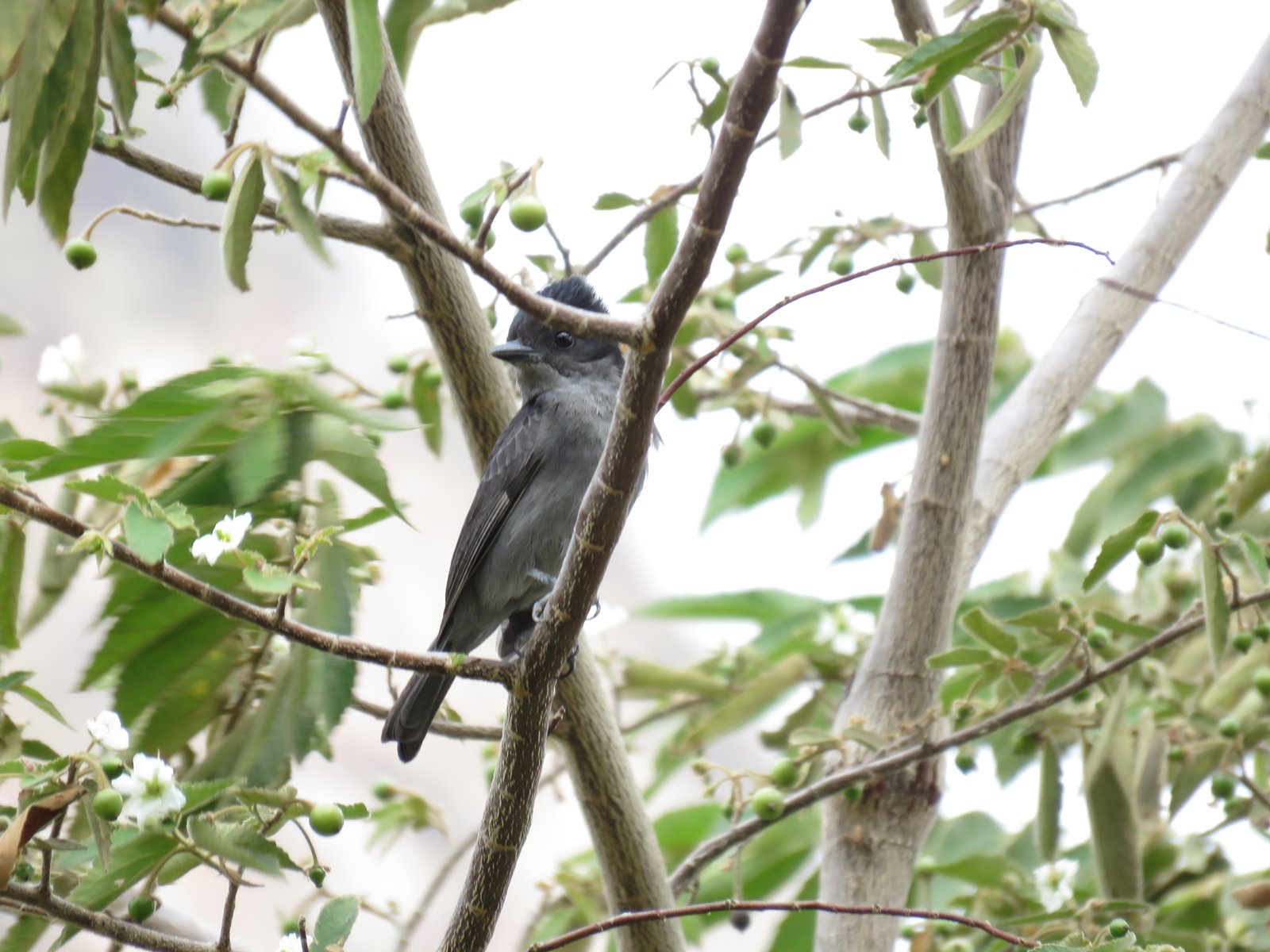
The One-colored Becard is a fairly large Pachyramphus becard that in the guide area occurs only in eastern Panama. The male is uniform dark slate-grey, the female uniform rufous. It lives at edges and in clearings of lowland forest.
Voice
High, sharp and somewhat sputtering call notes, sometimes in a rapid series.
Recording: Leonardo Ordóñez-Delgado — CC BY-NC-SA 4.0 · converted to mono · xeno-canto
Identification
16–17 cm. Stocky, with a large head and a short, broad bill. Male uniform dark slate-grey to blackish, the crown darkest and the underparts slightly paler grey; a small white patch on the shoulder is sometimes visible. Female rufous above, paler cinnamon to buff below, without a pale supraloral line. Young males are mottled brown and grey.
Confusion species
Cinnamon Becard Pachyramphus cinnamomeus closely resembles the female but is smaller and has a pale line above the dark lores. The male Cinereous Becard Pachyramphus rufus is much paler, with a black cap and greyish-white underparts. Mourners of the genus Rhytipterna and Rufous Piha Lipaugus unirufus live more in the forest interior and have different voices.
Habitat
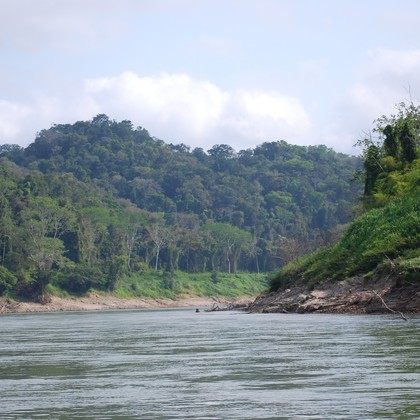
Edges and clearings of humid and semi-humid lowland forest, riverine forest and second growth, also in drier forest; mainly in the lowlands. It eats insects and fruit. It builds a large, globular nest high in a tree.
Where the bird is most at home, classified by the vegetation units of Mexico and Central America.



Range and movements
In the guide area only in eastern Panama, mainly in Darién and eastern Panamá province. Outside the guide area in northern and western Colombia, north-western Venezuela, western Ecuador and extreme north-western Peru.
- Resident
- dark = core range, pale = thinly spread
How and when to look
In the guide area best looked for along forest edges in eastern Panama, for example in Darién. The uniform grey male often perches upright in the canopy.
Conservation status
Not threatened. Widespread outside the guide area; in Panama restricted to the east and fairly scarce there.
Scientific name
Pachyramphus homochrous | Sclater, 1859
Sclater described the species in 1859 and placed it straight away in the genus where it still stands. The genus Pachyramphus was introduced in 1840 by Gray. Pachyramphus is Greek, from pakhus 'thick' and rhamphos 'bill', after the stout, broad bill. homochrous is Greek, from homokhroos 'of uniform colour', after the plain plumage. The specimen the first description was based on came from Pallatanga, Chimborazo, Ecuador.