All species › Passerines › Tityras, becards and allies › Rose-throated Becard
Position in the tree Birds Aves › Birds with a flexible palate Neognathae › All other modern birds Neoaves › Landbirds Telluraves › Falcons, parrots and passerines Australaves › Falcons and passerines Eufalconimorphae › Parrots and passerines Psittacopasserae
Rose-throated Becard | Pachyramphus aglaiae
Grote bekarde | Cabezón degollado
The Rose-throated Becard is the largest and most widespread Pachyramphus becard of the guide area. The male is grey with a dark cap and usually a pink throat patch; the female is brown and ochre with a grey cap. Its large, untidy hanging nest at the tip of a branch is conspicuous. It lives from the extreme south of the United States through Mexico to north-western Costa Rica.

Voice
A thin, falling whistle, tseeeeuu, often followed or preceded by soft chattering.
Recording: Zsombor Károlyi — CC BY-NC-SA 4.0 · shortened to the first 60 s, mono · xeno-canto
Identification
16–18 cm. Stocky, with a large head and a thick, short bill. Male grey, darker above than below, with a blackish cap and a pink patch on the throat. In western Mexico males are paler grey; in parts of the south the pink throat patch is small or absent. Female with a grey to dark grey cap, cinnamon-brown upperparts, a pale buff collar and buff underparts.
Confusion species
The male Grey-collared Becard Pachyramphus major is smaller and has a grey nape collar and white edgings to the wing and tail. Cinnamon Becard Pachyramphus cinnamomeus is smaller, uniformly cinnamon without a grey cap and has a pale supraloral line. Tityras are larger and largely white.
Habitat
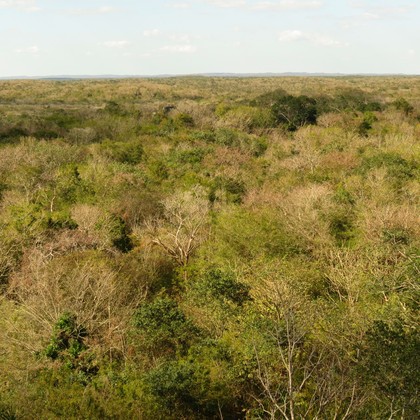
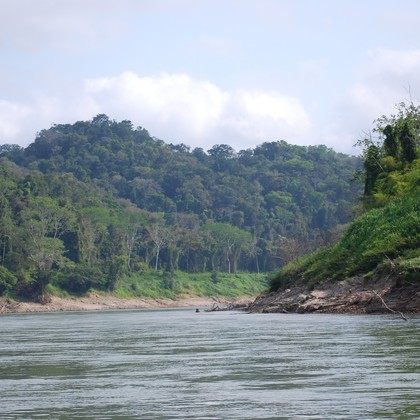
Dry and semi-humid forest, forest edges, riverine forest, clearings with tall trees, plantations, villages and parks, from sea level into the highlands. It eats insects and fruit. The large, globular nest of plant material hangs high from the tip of a branch, often above a clearing or road.
Where the bird is most at home, classified by the vegetation units of Mexico and Central America.




Range and movements
Locally in south-eastern Arizona and southern Texas; in Mexico from the north (Sonora and Tamaulipas) south along both slopes, on the Yucatán Peninsula and in the interior, through Guatemala, Belize, El Salvador, Honduras and Nicaragua to north-western Costa Rica.
- Resident
- dark = core range, pale = thinly spread
How and when to look
Common along forest edges and in villages along the Pacific coast of Mexico. The hanging nest, the size of a football or larger, often gives the species away before the birds are seen.
Conservation status
Not threatened. Widespread and common in many places; does well in semi-open, man-modified landscapes.
Scientific name
Pachyramphus aglaiae | (de Lafresnaye, 1839)
De Lafresnaye described the species in 1839 as Pachyrhynchus Aglaiae; because it was later moved to another genus, the author and year stand in brackets. The genus Pachyramphus was introduced in 1840 by Gray. Pachyramphus is Greek, from pakhus 'thick' and rhamphos 'bill', after the stout, broad bill. aglaiae honours Aglaé Brelay, wife of the French merchant, naturalist and collector Charles Brelay (1792–1857). The specimen the first description was based on came from vicinity of Xalapa, Veracruz, Mexico.