All species › Waders, gulls and terns › Sandpipers and allies › Pectoral Sandpiper
Position in the tree Birds Aves › Birds with a flexible palate Neognathae › All other modern birds Neoaves › Birds of the elements Elementaves › Cranes and waders Gruimorphae
Pectoral Sandpiper | Calidris melanotos
Gestreepte strandloper | Correlimos pectoral
The Pectoral Sandpiper is a fairly large sandpiper with a densely streaked breast sharply cut off from the white belly. It breeds on the tundra of Siberia and North America and migrates to southern South America. In the guide area it is a passage migrant, mainly in wet grassland and rice fields and less on open mudflats.

Voice
A low, rolling, rasping krrrt or trrrip, often on taking flight.
Recording: JAYRSON ARAUJO DE OLIVEIRA — CC BY-NC-SA 4.0 · converted to mono · xeno-canto
Identification
19–23 cm; males are clearly larger than females. Fairly long neck, a small head and a slightly decurved bill about the length of the head, dark with a paler, yellowish-brown base; legs yellow to yellowish-green. Brown above with dark feather centres and pale fringes, juveniles with two white V-lines on the back. Neck and breast densely streaked brown, sharply demarcated from the white belly. A pale supercilium and a somewhat darker crown. In flight a faint wing bar and a rump with a dark centre and white sides.
Confusion species
Least Sandpiper Calidris minutilla shares the pattern of yellow legs and streaked breast but is much smaller. Baird's Sandpiper Calidris bairdii is smaller and flatter, with black legs and a buff, less sharply demarcated breast band. Buff-breasted Sandpiper Calidris subruficollis is plain buff below, without streaks. Ruff Calidris pugnax is larger, with a shorter, thicker bill and a plain breast.
Habitat
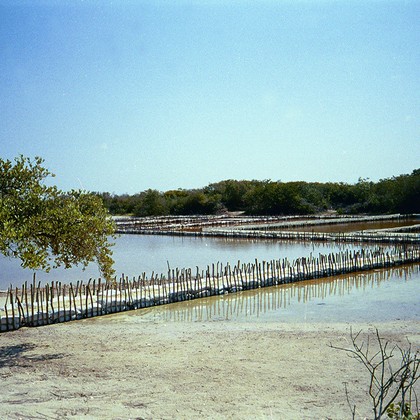
Wet grassland, flooded pastures and fields, rice fields, freshwater marshes and the vegetated edges of lakes, ponds and lagoons, also salt pans and shrimp ponds. It feeds among low vegetation and often stays hidden in the grass, flushing only at close range.
Where the bird is most at home, classified by the vegetation units of Mexico and Central America.





Range and movements
Passage migrant throughout the guide area, from northern Mexico to Panama, on both coasts and inland, up to the plateau. Most numerous in autumn, from August to October, especially in the lowlands and along the Gulf coast; again in spring from March to May. Wintering in the guide area is exceptional. Outside the guide area the species breeds on the tundra of northern Siberia, Alaska and Arctic Canada and winters mainly in southern South America; a small number winter in Australia.
- Passage (Mar–Apr, Oct–Nov)
- dark = core range, pale = thinly spread
How and when to look
After rain, flooded pastures and rice fields are the best places in autumn; the birds often hide in the grass and are only noticed when they flush with a rasping call.
Conservation status
Least Concern. The population is large. Long-term counts in North America point to a decline, partly through the loss of wet grassland along the migration route.
Scientific name
Calidris melanotos | (Vieillot, 1819)
Vieillot described the species in 1819 as Tringa melanotos; because it was later moved to another genus, the author and year stand in brackets. The genus Calidris was introduced in 1804 by Merrem. Calidris goes back to Ancient Greek kalidris or skalidris, a name Aristotle used for an unidentified grey waterside bird. melanotos is from Greek melas 'black' and notos 'back', so 'black-backed'. The specimen the first description was based on came from Paraguay.