All species › Waders, gulls and terns › Sandpipers and allies › Baird's Sandpiper
Position in the tree Birds Aves › Birds with a flexible palate Neognathae › All other modern birds Neoaves › Birds of the elements Elementaves › Cranes and waders Gruimorphae
Baird's Sandpiper | Calidris bairdii
Bairds strandloper | Correlimos de Baird
Baird's Sandpiper is a small, long-winged sandpiper that migrates from the North American tundra to southern South America. In the guide area it is a passage migrant, less tied to the coast than other small sandpipers and often turning up inland and on the plateau, including at lakes high in the mountains.

Voice
A dry, rolling krrrp or kreep, low and rather rasping, usually on taking flight.
Recording: Alvaro Rivera Rojas — CC BY-NC-SA 4.0 · converted to mono · xeno-canto
Identification
14–18 cm, slender and rather flat-backed, with long wings whose tips project clearly beyond the tail at rest. Bill short, straight, thin and black; legs black. Brownish above with a scaly pattern; juveniles, which account for most autumn records, have neat pale fringes to the feathers. A buff, finely streaked breast band contrasts sharply with the white belly, and there is a faint pale supercilium. In flight it shows a narrow wing bar and a dark centre to the rump.
Confusion species
White-rumped Sandpiper Calidris fuscicollis is also long-winged but greyer, with a white rump and a pale base to the lower mandible. Least Sandpiper Calidris minutilla is smaller, with yellow legs and a shorter wing projection. Semipalmated Sandpiper Calidris pusilla and Western Sandpiper Calidris mauri are smaller and more compact, with shorter wings. Pectoral Sandpiper Calidris melanotos is larger, with yellow legs and a sharply demarcated, densely streaked breast.
Habitat
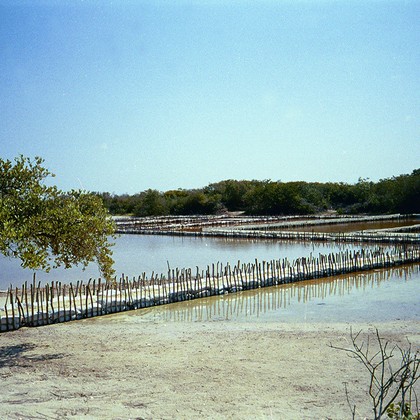
Drier edges of lakes, lagoons and reservoirs, short-grazed shores, drying pools, salt pans and flooded fields, from the lowlands to the plateau and the high mountains. It often feeds on the dry part of the shore, picking insects from the surface rather than probing in the mud.
Where the bird is most at home, classified by the vegetation units of Mexico and Central America.




Range and movements
Passage migrant throughout the guide area, but irregularly distributed: most regular on the Mexican Plateau and at inland lakes, scarcer along the coasts and in Central America, with records as far as Panama. Most numerous in autumn, especially in August and September; in spring most birds move north through the interior of South America and the Great Plains, and the species is scarce in the guide area. Outside the guide area it breeds on the tundra of north-eastern Siberia, Alaska, Canada and north-western Greenland and winters mainly in the Andes and southern South America.
- Passage (Mar–Apr, Oct–Nov)
- dark = core range, pale = thinly spread
How and when to look
In August and September the lake shores of the Mexican Plateau are the places to look for this species; the long wingtips and the habit of walking on the dry shore set it apart from the other small sandpipers.
Conservation status
Least Concern. The population is large and appears stable. The breeding grounds are remote; along the migration route the species depends on shallow inland lakes and shores, which can disappear through drought and water extraction.
Scientific name
Calidris bairdii | (Coues, 1861)
Coues described the species in 1861 as Actodromas (Actodromas) Bairdii; because it was later moved to another genus, the author and year stand in brackets. The genus Calidris was introduced in 1804 by Merrem. Calidris goes back to Ancient Greek kalidris or skalidris, a name Aristotle used for an unidentified grey waterside bird. bairdii honours the American naturalist Spencer Fullerton Baird (1823–1887), assistant secretary of the Smithsonian Institution. The specimen the first description was based on came from Fort Resolution, Great Slave Lake.