All species › Waders, gulls and terns › Sandpipers and allies › Dunlin
Position in the tree Birds Aves › Birds with a flexible palate Neognathae › All other modern birds Neoaves › Birds of the elements Elementaves › Cranes and waders Gruimorphae
Dunlin | Calidris alpina
Bonte strandloper | Correlimos común
The Dunlin is a medium-sized sandpiper with a long bill that droops at the tip. It breeds on the Arctic tundra and winters in large flocks on mudflats and beaches. In the guide area it is mainly a winter visitor to north-western Mexico, becoming rapidly scarcer further south.

Voice
A rasping, grating kreee or trrreet, especially on taking flight; flocks keep up a soft twittering.
Recording: Paul Kelly — CC BY-NC-SA 4.0 · converted to mono · xeno-canto
Identification
18–22 cm, compact, with a fairly short neck, short black legs and a black bill clearly longer than the head and drooping at the tip. In non-breeding plumage, the one most seen in the guide area, plain grey-brown above, with a faint grey-brown wash over the neck and breast and a white belly. In breeding plumage, sometimes still seen in April, a rufous back and crown and a large black belly patch. In flight it shows a clear white wing bar and a rump with a black centre and white sides.
Confusion species
Sanderling Calidris alba is much paler in winter, almost white, with a short straight bill and a black mark at the bend of the wing. Western Sandpiper Calidris mauri has a similar slightly drooping bill but is clearly smaller and more lightly built. Stilt Sandpiper Calidris himantopus has long greenish legs, a white rump and a pale supercilium. Red Knot Calidris canutus is larger and bulkier, with a shorter, straight bill.
Habitat
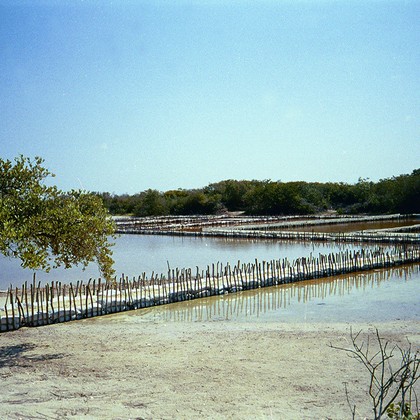
Mudflats, tidal flats, lagoons, estuaries, salt pans and sandy beaches, locally also the edges of freshwater lakes, sewage ponds and rice fields. It feeds with quick, repeated probing in wet mud, often in dense flocks with other sandpipers, and roosts at high tide on sandbars and dykes.
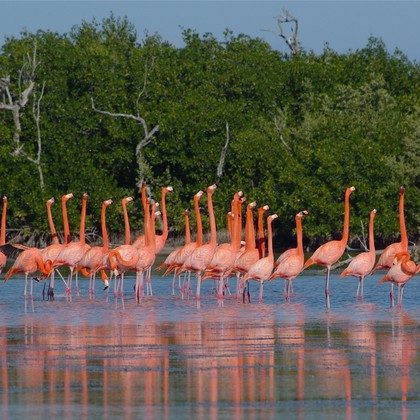
Where the bird is most at home, classified by the vegetation units of Mexico and Central America.




Range and movements
Common in winter along the coasts of Baja California and the Gulf of California, from the Colorado delta to Sonora and Sinaloa, and locally on the Gulf coast of Tamaulipas and Veracruz. Further south scarce along the Pacific coast to Nayarit and Jalisco and rare on the Yucatán Peninsula; in Central America a rare winter visitor, with scattered records as far as Costa Rica and Panama. Outside the guide area the species breeds around the whole Arctic, in America from Alaska to Hudson Bay, and in America winters mainly along the coasts of the United States.
- Winter visitor (c. Oct–Mar)
- dark = core range, pale = thinly spread
How and when to look
The extensive mudflats and salt pans around the Gulf of California and in Baja California hold large flocks in winter; on a rising tide these move up to the last dry banks, where they can be watched at close range.
Conservation status
Near Threatened. Long-term counts in North America point to a decline. In the wintering areas mudflats and salt pans are being lost to port construction, shrimp farming and coastal development; disturbance of high-tide roosts also plays a part.
Scientific name
Calidris alpina | (Linnaeus, 1758)
Linnaeus described the species in 1758 as Tringa alpina; because it was later moved to another genus, the author and year stand in brackets. The genus Calidris was introduced in 1804 by Merrem. Calidris goes back to Ancient Greek kalidris or skalidris, a name Aristotle used for an unidentified grey waterside bird. alpina is Latin for 'of high mountains'; here it refers to alpine tundra in general rather than to the Alps. The specimen the first description was based on came from Lapland.