All species › Waders, gulls and terns › Sandpipers and allies › Sanderling
Position in the tree Birds Aves › Birds with a flexible palate Neognathae › All other modern birds Neoaves › Birds of the elements Elementaves › Cranes and waders Gruimorphae
Sanderling | Calidris alba
Drieteenstrandloper | Correlimos tridáctilo
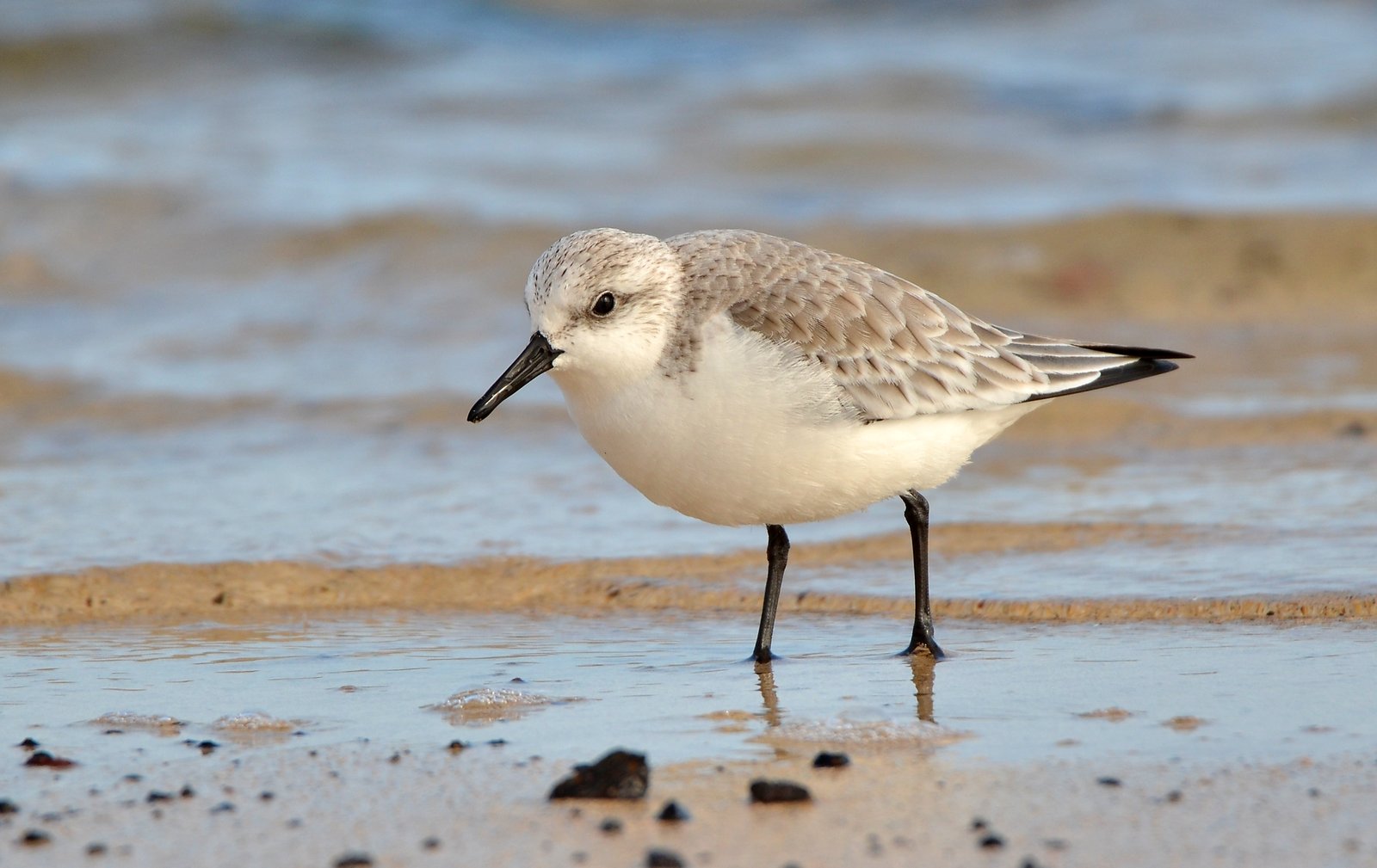
The Sanderling is the sandpiper of the surf: small flocks run back and forth along the tideline, pick food from the retreating water and dash away from the next wave. It breeds on the high Arctic tundra and is a common winter visitor on sandy beaches along both coasts of the guide area. It lacks a hind toe, hence its Dutch name, which means three-toed sandpiper.
Voice
A short, sharp kwit or twick, often in flight; flocks also give a soft twittering.
Recording: Daan van der Hoeven — CC BY-NC-SA 4.0 · converted to mono · xeno-canto
Identification
18–20 cm, stocky, with a short, straight black bill and black legs. In non-breeding plumage the palest sandpiper in the guide area: pale grey above, pure white below and on the face, with a black patch at the bend of the wing that often shows as a dark shoulder mark. Juveniles have a black-and-white chequered back. In breeding plumage, sometimes partly present in spring, rufous on the head, breast and back. In flight a broad white wing bar between a dark leading edge and dark primaries.
Confusion species
Semipalmated Sandpiper Calidris pusilla and Western Sandpiper Calidris mauri are smaller and darker grey-brown, lack the black bend of the wing and rarely feed in the surf. Red Knot Calidris canutus is larger and greyer, with a longer bill. Dunlin Calidris alpina has a longer bill that droops at the tip and a greyer breast.
Habitat
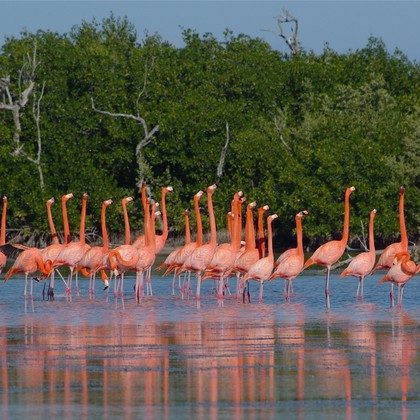
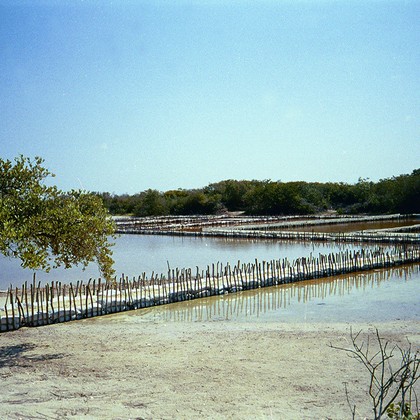
Mainly sandy beaches with surf, also sandbars, tidal flats, the edges of lagoons and salt pans, and offshore cays and islets. It eats small crustaceans, worms and small bivalves exposed by the waves. At high tide flocks rest higher up the beach or on rocks, often together with Ruddy Turnstones.
Where the bird is most at home, classified by the vegetation units of Mexico and Central America.


Range and movements
Winter visitor and passage migrant along both coasts of the entire guide area, from Baja California and the Gulf of California to Panama on the Pacific side, and from Tamaulipas via the Yucatán Peninsula and Belize to Panama on the Caribbean side. Common on suitable sandy beaches, scarcer along rocky and mangrove coasts; rare inland. Outside the guide area the species breeds on the high Arctic tundra and winters on beaches almost worldwide.
- Winter visitor (c. Oct–Mar)
- dark = core range, pale = thinly spread
How and when to look
Wide sandy beaches early in the morning, before they get busy, such as the Pacific beaches of Baja California and Sinaloa and the beaches of Yucatán. A pale sandpiper running up and down at the edge of the waves is almost always this species.
Conservation status
Not threatened, although counts along American coasts point to a decline. In the guide area disturbance from recreation, loose dogs and coastal development limits the resting and feeding sites on beaches.
Scientific name
Calidris alba | (Pallas, 1764)
Pallas described the species in 1764 as Trynga alba; because it was later moved to another genus, the author and year stand in brackets. The genus Calidris was introduced in 1804 by Merrem. Calidris goes back to Ancient Greek kalidris or skalidris, a name Aristotle used for an unidentified grey waterside bird. alba is Latin for 'white', after the pale winter plumage. The specimen the first description was based on came from the North Sea coast.